catscare.xyz Your comprehensive guide to cat breeds, care, and everything feline.
Language & Social Links Connect © 2026 catscare.xyz. All rights reserved.
Cat Litter Training: Your Complete 2026 Guide for Success Master cat litter training with proven strategies for kittens and adults. Learn setup, troubleshooting, and solving common problems for a clean, happy home.
Cat Litter Training: Your Complete 2026 Guide for Success
Meta Description: Master cat litter training with this comprehensive guide. Learn setup, troubleshooting accidents, and solving common litter box problems for a clean, happy home.
Introduction
Cat litter training is one of the most appealing aspects of feline companionship. Cats naturally bury their waste, making them among the easiest pets to house-train. Most kittens learn appropriate elimination behavior from their mothers, but even cats without this early education can be successfully trained with the right approach.
Whether you're litter training a new kitten, retraining an adult cat, or solving elimination problems, this comprehensive guide provides proven strategies for success. Understanding feline preferences, providing appropriate facilities, and addressing issues early creates lasting litter box habits.
Understanding Feline Elimination Behavior
Cat Litter Training: Your Complete 2026 Guide for Success - Articles
Natural Instincts
Predator avoidance: Hiding scent from larger predatorsPrey preservation: Not alerting prey to their presenceTerritory marking: Scent glands in paws leave a signatureCleanliness instinct: Naturally fastidious animals
Mother stimulates elimination for the first 3 weeks
Kittens observe and imitate mother by 4 weeks
Most are fully trained by 8 weeks
Orphaned kittens may need human guidance
Feline Preferences What Cats Want in a Bathroom:
Factor Preference Reason Cleanliness Immaculate Survival instinct Privacy Secluded Vulnerable when eliminating Safety Multiple escape routes Can't flee if cornered Location Convenient Easy access Substrate Sandy, diggable Natural behavior Space Adequate size Comfort and positioning
Setting Up for Success
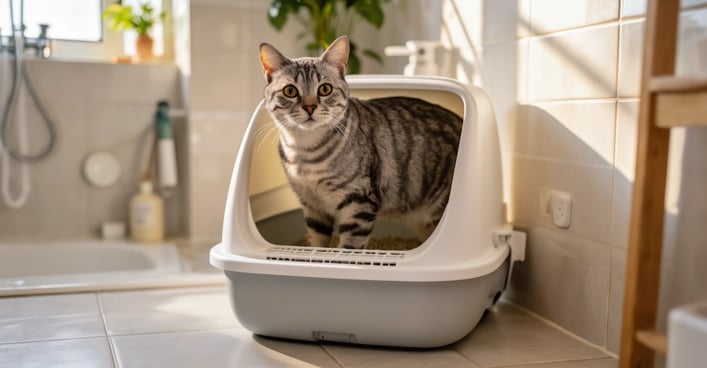
Litter Box Selection
Preferred by most cats
Easy escape routes
Better ventilation
Easier to clean
Less expensive
Trap odors (both good and bad)
May feel claustrophobic
Single exit only
Require more frequent cleaning
Some cats love them
Reduce litter tracking
Deter dogs from access
Some cats dislike them
Challenging for senior cats
Good for enthusiastic diggers
Convenient for owners
Expensive initial investment
Some cats are frightened by the mechanism
Require regular maintenance
May malfunction
Length: 1.5× the length of your cat (nose to tail base)Width: Equal to your cat's lengthDepth: 4-6 inches minimumFor large breeds (Maine Coon, Norwegian Forest): Storage bins work well
Litter Selection Type Pros Cons Cost Clay (clumping) Excellent odor control, easy scooping Dusty, heavy, not biodegradable $ Clay (non-clumping) Inexpensive Requires frequent changes, poor odor control $ Crystal Long-lasting, low dust Expensive, some cats dislike texture $$ Natural (corn, wheat) Biodegradable, often flushable Can mold, may attract pests $$ Pine Natural scent, biodegradable Some cats dislike smell, non-clumping $ Paper Dust-free, good for allergies Poor odor control $ Walnut shell Good clumping, natural Expensive $$
Unscented, clumping clay litter
Fine to medium grain texture
Maintain 2-3 inch depth
Transition gradually when changing types
The "N+1" Rule Essential Formula:
Number of cats + 1 = Number of litter boxes needed
1 cat: 2 boxes
2 cats: 3 boxes
3 cats: 4 boxes
Prevents territorial issues
Provides options for each cat
Reduces accidents
Critical for multi-cat household harmony
Location Strategy
Quiet, low-traffic areas
Away from food and water stations
Multiple locations (especially in multi-story homes)
Easy accessibility 24/7
Clear escape routes (not dead ends)
Near loud appliances (washer, dryer, furnace)
High-traffic family areas
Completely isolated, hard-to-reach spots
Areas requiring complex navigation
Damp, dark, or unpleasant environments
Avoid lining boxes up in the same room
Distribute across different areas of the home
Some cats prefer privacy; others want visibility
Ensure no single cat can guard all access points
Training Kittens
Step-by-Step Process Preparation (Before Kitten Arrives):
Set up boxes in chosen locations
Fill with 2-3 inches of unscented clumping litter
Show all family members the designated locations
Upon Arrival:
Gently place kitten in the litter box
Let them feel the litter with their paws
Offer gentle verbal praise
Never force them to stay
Optimal Timing:
First thing after waking from a nap
15-20 minutes after eating
After vigorous play sessions
Before bedtime
Any time they show pre-elimination behavior (sniffing, circling, digging)
Positive Reinforcement:
Offer immediate praise when they use the box
Provide a small treat after successful elimination
Never punish accidents—clean them thoroughly instead
Use enzymatic cleaners to completely remove odors
Signs Your Kitten Needs to Go:
Sniffing or scratching at the floor
Circling a particular spot
Digging motions
Crying or seeming restless
Sudden stop during play
Common Kitten Challenges
Often an aim or depth perception problem
Ensure low sides for easy kitten access
Provide a large enough target area
Be patient—they're still learning coordination
Normal exploratory kitten behavior
Usually outgrown within a few months
Provide plenty of alternative toys
Never punish—this creates negative associations
Common curiosity in young kittens
Always use non-toxic, kitten-safe litter
Usually outgrown quickly
Ensure they're receiving proper nutrition
Training Adult Cats
New Cat Introduction Confined Introduction Method:
Set up a safe room with all essentials, including a litter box
Place your new cat in this room initially
Gently show them the box location
Keep confined until using the box consistently (1-3 days)
Gradually expand their territory
Don't completely deep-clean used boxes when introducing a new cat
Mix a small amount of used litter from their previous home (if available)
This helps the cat recognize the appropriate elimination location
Retraining After Accidents
Veterinary Check (Always First):
Rule out medical causes before addressing behavior
Urinary tract issues are common triggers
Some conditions can be life-threatening
Evaluate Your Setup:
Is the box clean enough?
Are there enough boxes?
Is the location appropriate?
Does your cat dislike the litter type?
Clean Thoroughly:
Enzymatic cleaner is essential—regular cleaners won't work
Remove all odor traces to prevent re-marking
Temporarily block access to the accident spot
Consider placing a box in the preferred location if accidents are consistent
Positive Redirection:
Gently place your cat in the box at key times
Praise for simply being near or in the box
Reward with treats for using it correctly
Patience is essential—retraining takes time
Solving Litter Box Problems
Medical Causes (Always Rule Out First) Condition Signs Urgency UTI (Urinary Tract Infection) Straining, blood in urine, frequent small amounts Moderate to High Crystals/Bladder stones Straining, crying, blood, frequent attempts High Kidney disease Increased volume and frequency, weight loss Moderate Diabetes Large amounts, increased frequency, thirst Moderate Arthritis Missing box, reluctance to climb in, stiffness Low to Moderate Cognitive dysfunction Forgetting location, confusion, vocalizing Low to Moderate
Visit Your Veterinarian If You Notice:
Sudden change in litter box habits
Straining or crying during elimination
Blood in urine or stool
Dramatically increased frequency
Noticeably increased volume
Any other signs of illness (lethargy, appetite change)
Behavioral Causes and Solutions
Box is too dirty
Wrong litter type or texture
Box is too small or cramped
Covered box creates claustrophobia
Negative association (pain during past elimination)
Scoop daily, deep clean weekly
Experiment with different litter types
Upgrade to a larger box
Remove the cover if present
Add additional boxes in different styles
Address any underlying medical issues
Area is too noisy or busy
Too isolated or difficult to access
Cornered/trapped feeling with no escape
Competition or bullying from other cats
Recent change in box location
Relocate to a quieter, more accessible area
Ensure multiple escape routes
Separate boxes from other cats' stations
Return to previous location if recently moved
Add boxes in your cat's preferred locations
Learned preference for soft surfaces (carpet, bedding)
Specific texture preference
Strong association with a particular location
Temporarily place a litter box on the preferred surface
Gradually move it to your desired location over days/weeks
Experiment with different litter textures (softer options)
Make the preferred surface temporarily unavailable
Place puppy pads near the box as a transition
Standing with quivering tail upright
Small amount of urine on vertical surfaces
Primarily territorial behavior
Most common in unneutered males, but any cat can spray
Neuter or spay if not already done
Use Feliway or similar pheromone diffusers
Increase territory resources (perches, scratching posts)
Identify and reduce environmental stressors
Clean all marked areas thoroughly with enzymatic cleaner
Consult your vet about anti-anxiety medication in severe cases
Multi-Cat Household Issues
One cat guards access to the litter box
Victim cat finds alternative elimination spots
Provide more boxes in multiple, separated locations
Create visual barriers between boxes
Place boxes on different levels of your home
Address the bully cat's behavior through environmental enrichment
Ensure enough resources (food, water, perches) for all cats
Often triggered by new cat introductions
Hierarchy re-establishment periods
Competition over limited resources
Follow proper slow introduction protocols for new cats
Adhere to the "N+1" box rule religiously
Separate boxes into different territories
Provide multiple resources (feeding stations, water bowls)
Use Feliway Multicat diffusers to promote harmony
Special Situations
Senior Cats (Ages 10+)
Arthritis (difficulty climbing, painful positioning)
Cognitive decline or confusion
Incontinence or decreased control
Reduced mobility and vision
Low-entry boxes (or cut down one side of existing box)
Place boxes on each level of your home
Larger boxes for easier positioning
More frequent cleaning schedule
Extra boxes for convenience
Night lights near box locations
Mobility-Impaired Cats Important Considerations:
Boxes must be easily accessible without jumping or climbing
May need very low sides or ramps
Covered boxes may be too difficult to navigate
Place boxes close to primary resting areas
Ensure non-slip surfaces around and inside boxes
Outdoor Cats Transitioning to Indoor Life
Not familiar with litter boxes
Strong preference for grass/dirt substrates
Accustomed to large territory for elimination
Mix outdoor soil or sand with litter initially
Gradually decrease soil amount over 2-3 weeks
Use very large, open boxes
Choose unscented, natural-texture litter
Provide multiple box locations
Be patient—this transition may take several weeks
Maintenance Best Practices
Daily Maintenance
Minimum: Once daily
Ideal: Twice daily (morning and evening)
Remove all solid waste and clumps
Top off litter as needed to maintain 2-3 inch depth
Check for changes in urine/output volume
Note consistency of stool
Monitor for early signs of medical issues
Ensure boxes remain accessible and clean
Weekly Maintenance
Completely empty all litter
Wash box with mild, unscented soap
Rinse thoroughly—no soap residue
Dry completely before refilling
Refill with fresh litter to proper depth
Complete change recommended weekly for clumping litter
Maintain consistent 2-3 inch depth
Non-clumping litter may need more frequent complete changes
Monthly Maintenance
Replace boxes if scratched, cracked, or stained
Plastic can absorb and hold odors over time
Annual replacement is often needed
Having multiple boxes allows for rotation and thorough cleaning
Troubleshooting Quick Reference Problem Likely Cause Immediate Solution Not using box at all Medical issue, severe aversion Veterinary check first, then evaluate setup Going beside box Box too dirty, wrong size, pain Clean more frequently, try larger box, vet check Eliminating on bed/couch Soft surface preference, stress Cover surfaces temporarily, add softer litter, reduce stress Eliminating on bare floor Location or box type issue Evaluate and adjust location/box style Spraying on walls Territorial marking, stress Neuter/spay, use Feliway, clean thoroughly Diarrhea outside box Medical issue, diet problem Veterinary check, ensure easy box access Problems after household changes Stress, routine disruption Use Feliway, maintain routine, provide safe spaces
Cost of Litter Box Setup (2026 Estimates)
Initial Investment Item Budget Option Mid-Range Premium Litter boxes (2) $20 - $30 $40 - $80 $100 - $400 (automatic) Litter (month supply) $10 - $20 $30 - $60 $60 - $120 Scoop $3 - $8 $10 - $20 $20 - $40 Mat $10 - $20 $25 - $50 $50 - $100 Enzymatic cleaner $10 - $15 $15 - $25 $25 - $50 Total $53 - $93 $120 - $235 $255 - $710
Ongoing Monthly Costs Litter Type Single Cat Two Cats Three Cats Clay clumping $15 - $30 $30 - $60 $45 - $90 Crystal $25 - $50 $50 - $100 $75 - $150 Natural/biodegradable $20 - $40 $40 - $80 $60 - $120
Conclusion Successful cat litter training hinges on respecting feline instincts while providing facilities that meet their natural preferences. Investing in appropriate boxes, quality litter, and strategic placement prevents the frustration and expense of elimination problems while supporting your cat's health and wellbeing.
Remember that accidents are communication—your cat is telling you something is wrong with their bathroom situation. Whether it's a medical issue, an environmental concern, or a behavioral stress response, addressing the underlying cause resolves the symptom.
The guidelines in this comprehensive 2026 guide provide the foundation for successful litter box habits, but individual cats may have unique preferences. Careful observation, flexibility, and patience allow you to fine-tune your approach to your specific cat's needs.
Your commitment to maintaining clean, accessible, appropriately placed litter boxes demonstrates the attentive care that defines excellent cat ownership. The reward is a harmonious home where both you and your feline companion can be comfortable—and where accidents are rare exceptions rather than frustrating patterns.
Cat's Doctor Get AI-powered advice about your cat's health and care. Enter your cat's information and start a conversation with our veterinary assistant.
Start Chat with AI Cat's Expert Get expert advice about cat care, behavior, nutrition, grooming, and training. Ask our AI cat care expert anything about your cat and receive professional guidance.
Start Chat with Expert