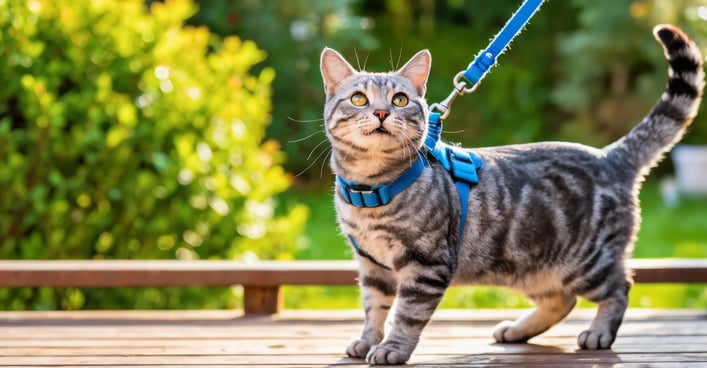
Cat Harness and Leash Training: Your Complete 2026 Guide
Safely introduce your cat to the outdoors with our step-by-step harness training guide. Learn equipment selection, proven techniques, and essential safety tips for successful walks.
Share this page
Cat Harness and Leash Training: Your Complete 2026 Guide
Meta Description: Master cat harness and leash training with our expert guide. Learn safe techniques, equipment selection, and step-by-step methods to provide your feline with enriching, supervised outdoor adventures.
Harness and leash training offers a perfect compromise for cat owners: it provides the mental and sensory stimulation of the outdoors while maintaining a controlled, safe environment. While not every cat will become an avid walker, many learn to enjoy these supervised excursions. This comprehensive guide covers everything from selecting the right gear to mastering training techniques and prioritizing safety for a positive experience.
Why Walk Your Cat?
The Benefits of Leash Walking
Walking your cat isn't just a novelty; it offers tangible benefits for their well-being.
Exposure to new sights, sounds, and smells engages their curious nature.
Physical Exercise
Encourages movement and activity, supporting a healthy weight.
Strengthened Bond
Shared adventures build trust and deepen your connection.
Confidence Building
Overcoming new challenges in a safe way can boost a cat's self-assurance.
Sensory Enrichment
Direct experience of grass, sunshine, and fresh air.
Controlled Safety
Supervised exploration prevents the dangers of free-roaming.
Is Your Cat a Good Candidate?
Assessing your cat's personality is the first step to success.
Cats Typically Better Suited:
Confident, curious personalities
Food-motivated individuals
Younger cats and kittens (often more adaptable)
Cats who frequently show interest in doors or windows
Patient and tolerant temperaments
Cats That May Find It Challenging:
Extremely fearful or anxious cats
Elderly cats with arthritis or mobility issues
Cats with significant health conditions
Individuals who panic easily in new situations
Choosing the Right Equipment
Types of Cat Harnesses
H-Style Harness:
Design: Traditional two-loop design connected by a strap on the back.
Pros: Highly adjustable, good for cats comfortable with handling.
Cons: Can be easier for some cats to slip out of if not fitted perfectly.
Vest Harness:
Design: Provides more torso coverage, often with Velcro or buckles.
Pros: Distributes pressure more evenly, more secure for "escape artists," often more comfortable for longer wear.
Cons: Can be bulkier and warmer.
Step-In Harness:
Design: Cat steps into two leg loops; the harness buckles on the back.
Pros: Minimizes overhead handling, ideal for head-shy cats.
Cons: Security depends on a proper fit; some cats dislike the step-in motion.
Jacket/Soft Harness:
Design: Offers the most coverage, resembling a lightweight garment.
Pros: Typically the most secure option.
Cons: Bulkiest design; best for cats dedicated to regular walking.
Harness Comparison Guide
Type
Security
Comfort
Ease of Use
Best For
H-style
Moderate
Good
Easy
Beginners, cost-conscious owners
Vest
High
Excellent
Moderate
Escape artists, longer walks
Step-in
Moderate
Good
Easy
Head-shy or wiggly cats
Jacket
Highest
Good
Moderate
Regular walkers, strong pullers
Recommended Harness Brands for 2026
Brand
Primary Style
Price Point
Key Notes
Rabbitgoo
Vest
$15-25
Highly rated for security and adjustability.
PetSafe Come With Me Kitty
H-style
$12-20
Excellent, simple option for initial training.
Escape Proof
Vest/Jacket
$20-35
Designed specifically for security.
Voyager
Vest
$15-30
Known for comfort and breathable mesh.
Kitty Holster
Jacket
$25-40
Very secure, soft fabric, popular choice.
Leash Selection Essentials
Length & Type:
4-6 feet: Ideal for control and safety, especially near any potential hazards.
Longer leashes (8-15 ft): Allow for more exploration in safe, open areas.
Retractable leashes:Not recommended. They offer less control in an emergency and can startle cats with their mechanism.
Material & Features:
Nylon: Durable, affordable, and widely available.
Cotton/Rope: Softer on the hands, good grip.
Bungee/Shock-Absorbing: Helps mitigate sudden tugs, reducing pressure on the cat.
Key Feature: A lightweight, secure clasp (like a bolt snap) and a comfortable handle for you.
The Step-by-Step Training Process
Phase 1: Harness Introduction & Positive Association (Days 1-7)
Goal: Create a positive link between the harness and good things (treats, praise).
Daily Steps:
Days 1-2: Place the harness near your cat's food bowl or favorite resting spot. Let them investigate it freely.
Days 3-4: Gently touch your cat with the harness, then immediately offer a high-value treat.
Days 5-6: Drape the unfastened harness over your cat's back/shoulders for a few seconds, followed by a treat and praise.
Day 7: Briefly fasten the harness (just one buckle if it has multiple), give multiple treats, and then remove it. Keep this session under a minute.
Pro Tips:
Use irresistible treats like freeze-dried chicken or tuna.
Keep every session short (2-5 minutes) and end on a positive note.
Never force the issue or hold a struggling cat.
Phase 2: Wearing the Harness Indoors (Days 8-14)
Goal: Build duration and comfort while wearing the harness indoors.
Progression Schedule:
Day Range
Target Duration
Suggested Activity
8-9
5-10 minutes
Harness on with close supervision. Engage in calm petting or treat-dispensing.
10-11
15-20 minutes
Harness on during normal, calm indoor activities (e.g., lounging, gentle play).
12-13
30-60 minutes
Incorporate short, fun play sessions while harnessed to create positive associations.
14
Several hours
Extended wear during a relaxed day at home. Ensure your cat is moving and acting normally.
Watch For: Attempts to wriggle out, "freezing" in place, hiding, or excessive grooming—all signs of stress. If seen, revert to the previous successful step for a few more days.
Phase 3: Adding the Leash Indoors (Days 15-21)
Goal: Acclimate your cat to the sensation of leash pressure without fear.
Training Steps:
Attach the leash and let it drag behind your cat as they move around a safe room (under your direct supervision to prevent tangling).
After they're comfortable dragging it, pick up the slack and simply follow your cat around, letting them lead.
Practice very gentle guidance: apply light tension in one direction and reward any movement in that direction.
Practice casual "walking" together indoors, rewarding them for staying near you.
Critical Rule: Never pull, drag, or correct your cat with the leash. The leash is a safety tether, not a steering tool. Let them set the pace.
Phase 4: The Outdoor Introduction (Days 22+)
Goal: A calm, positive first experience in the outside world.
First Outdoor Session Protocol:
Timing: Choose a quiet time of day (early morning or late evening).
Location: Start in a secure, enclosed space like a patio, porch, or quiet backyard. If not available, choose a secluded spot.
Transport: Carry your cat outside in your arms or a carrier. Do not let them walk out the door on leash, as this can encourage door-dashing.
Exploration: Set them down gently. Let them sniff and explore at their own pace. You are a calm, reassuring presence.
Duration: Keep the first session very short (5-10 minutes). The goal is to leave while they're still curious, not overwhelmed.
Return: Carry them back inside and offer a treat, making the return positive.
Gradual Expansion: Slowly increase duration by a few minutes each successful outing. Gradually expand to new, quiet areas, always following your cat's comfort level.
Effective Walking Techniques
The "Follow the Feline" Approach
This is the gold standard for cat walking. Your cat chooses the direction, pace, and duration of stops. Your role is to follow, provide security, and offer gentle, occasional redirection away from hazards. Patience is non-negotiable.
Guidelines for Safe Exploration
Do
Don't
Allow thorough sniffing of safe areas.
Let them chew on or eat unknown plants/grass.
Let them climb on low, sturdy structures.
Allow climbing to dangerous heights where they could get stuck or fall.
Maintain constant, attentive supervision.
Get distracted by your phone or conversations.
Stay in familiar, low-traffic areas initially.
Walk near busy roads, parking lots, or off-leash dog areas.
Continuously monitor your cat's body language for stress.
Force interactions with strangers, other animals, or new environments.
Handling Common Distractions
Other Animals: If a dog or other animal approaches, calmly pick your cat up and create distance. Do not let your cat feel trapped.
Loud Noises (sirens, trucks): Crouch down to provide a sense of security, speak softly, and consider heading home if your cat is severely startled.
Potential for Escape: Always check harness fit before going out (you should be able to slip two fingers under the straps). Be mentally prepared to scoop your cat up instantly if needed.
Safety Considerations: A Non-Negotiable Priority
Pre-Walk Safety Checklist
Harness Fit: Snug but not tight (the "two-finger rule").
Hardware Check: All buckles and straps are secure.
Leash Integrity: Clasp is functioning; leash is not frayed.
Identification: Harness has an ID tag with your current phone number. A microchip is also essential.
Health: Cat is current on vaccinations (especially rabies) and parasite prevention (fleas, ticks, heartworm).
Weather: Conditions are safe (see table below).
Outdoor Hazard Prevention
Hazard
Prevention Strategy
Parasites (Fleas, Ticks)
Monthly vet-recommended preventative medication.
Infectious Diseases
Keep all core vaccinations up-to-date.
Predators (Birds of Prey, Coyotes)
Supervise closely; avoid walking at dusk/dawn.
Toxic Substances
Prevent ingestion of plants, puddles (antifreeze), or pesticides.
Escape
Use a secure harness style, check fit, remain vigilant.
Vehicles
Avoid roads and parking areas entirely.
Unfriendly Cats
Maintain a safe distance; do not allow interactions.
Off-Leash Dogs
Be aware of your surroundings; have an exit plan.
Weather Safety Guidelines
Condition
Safety Advice
Hot (Above 80°F / 27°C)
Avoid walks. Pavement can burn paw pads rapidly. Opt for early morning only if necessary.
Cold (Below 40°F / 4°C)
Limit exposure. Watch for shivering. Consider a feline-safe sweater for very short trips.
Wet/Rainy
Most cats dislike it. It can lead to chilling. Best to skip the walk.
Windy
Can be frightening and carry unfamiliar scents/sounds. Keep a secure hold.
Snow
Some cats enjoy it briefly. Ensure paws don't get impacted with ice balls. Dry them thoroughly after.
Emergency Preparedness
Carry your phone.
Know the location and hours of the nearest emergency vet.
Have a cat carrier readily accessible (e.g., in your car if driving to a location).
Bring water and a collapsible bowl for walks longer than 20-30 minutes.
Watch for signs of overheating (panting, lethargy) or exhaustion.
Troubleshooting Common Challenges
The Harness Escape Artist
Solutions:
Upgrade Gear: Switch to a more secure vest or jacket-style harness.
Perfect the Fit: Ensure it's snug around the neck and chest. There should be no large gaps.
Re-train: Go back to Phase 2 and build more positive indoor associations before trying outside again.
Refusing to Walk or Move
Potential Causes & Solutions:
Cause: Discomfort/Pain. Solution: Try a different harness style or size; consult your vet to rule out physical issues.
Cause: Overwhelm/Fear. Solution: Go back to a quieter, more familiar environment. Shorten sessions dramatically.
Cause: Wrong Timing. Solution: Try a different time of day when the environment is calmer.
Freezing, Flattening, or Panicking
This means your cat is overwhelmed.Correct Response:
Do not pull on the leash.
Calmly pick your cat up and offer soothing words.
Immediately return to the safety of your home or carrier.
End the session. Try again another day, starting with a shorter, easier step in the process.
Equipment Care & Maintenance
Harness: Check for fraying, stitching wear, and buckle function weekly. Hand-wash according to manufacturer instructions monthly or as needed.
Leash: Regularly inspect the clasp mechanism and the entire length for damage. Clean with a damp cloth.
General Rule: Replace any equipment that shows significant wear to prevent failure during a walk.
Cost Breakdown for 2026
Initial Investment
Item
Cost Range
Quality Harness
$15 - $40
Standard Leash
$10 - $25
ID Tags
$5 - $20
Treat Pouch (optional)
$10 - $20
Portable Water Bowl
$5 - $15
Total Estimated Startup Cost
$45 - $120
Approximate Annual Ongoing Costs
Item
Annual Cost Estimate
Flea/Tick/Heartworm Prevention
$150 - $350
Harness Replacement (as needed)
$15 - $40
High-Value Training Treats
$50 - $100
Total Estimated Annual Cost
$215 - $490
Frequently Asked Questions (FAQs)
Q: At what age can I start harness training my cat?A: You can start with kittens as young as 8-10 weeks old, as they are often highly adaptable. However, cats of any age can learn; it may just require more patience with older individuals.
Q: How long does it take for a cat to get used to walking on a leash?A: The full process typically takes 4 to 8 weeks of consistent, positive training. Some cats may adapt faster, while others may only ever tolerate short, cautious explorations.
Q: Can I just use a collar instead of a harness?A: Absolutely not. Cats have delicate throats and necks. A collar poses a serious risk of injury, strangulation, or escape if the cat pulls or panics. A harness that distributes pressure across the chest and shoulders is the only safe option.
Q: My cat just lies down and won't move when we go outside. What should I do?A: This is extremely common. They are often processing the overload of new information. Be patient. Sit with them, let them observe, and don't force movement. If they don't move after 5-10 minutes, calmly end the session and try again later. For some cats, "walking" is simply supervised lounging outdoors.
Q: What's an ideal walk duration for a cat?A: Start with 5-10 minutes. As your cat gains confidence, you can gradually work up to 20-30 minutes. Quality (a calm, positive experience) is always more important than quantity or distance.
Q: Is it safe to walk a declawed cat?A: You can, but you must be extra vigilant. Declawed cats lack their primary defense mechanism and cannot climb to escape danger. Stick to very secure, quiet environments and avoid any situations with potential threats.
Last Updated: 2026 | Remember, not every cat will enjoy leash walking. Always respect your cat's individual personality and comfort level. The goal is enrichment, not stress.
Get expert advice about cat care, behavior, nutrition, grooming, and training. Ask our AI cat care expert anything about your cat and receive professional guidance.