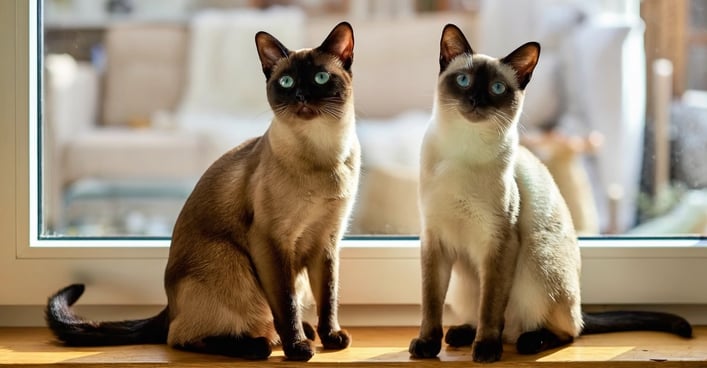
Burmese vs Tonkinese: The 2026 Breed Comparison Guide
Choosing between a Burmese and a Tonkinese cat? Our detailed 2026 guide compares their personalities, care, health, and costs to help you find your perfect feline match.
Share this page
Burmese vs Tonkinese: The 2026 Breed Comparison Guide
Two captivating breeds from Southeast Asia, the Burmese and Tonkinese, share a common heritage but offer distinct companionship experiences. Both are known for their silky coats, engaging personalities, and strong bonds with people, yet they differ significantly in appearance, temperament, and care. This comprehensive 2026 guide will help you determine which affectionate feline is the ideal addition to your home.
Origins and History
Burmese Origins
The modern Burmese breed traces its lineage to a single, chocolate-colored cat named Wong Mau, who was brought from Burma to San Francisco in 1930 by Dr. Joseph Thompson. Through selective breeding with Siamese cats, the foundation for the breed was established.
Key Development Milestones:
1930: Wong Mau arrives in America.
1936: Gains recognition from the Cat Fanciers' Association (CFA).
1947-1953: Registration was temporarily suspended; breeders worked to re-establish a pure Burmese type.
Modern Day: Two distinct types exist: the contemporary "American" Burmese (stockier) and the traditional "European" Burmese (more wedge-shaped).
The Tonkinese is a deliberate hybrid, developed to capture the best traits of its parent breeds. It originated from natural crosses between Burmese and Siamese cats and was intentionally refined by Canadian breeders in the 1960s and 1970s.
1960s: Purposeful breeding programs began in Canada.
1978: Achieved CFA recognition.
Modern Day: Celebrated as the perfect midpoint between the Burmese and Siamese, named for the Tonkin region of Indochina.
Physical Appearance: A Side-by-Side Look
Size and Build
Feature
Burmese
Tonkinese
Weight (Male)
8-12 lbs (3.6-5.4 kg)
8-12 lbs (3.6-5.4 kg)
Weight (Female)
6-10 lbs (2.7-4.5 kg)
6-10 lbs (2.7-4.5 kg)
Body Type
Compact, muscular, and rounded
Medium, athletic, and well-balanced
Bone Structure
Substantial and heavy
Medium, neither delicate nor coarse
Overall Impression
Surprisingly heavy for size; stocky
Elegant and moderate; a harmonious blend
Coat and Color
Burmese Coat:
Texture & Feel: Short, fine, and satin-like; lies close to the body.
Colors: Sable (rich brown), champagne, blue, and platinum.
Pattern: Exclusively solid.
Luster: Has a distinctive, high-gloss shine.
Tonkinese Coat:
Texture & Feel: Short, soft, and silky with a unique "mink" texture.
Colors: Natural, champagne, blue, and platinum.
Patterns: Offers three varieties: pointed (like a Siamese), mink (its signature look), and solid.
Luster: Exhibits a beautiful, subtle sheen.
Head and Facial Features
Burmese:
Rounded, broad head with full cheeks.
Large, expressive eyes set well apart; color ranges from gold to yellow.
Medium-sized, wide-set ears.
Short, broad muzzle with a sweet, open expression.
Tonkinese:
Modified wedge-shaped head, less rounded than the Burmese.
Striking almond-shaped eyes; color is pattern-dependent (blue for pointed, aquamarine for mink, green/yellow-green for solid).
Medium ears with slightly rounded tips.
Slightly longer muzzle, presenting an alert and inquisitive look.
Personality and Temperament: Heart of the Companion
The Burmese Personality
Burmese cats are often described as "dog-like" for their intense loyalty and social nature.
Devoted & Affectionate: Forms an extremely strong bond with their family; true "velcro" cats.
Playful & Energetic: Maintains a kitten-like zest for life, enjoys games of fetch, and is a skilled jumper.
Vocal: Communicates with a soft, raspy, and sweet voice.
Intelligent & Trainable: Responds well to clicker training and learning tricks.
Social Needs: Requires significant companionship and does not do well when left alone for long periods.
The Tonkinese Personality
Tonkinese cats blend the best of both worlds, creating a uniquely charming companion.
Social & Outgoing: Friendly with family, guests, and other pets; less prone to single-person attachment.
Conversational: Enjoys "talking" with their humans in a moderate, melodic voice.
Moderately Active: Playful and curious but often more balanced and graceful than the Burmese.
Affectionate but Independent: Loves cuddles but is generally less clingy, able to entertain themselves for short periods.
Adaptable: Fits well into various household dynamics, from busy families to quieter homes.
Temperament Comparison Table
Trait
Burmese
Tonkinese
Energy Level
High
Moderate to High
Affection Level
Very High (Velcro cat)
High (Social butterfly)
Independence
Low
Moderate
Vocalization
Moderate (soft voice)
Moderate to High (conversational)
Playfulness
Very High
High
Compatibility with Pets/Kids
Excellent
Excellent
Grooming and Care: Easy Maintenance
Both breeds are famously low-maintenance, making them excellent for busy owners.
Shared Grooming Routine
Brushing: A weekly 10-minute brush with a soft bristle or rubber grooming mitt removes loose hair and distributes skin oils.
Bathing: Rarely necessary due to their short coats and fastidious self-grooming habits.
Nail Trimming: Every 2-3 weeks.
Ear Cleaning: Check and gently clean monthly.
Dental Care:Most Important. Daily tooth brushing or dental treats are crucial to prevent periodontal disease common in both breeds.
Health, Lifespan, and Costs
Health Overview
Burmese:
Average Lifespan: 10-17 years.
Potential Concerns: Can be prone to certain genetic conditions like hypokalemic polymyopathy (muscle weakness), cranial deformities (in some lines), diabetes, and glaucoma. Reputable breeders screen for these.
Tonkinese:
Average Lifespan: 15-18 years.
Potential Concerns: Benefits from hybrid vigor. May inherit some benign Siamese traits like crossed eyes or a kinked tail. Generally considered a robust and healthy breed.
Cost of Ownership Breakdown (2026 Estimates)
Initial Purchase/Adoption:
Source
Burmese
Tonkinese
Reputable Breeder (Pet Quality)
$800 - $2,000
$700 - $1,500
Show Quality
$1,800 - $3,000
$1,500 - $2,500
Rescue/Adoption Fee
$100 - $400
$100 - $400
Approximate Monthly Costs:
High-Quality Food: $40 - $70
Litter: $20 - $30
Pet Insurance: $30 - $60 (highly recommended for purebreds)
Toys/Treats/Misc.: $20 - $40
Monthly Total:$110 - $200
Ideal Living Environment
Best Home for a Burmese:
Households with someone home often or with another pet for companionship.
Families with children who want an interactive, playful cat.
Owners seeking a deeply devoted, "shadow" companion.
Those who can provide ample interactive playtime and mental stimulation.
Best Home for a Tonkinese:
A variety of homes, from active families to singles.
Households that enjoy a social, conversational cat.
Owners who want an affectionate but slightly more independent companion.
Those attracted to their unique mink coat colors and patterns.
Pros and Cons at a Glance
Burmese
Pros: ✅ Extremely affectionate and loyal ✅ Playful and entertaining ✅ Intelligent and trainable ✅ Minimal grooming ✅ Good with families and pets
Cons: ❌ Can develop separation anxiety ❌ Higher potential for certain hereditary health issues ❌ Can be demanding of attention
Tonkinese
Pros: ✅ Excellent hybrid health and longevity ✅ Social and adaptable personality ✅ Beautiful, unique coat patterns ✅ Moderate, manageable energy ✅ Less prone to single-person attachment
Cons: ❌ Can be quite vocal ❌ Still requires daily interaction and play ❌ Less predictable in looks than established purebreds
Making Your Choice: Final Guidance
Choose a Burmese if you:
Desire an intensely devoted, "heart-on-paws" companion.
Have plenty of time for daily interaction and play.
Love the idea of a dog-like cat that follows you everywhere.
Prefer a solid-colored, plush-coated cat.
Choose a Tonkinese if you:
Want a social, friendly cat that greets everyone.
Appreciate a balance of affection and independence.
Are drawn to unique aquamarine eyes and mink coats.
Value hybrid vigor and potential for a longer, healthier lifespan.
Conclusion
Both the Burmese and Tonkinese offer unparalleled affection, intelligence, and beauty. Your decision ultimately hinges on your lifestyle and the type of bond you seek. The Burmese offers profound, unwavering devotion, while the Tonkinese provides a more balanced, socially versatile friendship. Whichever you choose, you are guaranteed a loving, silky-soft companion who will enrich your life for years to come.
Remember: Always choose a responsible breeder who performs genetic health screenings or consider giving a wonderful home to a cat from a breed-specific rescue.
Get expert advice about cat care, behavior, nutrition, grooming, and training. Ask our AI cat care expert anything about your cat and receive professional guidance.