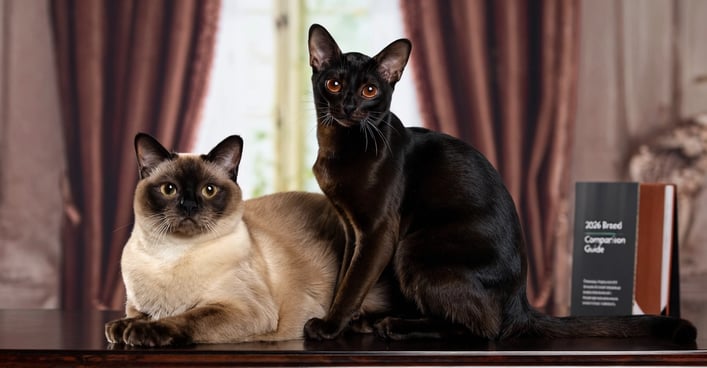
Burmese vs Bombay Cat: 2026 Breed Comparison Guide
Choosing between a Burmese and a Bombay cat? Our detailed 2026 guide compares temperament, appearance, health, and care to help you find your perfect dark-coated feline companion.
Share this page
Burmese vs Bombay Cat: The Complete 2026 Breed Comparison Guide
Meta Description: Deciding between a Burmese and a Bombay cat? Our comprehensive 2026 guide compares temperament, appearance, health, and care needs to help you choose your ideal dark-coated feline friend.
Introduction
Choosing between a Burmese and a Bombay cat presents a delightful challenge for prospective owners drawn to stunning dark coats and golden eyes. While both breeds share a captivating aesthetic, they differ significantly in origin, physique, and personality. The Burmese, an ancient breed from Southeast Asia, is a playful, people-oriented dynamo. The Bombay, a modern American creation, is a sleek, panther-like lap cat with a more moderate energy level.
This definitive 2026 guide provides a detailed, side-by-side analysis of every crucial factor—from temperament and grooming to health and cost—to empower you to make the perfect choice for your home and lifestyle.
Burmese vs Bombay Cat: 2026 Breed Comparison Guide - Articles
Origins and History: From Ancient Lineage to Modern Creation
Burmese Origins
The modern Burmese breed traces its roots to a single cat named Wong Mau, a small, walnut-brown feline brought from Burma (now Myanmar) to San Francisco in 1930. Acquired by Dr. Joseph Thompson, Wong Mau became the foundation for the breed through careful breeding programs with Siamese cats. Recognized by the Cat Fanciers' Association (CFA) in 1936, the breed has since diverged into two distinct types:
American Burmese: Characterized by a rounder, more compact, and substantial build.
British/European Burmese: Features a more slender, elegant, and elongated body style.
Both types inherit the famously affectionate and sociable nature of their celebrated ancestor.
Bombay Origins
The Bombay cat is a triumph of deliberate breeding. In the 1950s, American breeder Nikki Horner set out to create a domestic cat with the exotic appearance of a miniature black panther. By selectively crossing sable Burmese with black American Shorthairs, she achieved her vision: a cat with a jet-black coat, luminous copper eyes, and a muscular, athletic body. The breed earned CFA recognition in 1976 and remains a popular choice for those seeking a dramatic look paired with a loving temperament. Every Bombay cat is a living testament to Horner's original creative vision.
Physical Characteristics: A Detailed Comparison
Burmese Appearance
Body Structure:
Type: Compact, muscular, and deceptively heavy for its size (often described as "a brick wrapped in silk").
Weight: 8–12 pounds.
Build: Medium-sized with substantial bone structure and well-muscled, medium-length legs.
Paws: Rounded and neat.
Head and Face:
Shape: Distinctly rounded with no flat planes and a visible nose break (stop) in profile.
Eyes: Large, round, and set well apart; color ranges from gold to yellow.
Expression: Sweet, alert, and innocent.
Ears: Medium-sized, set well apart, with rounded tips.
Coat:
Length & Texture: Short, fine, close-lying, with a soft, satin-like texture and glossy sheen.
Colors: Original sable, plus champagne, blue, and platinum (European standards include additional colors).
Grooming: Minimal; a weekly brushing is sufficient.
Bombay Appearance
Body Structure:
Type: Medium-sized, muscular, and athletic, designed to resemble a miniature panther.
Weight: 8–15 pounds (males tend to be larger).
Build: Balanced—neither cobby nor foreign—with proportionate, medium-length legs.
Paws: Rounded and neat.
Head and Face:
Shape: Rounded with a full face and a prominent stop in profile.
Eyes: Large, round, set wide apart; distinctive copper to gold color is a hallmark.
Expression: Alert, intelligent, with a slightly wild allure.
Ears: Medium-sized, set wide, with rounded tips.
Coat:
Length & Texture: Short, fine, and glossy with a unique "patent-leather" sheen.
Color: Jet black from root to tip, with no gray undercoat.
Grooming: Minimal; weekly brushing with a chamois cloth enhances the brilliant shine.
Side-by-Side Physical Comparison
Feature
Burmese
Bombay
Body Type
Compact, rounded, substantial
Balanced, muscular, panther-like
Average Weight
8–12 lbs
8–15 lbs
Head Shape
Round with visible stop
Round with prominent stop
Eye Color
Gold to yellow
Copper to gold
Coat Colors
Sable, champagne, blue, platinum
Black only
Coat Sheen
Glossy satin
Patent leather
Overall Feel
"Brick wrapped in silk"
Sleek, cool, and smooth
Personality and Temperament: Social Butterflies with Different Rhythms
Burmese Personality
Communication: Burmese are famously vocal and opinionated. They use a soft, sweet, often raspy voice to comment on daily life, greet owners, and express their desires. They are constant conversationalists.
Social Nature: This is an exceptionally people-oriented breed. They form deep bonds, shadow their favorite humans, and demand significant interaction (3+ hours daily). They are prone to separation anxiety if left alone frequently and thrive as lap cats.
Activity & Play: Burmese retain a kitten-like energy well into their senior years. They are highly intelligent, acrobatic, and love interactive games like fetch and puzzle-solving. They are inquisitive and will involve themselves in all household activities.
Compatibility: Generally excellent with children, cat-friendly dogs, and other pets, though their dominant, playful nature can overwhelm shy animals.
Bombay Personality
Communication: Bombays are moderately vocal, using a soft, pleasant voice to politely request attention. They are communicative but less persistently chatty than the Burmese.
Social Nature: Bombays form deep, devoted bonds with their families but maintain a degree of independence. They are exceptional lap cats who enjoy being near their people but tolerate alone time slightly better than Burmese.
Activity & Play: They have a moderate energy level, enjoying bursts of playful activity balanced with appreciative relaxation. They are intelligent and trainable, enjoying interactive toys and climbing.
Compatibility: Adaptable and generally good with children and other pets. They are less demanding than Burmese but still require consistent social interaction.
Personality Comparison Summary
Trait
Burmese
Bombay
Vocalization
Moderate to High
Moderate
Energy Level
High, lifelong
Moderate
Attention Needs
Very High
High
Independence
Low
Moderate
Playfulness
Kitten-like throughout life
Moderate, age-appropriate
Lap Cat Tendency
Excellent
Exceptional
Best For
Active, engaged households
Various lifestyles, including busier homes
Health and Lifespan: What to Expect
Burmese Health Profile (Lifespan: 10–16 years)
Common Concerns:
Craniofacial Defect: A serious genetic condition in some American Burmese lines, now reduced through responsible breeding and genetic screening.
Hypokalemia: An inherited condition causing low blood potassium, leading to muscle weakness. Manageable with supplementation.
Diabetes Mellitus: Higher incidence; preventable with weight management.
Recommended Care: Genetic testing for breeders, regular veterinary check-ups, and proactive weight management.
Bombay Health Profile (Lifespan: 12–16 years)
Common Concerns:
Respiratory Issues: Some tendency toward snoring/breathing sounds due to head shape; sensitivity to extreme heat.
Inherited Conditions: Potential for some Burmese-lineage issues (e.g., craniofacial defect, hypokalemia), though incidence is lower.
Obesity: Prone to weight gain; requires portion control and exercise.
Dental Disease: Regular dental care is essential.
Recommended Care: Annual wellness exams, weight monitoring, dental hygiene, and cardiac screening as recommended by your vet.
Health Comparison at a Glance
Factor
Burmese
Bombay
Typical Lifespan
10–16 years
12–16 years
Genetic Condition Risk
Moderate to High
Moderate
Obesity Risk
Moderate
Higher
Overall Hardiness
Good
Good
Care and Grooming Requirements
Burmese Care Needs
Grooming: Easy. Weekly brushing with a soft brush.
Exercise:High need. Requires 30–45 minutes of active, engaging play daily (fetch, chase, puzzle toys).
Environment:Critical need for companionship. Does not tolerate long solitude. Needs vertical space (cat trees) and mental stimulation.
Bombay Care Needs
Grooming: Easy. Weekly brushing; a chamois cloth enhances shine.
Exercise:Moderate need. 20–30 minutes of daily interactive play is sufficient.
Environment: Social but more adaptable to alone time. Prefers moderate climates and cozy resting spots. An indoor-only lifestyle is strongly recommended.
Care Comparison Summary
Care Aspect
Burmese
Bombay
Grooming Effort
Low (10-15 min/week)
Low (10-15 min/week)
Exercise Demand
High
Moderate
Mental Stimulation
Critical
Important
Alone Time Tolerance
Poor
Fair to Good
Cost Comparison: 2026 Estimates
Initial Costs (First Year)
Expense
Burmese
Bombay
Kitten (Pet Quality)
$600 – $1,500
$500 – $1,200
Initial Vet Care & Vaccinations
$200 – $400
$200 – $400
Spay/Neuter
$200 – $500
$200 – $500
Supplies (Carrier, Bed, etc.)
$200 – $400
$200 – $400
Total Initial Investment
$1,200 – $2,800
$1,100 – $2,500
Annual Recurring Costs
Expense
Burmese
Bombay
High-Quality Food
$400 – $800
$400 – $800
Litter & Supplies
$150 – $300
$150 – $300
Routine Veterinary Care
$250 – $500
$200 – $450
Pet Insurance
$300 – $600
$300 – $600
Toys & Enrichment
$150 – $300
$100 – $200
Total Annual Cost
$1,250 – $2,500
$1,150 – $2,350
Note: These are estimates. Costs vary by location, breeder reputation, and individual pet health. Always budget for unexpected veterinary expenses.
Which Breed Is Right for You?
Choose a Burmese If You:
✅ Desire a perpetually playful, kitten-like companion.
✅ Work from home or can provide near-constant companionship.
✅ Enjoy a vocal, communicative, and highly interactive pet.
✅ Want a "dog-like" cat that plays fetch and learns tricks.
✅ Have an active household with children or other pets.
Choose a Bombay If You:
✅ Are captivated by the sleek, panther-like aesthetic.
✅ Want a deeply affectionate and exceptional lap cat.
✅ Prefer a social companion with a more moderate energy level.
✅ Appreciate striking copper eyes and a patent-leather coat.
✅ Need a cat that adapts well to various living situations.
Reconsider Both Breeds If You:
❌ Are regularly away from home for 10+ hours a day.
❌ Prefer a quiet, aloof, and independent cat.
❌ Cannot commit to a 12–16 year responsibility.
❌ Are unable to provide daily interactive play and social engagement.
Conclusion
The choice between a Burmese and a Bombay cat ultimately hinges on your lifestyle and the type of feline companionship you seek.
The Burmese is a dynamo of love and energy—an intelligent, vocal, and demanding shadow that will fill your home with activity and affection. They are ideal for dedicated owners who can match their high social and play needs.
The Bombay offers the mesmerizing look of a miniature panther with a slightly more relaxed, adaptable temperament. They are devoted and loving but often better suited to owners with somewhat busier schedules.
Both breeds are stunning, people-oriented, and require a committed indoor lifestyle. Whichever dark-coated beauty you choose, you are guaranteed a loyal and captivating companion for years to come. Your perfect feline partner awaits.
Get expert advice about cat care, behavior, nutrition, grooming, and training. Ask our AI cat care expert anything about your cat and receive professional guidance.