British Shorthair vs Russian Blue: The 2026 Breed Comparison Guide
Choosing between a British Shorthair and a Russian Blue? Our detailed guide compares their temperament, health, grooming, and costs to help you find your perfect feline companion.
Share this page
British Shorthair vs Russian Blue: The 2026 Breed Comparison Guide
When seeking a solid-colored, plush-coated feline with a calm demeanor, the British Shorthair and Russian Blue stand out as premier choices. Both breeds captivate with their stunning looks, reserved yet affectionate personalities, and relatively low-maintenance care. However, key distinctions in origin, physique, and temperament are crucial for prospective owners to understand before welcoming one of these magnificent cats into their home.
Breed Overview
British Shorthair
Origin and History
The British Shorthair is one of England's oldest cat breeds, with roots tracing back to domestic cats brought by the Romans roughly 2,000 years ago. These hardy working cats were valued for controlling rodent populations. Over centuries, they evolved into a distinct, sturdy breed well-adapted to the British climate.
Selective breeding began in the late 1800s under cat fancier Harrison Weir, who established the first breed standard. The breed faced near-extinction during both World Wars but was revitalized through careful breeding programs, sometimes involving outcrosses to Persians. Today, the British Shorthair is a beloved and popular breed worldwide.
British Shorthair vs Russian Blue: The 2026 Breed Comparison Guide - Articles
Physical Characteristics
Weight: 12-18 lbs (males), 8-14 lbs (females)
Length: 16-20 inches
Coat: Short, exceptionally dense, plush with a crisp texture
Colors: Blue is iconic, but over 30 colors and patterns are accepted
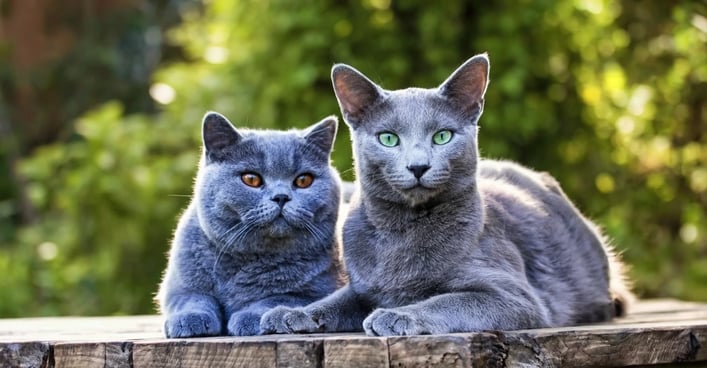
Eyes: Large, round, typically copper or gold (color-dependent)
Distinctive Feature: Pronounced round face with full cheeks, stocky "cobby" build
Lifespan: 12-17 years
Russian Blue
Origin and History
The Russian Blue's origins are linked to the port of Arkhangelsk in northern Russia, where they were known as Archangel Cats. Favored by Russian nobility, they were first exhibited in England in 1875.
The breed's numbers dwindled during World War II but were preserved through strategic breeding with Siamese and British Shorthairs. Post-war efforts successfully restored the breed's original elegant characteristics. Russian Blues are now prized globally for their striking appearance and gentle disposition.
Physical Characteristics
Weight: 10-15 lbs (males), 7-12 lbs (females)
Length: 15-18 inches
Coat: Short, fine, dense double coat with distinctive silver tipping
Colors: Blue only, ranging from light to dark slate
Eyes: Large, almond-shaped, vivid green in adults
Distinctive Feature: A unique "smiling" expression and luminous, silvery-blue coat
Lifespan: 15-20 years
Physical Characteristics: A Side-by-Side Look
Coat & Color
Feature
British Shorthair
Russian Blue
Texture
Dense, plush, crisp (like thick carpet)
Fine, silky, very dense double coat
Key Trait
Coat stands away from the body
Silver-tipped guard hairs create a shimmering sheen
Colors
Blue, black, white, cream, silver, tabby, tortoiseshell, etc.
Blue only, with luminous silver quality
Grooming
Weekly brushing; moderate seasonal shedding
Weekly or less; minimal shedding
Body Type & Size
Feature
British Shorthair
Russian Blue
Build
Stocky, substantial, heavy-boned "cobby" type
Elegant, lithe, fine-boned "foreign" type
Face
Round with full cheeks
Wedge-shaped with prominent whisker pads
Expression
Sweet, teddy bear-like
Sweet, often described as "smiling"
Male Weight
12-18 lbs
10-15 lbs
Female Weight
8-14 lbs
7-12 lbs
Overall Size
Large
Medium
Temperament and Personality: Understanding Their Nature
British Shorthair Personality
Easygoing & Placid: Famously calm and adaptable, they take life in stride.
Independent but Affectionate: Form strong bonds but aren't clingy; enjoy being near you, not necessarily on you.
Quiet & Undemanding: Communicate with soft chirps; not vocal complainers.
Excellent Family Cats: Patient and tolerant, typically good with children, other cats, and cat-friendly dogs.
Playful but Moderate: Enjoy short play sessions but are not high-energy; become more sedentary with age.
Russian Blue Personality
Reserved but Deeply Loyal: Form intense bonds with family but can be shy with strangers initially.
Highly Intelligent & Observant: Enjoy puzzle toys and learning routines; need mental stimulation.
Gentle & Quiet: Have soft voices and are generally undemanding.
Playful & Athletic: Maintain a kitten-like playfulness into adulthood; enjoy climbing and chasing.
Routine-Oriented & Sensitive: Thrive in stable, predictable environments and are attuned to their owner's emotions.
Temperament Summary
Trait
British Shorthair
Russian Blue
Energy Level
Low to Moderate
Moderate
Affection Display
Moderate (proximity)
Moderate to High (devoted)
Social with Strangers
Friendly
Reserved
Intelligence
Moderate
High
Adaptability
Very Good
Moderate (prefers routine)
Good with Children/Pets
Very Good
Good (with proper introduction)
Vocalization
Low
Low
Health, Lifespan, and Care
Health Profile
Health Factor
British Shorthair
Russian Blue
Overall Health
Good
Excellent
Lifespan
12-17 years
15-20 years
Common Concerns
Hypertrophic Cardiomyopathy (HCM), obesity, Hemophilia B
Generally very robust; watch for obesity, potential bladder stones
Genetic Testing
Recommended for HCM & PKD
Minimal typically required
Grooming & Exercise Needs
British Shorthair: Requires weekly brushing to manage its dense coat. Needs short, daily play sessions to prevent obesity.
Russian Blue: Requires minimal grooming; occasional brushing or wipe-downs suffice. Needs regular interactive play for mental and physical stimulation.
Cost of Ownership (2026 Estimates)
Initial Investment
Expense
British Shorthair
Russian Blue
Kitten from Breeder
$1,000 - $2,500
$800 - $2,000
Initial Vet & Supplies
$600 - $1,300
$600 - $1,300
Total Initial Cost
$1,600 - $3,800
$1,400 - $3,300
Annual Ongoing Costs
Expect to budget between $1,250 and $2,800 per year for high-quality food, litter, routine veterinary care, and insurance for either breed.
Which Breed Is Right for You?
Choose a British Shorthair if you want:
An adaptable, easygoing "teddy bear" cat for any household.
A larger, stockier companion.
A cat that is typically friendly with everyone.
A wide variety of coat colors and patterns.
Choose a Russian Blue if you want:
A long-lived, elegant, and highly intelligent companion.
A cat for a calm, stable, and predictable home.
A devoted bond with a initially reserved cat.
Minimal grooming and a stunning, shimmering blue coat.
Conclusion
Both the British Shorthair and Russian Blue offer the joy of a plush-coated, gentle, and relatively low-maintenance companion. Your decision ultimately hinges on lifestyle and preference: the British Shorthair is the adaptable, charming teddy bear, while the Russian Blue is the elegant, sensitive, and devoted intellectual. Whichever you choose, you'll gain a quiet, loving feline friend for many years to come.
Disclaimer: Individual cats may vary. Always meet kittens and their parents when possible. Source your companion from reputable breeders who conduct essential health screenings and prioritize animal welfare.
Get expert advice about cat care, behavior, nutrition, grooming, and training. Ask our AI cat care expert anything about your cat and receive professional guidance.