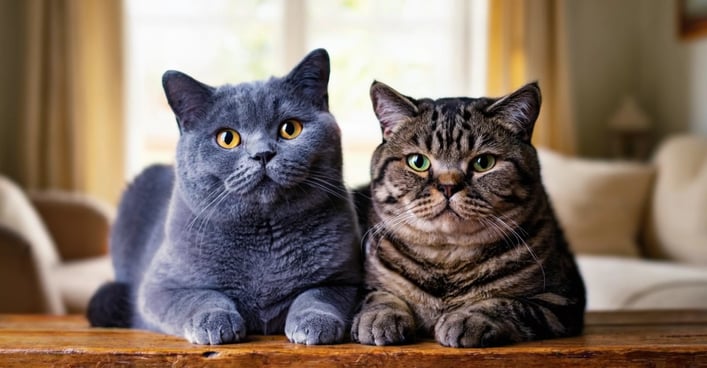
British Shorthair vs American Shorthair: Complete Breed Comparison (2026)
Choosing between a British Shorthair and an American Shorthair? Our 2026 guide compares their personality, appearance, and care to help you find your perfect feline match.
Share this page
British Shorthair vs American Shorthair: Complete Breed Comparison (2026)
Deciding between a British Shorthair and an American Shorthair? Both are beloved shorthaired breeds known for their wonderful temperaments and manageable care, yet they possess distinct personalities, appearances, and histories. This comprehensive 2026 guide will help you determine which charming companion best fits your family's lifestyle.
Quick Overview: British Shorthair vs American Shorthair
British Shorthair vs American Shorthair: Complete Breed Comparison (2026) - Articles
Feature
British Shorthair
American Shorthair
Origin
United Kingdom
United States
Weight
9-17 lbs (males larger)
8-15 lbs
Lifespan
12-17 years
15-20 years
Coat
Dense, plush, crisp feel
Short, dense, hard texture
Build
Stocky, cobby, round
Medium, muscular, athletic
Personality
Calm, reserved, dignified
Easygoing, adaptable, social
Vocalization
Quiet
Moderate
Origins and History
British Shorthair History
The British Shorthair is one of England's oldest cat breeds, with origins tracing back to Roman-occupied Britain. Roman soldiers brought cats to protect food supplies from rodents, and these felines interbred with native wildcats. Over centuries, they evolved into the sturdy, dense-coated cats we recognize today.
The breed faced near-extinction during both World Wars. Dedicated breeders revived the population by carefully introducing Persian bloodlines. The British Shorthair gained official recognition in the late 1970s.
American Shorthair History
Originally known as the Domestic Shorthair, this breed descended from European cats brought to North America by early settlers. These hardy working cats protected ships' cargo and homesteads from rodents. Unlike many pedigree breeds, American Shorthairs developed naturally through selection for superior hunting ability and resilience.
The breed was formally recognized in 1906 but was renamed the American Shorthair in 1966 to distinguish it from random-bred domestic shorthairs.
Physical Appearance
British Shorthair Appearance
British Shorthairs are celebrated for their teddy bear-like charm:
Head: Large, round face with full, chipmunk-like cheeks
Eyes: Large, round, and widely spaced (copper or gold are preferred)
Body: Cobby, compact, and powerfully built
Coat: Short, exceptionally dense, and plush with a crisp texture
Colors: Blue (gray) is iconic, but over 30 colors and patterns are accepted
Build: Heavy boning, broad chest, and short, strong legs
The British Shorthair's rounded features and dense coat create an irresistibly cuddly, stuffed-animal appearance.
American Shorthair Appearance
American Shorthairs boast a more athletic, working-cat physique:
Head: Medium-sized with full cheeks, but less round than the British
Eyes: Large, wide-set, with a slight upward slant
Body: Medium to large, well-balanced, and muscular
Coat: Short, dense, with a protective, hard texture
Colors: The silver tabby is most popular, with over 80 colors and patterns available
Build: Athletic, well-muscled, with a rectangular body shape
American Shorthairs embody the quintessential image of a healthy, agile domestic cat.
Coat Differences
British Shorthair Coat
Texture: Dense, plush, with a distinctive "crisp" feel
Density: Very thick double coat
Feel: Often compared to plush velvet or a teddy bear
Seasonal changes: Coat thickens significantly in winter
Colors: Famous for blue (gray), but available in many colors
American Shorthair Coat
Texture: Short, dense, protective, with a hard-feeling texture
Density: Moderate double coat
Feel: Smooth and sleek to the touch
Seasonal changes: Moderate seasonal variations
Colors: Silver tabby is iconic, but the breed offers an extensive color range
Personality and Temperament
British Shorthair Personality
British Shorthairs are famously reserved and dignified:
Calm and quiet: Low-energy observers who prefer watching to participating
Independent: Content with solitude and not overly demanding
Reserved with strangers: Take time to warm up to new people
Loyal: Form strong, deep bonds with family once comfortable
Not typically lap cats: Affectionate but often prefer being near you rather than on you
Routine-oriented: Thrive on predictable schedules and environments
The British Shorthair motto could be "dignity above all." They are not clingy and maintain a charming air of quiet composure.
American Shorthair Personality
American Shorthairs are adaptable and easygoing:
Friendly and social: Generally outgoing and welcoming with everyone
Moderately active: Enjoy play sessions but are not hyperactive
Highly adaptable: Handle changes and new situations with ease
Excellent with children: Patient, tolerant, and playful
Affectionate: More likely to be lap cats than their British counterparts
Independent yet social: Skillfully balance alone time with family interaction
American Shorthairs are often described as "easy cats" due to their ability to adapt seamlessly to various households and lifestyles.
Grooming Requirements
British Shorthair Grooming
Low-maintenance but essential:
Brushing: Weekly brushing to remove loose hair and prevent mats
Seasonal care: Increase to 2-3 times weekly during heavy shedding seasons (spring/fall)
Bathing: Rarely needed
Time commitment: Approximately 15-20 minutes per week
Despite their dense coat, British Shorthairs are relatively straightforward to groom with consistent care.
American Shorthair Grooming
Similarly low-maintenance:
Brushing: Weekly brushing is usually sufficient
Seasonal care: Increase frequency during seasonal sheds
Bathing: Rarely required
Time commitment: About 15 minutes per week
Both breeds are excellent choices for owners who desire beautiful cats without extensive grooming routines.
Health and Lifespan
British Shorthair Health
Generally healthy with a lifespan of 12-17 years. Be mindful of:
Hypertrophic Cardiomyopathy (HCM): A common heart condition
Hemophilia B: A bleeding disorder found in some bloodlines
Obesity: Prone to weight gain due to low activity levels; portion control is key
Dental issues: Regular dental care is important
American Shorthair Health
A very robust breed with a lifespan of 15-20 years. Watch for:
Hypertrophic Cardiomyopathy (HCM): Can occur, as in many breeds
Obesity: Possible if overfed and under-exercised
Generally robust: Fewer breed-specific health problems overall
American Shorthairs tend to have slightly longer lifespans and fewer hereditary health concerns than British Shorthairs.
Exercise and Activity
British Shorthair Activity Level
Low to moderate energy:
Play sessions: Short, gentle play periods (5-10 minutes)
Activity style: Often prefer watching to participating
Exercise needs: Low; prone to obesity without careful diet and portion control
Best activities: Gentle interactive play, food puzzle toys, and feather wands
British Shorthairs are natural couch potatoes and require monitoring to maintain a healthy weight.
American Shorthair Activity Level
Moderate energy:
Play sessions: Enjoy longer, 15-20 minute interactive play sessions
Activity style: More playful and engaged than British Shorthairs
Exercise needs: Moderate; they retain strong hunting instincts
Best activities: Interactive chase toys, feather wands, climbing trees, and puzzle feeders
American Shorthairs maintain more of their working-cat heritage and genuinely enjoy active play.
Training and Intelligence
British Shorthair Training
Intelligent but notably independent:
Litter training: Typically easy and reliable
Tricks: Capable of learning but may choose not to perform on command
Training approach: Requires patient, reward-based methods (treats, praise)
Independence: May politely ignore commands they find uninteresting
American Shorthair Training
Intelligent and generally more trainable:
Litter training: Very easy and quick
Tricks: Can learn various commands and enjoy interactive games
Training approach: Responds very well to positive reinforcement
Adaptability: Learns household rules and routines quickly
Both breeds are intelligent, but American Shorthairs often show more eagerness to please during training sessions.
Cost Comparison (2026 Estimates)
Initial Costs
Expense
British Shorthair
American Shorthair
Kitten Price (Reputable Breeder)
$800-$2,500+
$600-$1,200
Adoption Fee
$75-$200
$75-$150
Initial Vet Visit (Vaccinations, Check-up)
$100-$300
$100-$300
Initial Supplies (Carrier, Bed, Litter Box, etc.)
$150-$400
$150-$400
Annual Costs
Expense
British Shorthair
American Shorthair
High-Quality Food
$300-$600
$300-$600
Routine Vet Care
$200-$500
$200-$400
Grooming Supplies/Professional
$50-$100
$50-$100
Litter
$150-$300
$150-$300
Pet Insurance
$200-$500
$200-$400
Estimated Annual Total: $900-$2,000 for British Shorthairs, $900-$1,800 for American Shorthairs.
Ideal Living Environment
Best Homes for British Shorthairs
Quiet, calm, and predictable households
Homes with people who work full-time (they value independence)
Primarily indoor living environments
Owners who appreciate undemanding companionship
Apartments or houses (adaptable to space)
Best Homes for American Shorthairs
Virtually any type of household—busy or quiet
Families with children
Multi-pet homes (with proper introductions)
First-time cat owners
Indoor living or homes with safe, supervised outdoor access (e.g., catios)
Family Compatibility
With Children
British Shorthair: Good with gentle, respectful children; may retreat from loud or rough play.
American Shorthair: Excellent with children of all ages; known for patience and tolerance.
With Other Pets
British Shorthair: Often prefer being the only cat; can coexist with calm, cat-friendly dogs or other pets.
American Shorthair: Usually good with other cats and dog-friendly dogs, especially if socialized early.
With Seniors
British Shorthair: An excellent match due to their calm, low-maintenance, and undemanding nature.
American Shorthair: Also a good match, offering slightly more interactive companionship.
Frequently Asked Questions (2026)
Which breed is better for first-time cat owners?
American Shorthairs are generally the top recommendation for first-time owners due to their adaptable, easygoing, and forgiving nature. British Shorthairs are also suitable but their more reserved personality may be less immediately rewarding for someone seeking a highly demonstrative cat.
Do British Shorthairs shed more than American Shorthairs?
Yes, typically. British Shorthairs often shed more noticeably due to their denser, plush double coat. Both breeds require weekly brushing, but British Shorthairs may produce a greater volume of fur, especially during seasonal changes.
Which breed is more affectionate?
American Shorthairs are generally more openly affectionate and more likely to seek out lap time. British Shorthairs are deeply affectionate but express it in a more reserved, dignified manner—often preferring to sit beside you rather than on you.
Are British Shorthairs always gray (blue)?
No. While the blue (gray) coat is the most famous and popular, British Shorthairs come in over 30 recognized colors and patterns, including black, white, cream, red, chocolate, and various tabby and colorpoint patterns.
Which breed tends to live longer?
American Shorthairs typically have a longer average lifespan (15-20 years) compared to British Shorthairs (12-17 years). With excellent care, proper nutrition, and regular vet check-ups, individuals of both breeds can exceed these ranges.
Conclusion: Making Your Choice
Both the British Shorthair and American Shorthair make exceptional companions, but they cater to different preferences and lifestyles.
Choose a British Shorthair If:
You desire a calm, dignified, and undemanding companion.
You have a quieter, predictable routine and may work outside the home.
You adore their distinctive teddy bear appearance and plush coat.
You appreciate affection that is quiet, loyal, but not overly clingy.
You have a peaceful, adult-oriented household.
Choose an American Shorthair If:
You want a highly adaptable, easygoing "family cat."
You have children, other pets, or a busier household.
You value a robust, generally healthy, and long-lived companion.
You prefer a more interactive, playful, and openly affectionate cat.
You are a first-time cat owner.
Both breeds offer the practical benefits of short coats—minimal grooming and less shedding than long-haired breeds. Your decision should hinge on whether the British Shorthair's serene dignity or the American Shorthair's friendly versatility better aligns with your heart and home.
Final Reminder: Regardless of your choice, both breeds will thrive with high-quality nutrition, proactive veterinary care, environmental enrichment, and, most importantly, your love and commitment. Whether you welcome the cuddly British teddy bear or the versatile all-American friend, you are gaining a loyal feline companion for many joyful years to come.
Get expert advice about cat care, behavior, nutrition, grooming, and training. Ask our AI cat care expert anything about your cat and receive professional guidance.