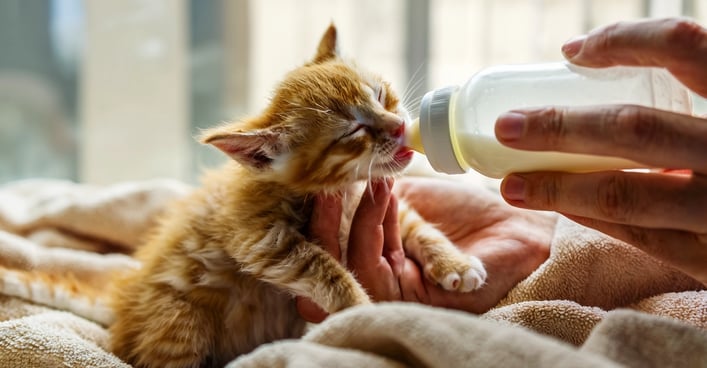
Bottle Feeding Kittens: The Complete 2026 Guide for Caregivers
Master the art of bottle feeding orphaned or supplemental-fed kittens with this step-by-step guide. Learn proper technique, essential equipment, and how to avoid common, dangerous mistakes.
Share this page
Bottle Feeding Kittens: The Complete 2026 Guide for Caregivers
Bottle feeding is an essential skill for anyone caring for orphaned, rejected, or supplemental-fed kittens. Proper technique is critical; it ensures kittens receive vital nutrition while preventing life-threatening complications like aspiration pneumonia. This definitive guide provides everything you need to know, from selecting the right equipment to troubleshooting common feeding problems.
When Is Bottle Feeding Necessary?
Situations Requiring Human Intervention
Orphaned Kittens:
Mother cat is deceased or has abandoned the litter.
Mother cat is unable to nurse due to illness, injury, or mastitis.
Kittens are found alone with no mother in sight.
Supplemental Feeding:
Large litters where the mother cannot adequately feed all kittens.
"Runts" or weaker kittens not getting enough milk during nursing.
Mother cat has insufficient milk production.
Sick kittens requiring extra nutrition for recovery.
Human baby formula: Incorrect protein/fat ratios for felines.
Outdated evaporated milk recipes: Nutritionally inadequate and dangerous.
Preparing Powdered KMR Correctly
Step-by-Step Preparation:
Wash your hands thoroughly.
Use a clean, sterilized mixing container and bottle.
Add warm water (not hot, about 100°F) first, per package directions.
Add powder slowly while stirring or whisking vigorously.
Mix until completely dissolved with no clumps.
Use immediately or refrigerate promptly.
Storage & Safety Guidelines:
Refrigerate mixed formula immediately in a sealed container.
Discard any unused formula after 24 hours.
Never save leftover formula from a feeding session due to bacterial growth.
Warm a fresh portion for each feeding.
Label the container with the date and time it was mixed.
Warming Formula to the Perfect Temperature
Target Temperature: 100-102°F (38-39°C) – approximately body temperature.
Test it: Place a few drops on the inside of your wrist. It should feel warm, not hot.
Safe Warming Methods:
Warm Water Bath: Place sealed bottle in a bowl of hot water for a few minutes.
Bottle Warmer: Use a dedicated warmer on a low setting.
Microwave (with caution): Heat for 5-10 seconds only. Shake extremely well and test temperature thoroughly to avoid hot spots.
Dangers of Incorrect Temperature:
Too cold: Kittens may refuse it; can cause digestive upset and hypothermia.
Too hot: Can cause severe burns to the mouth and esophagus.
Feeding Schedule, Amounts, and Growth Tracking
Age-Based Feeding Guide (General Guidelines)
Age
Approx. Weight
Frequency
Amount per Feeding
Daily Total
0-1 day
85-115 g (3-4 oz)
Every 2 hours
1-2 ml
12-24 ml
2-3 days
115-140 g (4-5 oz)
Every 2 hours
2-4 ml
24-48 ml
4-7 days
140-200 g (5-7 oz)
Every 2-3 hours
4-6 ml
32-72 ml
1-2 weeks
200-285 g (7-10 oz)
Every 3-4 hours
6-10 ml
48-80 ml
2-3 weeks
285-400 g (10-14 oz)
Every 4-5 hours
10-14 ml
60-100 ml
3-4 weeks
400-500 g (14-18 oz)
Every 5-6 hours
14-18 ml
70-120 ml
Important Notes on Feeding:
These are guidelines only; individual needs vary. Let the kitten's cues guide you.
Never exceed stomach capacity (see below).
Focus on consistent weight gain rather than strictly adhering to volume.
Calculating Stomach Capacity
General Rule: A kitten's stomach can hold approximately 13-15 ml per 100 grams of body weight.
Example: A 100g kitten should have no more than 13-15ml per feeding.
Overfeeding is a common cause of diarrhea, bloating, and discomfort.
Signs of Proper Feeding Volume:
Belly feels round and soft, not tight or drum-like.
Kitten is content, sleepy, and stops sucking actively.
No regurgitation or spit-up after feeding.
The Step-by-Step Feeding Technique
Proper Positioning is Critical
The Natural Nursing Position:
Hold the kitten on its belly (prone position), never on its back.
Support its chest and front paws with your hand.
Keep the head slightly elevated and straight.
Allow natural kneading behavior with the front paws.
Feeding on the back greatly increases aspiration risk.
Temperature is Key:
Always warm a cold kitten before feeding. A cold kitten cannot digest food.
Use a heating pad set on low (under half the bedding) or your own body heat.
Never attempt to feed a hypothermic kitten.
The Feeding Process: From Start to Finish
Pre-Feeding Routine:
Stimulate elimination to empty the bladder and colon.
Ensure the kitten is fully warm to the touch.
Prepare a fresh portion of warm formula.
Test the nipple flow over a sink.
During the Feeding:
Gently touch the nipple to the kitten's lips to stimulate the rooting reflex.
Allow the kitten to open its mouth and draw the nipple in.
Hold the bottle at a 45-degree angle to prevent air swallowing.
Let the kitten set the pace. Never squeeze the bottle to force formula.
Watch for a steady swallowing rhythm—you'll often see the ears wiggle.
Feeding Signs to Monitor Closely:
Good Signs
Warning Signs (STOP Feeding)
Ears wiggling with each swallow
Milk bubbling from the nose
Steady, audible swallowing
Choking, coughing, or gagging
Content purring/vibrating
Squirming away or fighting the bottle
Relaxed body posture
Bloated, tight belly during feeding
Kneading with front paws
Lethargy or falling asleep mid-feed
Post-Feeding Care:
Remove the nipple slowly.
Wipe the mouth and face gently with a soft, warm cloth.
Burp the kitten by holding it against your shoulder and patting its back gently.
Stimulate for elimination one more time.
Return the kitten to its warm, clean bedding.
Record the amount consumed in your log.
Troubleshooting Common Feeding Problems
Problem: Kitten Refuses to Eat
Possible Causes: Hypothermia, incorrect formula temperature, wrong nipple, illness, dehydration.
Solutions:
Check and correct the kitten's body temperature.
Re-test formula warmth.
Try a different nipple type or size.
Check for signs of illness (lethargy, nasal discharge).
Offer a drop of Karo syrup or sugar water on the gums for quick energy if weak.
Consult a vet if refusal persists beyond two feedings.
Emergency: Aspiration (Milk in the Lungs)
Signs: Milk comes out the nose, coughing/wheezing during/after feeding, difficulty breathing, lethargy, fever.
Immediate Action:
STOP FEEDING IMMEDIATELY.
Hold the kitten vertically, head up, and gently pat its back.
Wipe away any milk from the nose and mouth.
Keep the kitten warm.
THIS IS A VETERINARY EMERGENCY—seek immediate care.
Prevention: Correct positioning, proper nipple flow, feeding slowly, and stopping at any sign of cough.
Problem: Diarrhea
Common Causes: Overfeeding, formula mixed too rich/concentrated, spoiled formula, sudden brand changes, parasites (e.g., coccidia).
Treatment:
Reduce the feeding amount by 25% for the next 24 hours.
Double-check formula preparation ratios and freshness.
Use only freshly mixed formula.
Ensure bottles and nipples are sterilized.
Call the vet if diarrhea persists more than 24 hours or is severe.
Danger Signs Requiring a Vet: Bloody diarrhea, severe dehydration (skin tenting, dry gums), extreme lethargy, loss of appetite.
Problem: Constipation
Signs: Straining without producing stool, hard/dry stool, crying during stimulation, no stool for 24+ hours.
Treatment:
Add 1-2 drops of warm water to the formula for the next few feedings.
Increase the duration and frequency of stimulation.
Try a gentle clockwise belly massage.
Consult your vet if there's no improvement—they may recommend a kitten-safe laxative.
Problem: Bloating
Signs: Tight, distended belly, discomfort or crying, restlessness, reduced appetite.
Causes: Overfeeding, formula too rich, swallowing too much air during feeding.
Treatment:
Reduce the amount fed per session.
Burp the kitten more frequently during the feed.
Check that you are holding the bottle at a 45-degree angle.
Contact your vet if bloating is severe or the kitten seems in pain.
Monitoring, Record Keeping, and Growth Charts
Daily Kitten Log Sheet (Essential Tool)
Record for Each Kitten, Every Feeding:
Time
Amount Fed (ml)
Urine (Y/N)
Stool (Y/N)
Weight (g)
Notes
6:00 AM
9:00 AM
12:00 PM
3:00 PM
6:00 PM
9:00 PM
12:00 AM
Key Growth Metrics:
Daily Weight Gain: Healthy kittens should gain 10-15 grams per day.
Weekly Gain: Expect about ½ ounce (14g) every 2-3 days.
Red Flag: Any weight loss or failure to gain weight for 24 hours is a reason to call the vet.
Warning Signs and Action Chart
Problem
Recommended Action
Weight loss
Call vet immediately.
No weight gain for 24 hrs
Increase feeding frequency/amount slightly, monitor closely, call vet if no change.
Diarrhea
Reduce formula amount by 25%, ensure proper mixing. Call vet if it continues.
No stool for 24 hrs
Increase stimulation, try belly massage. Call vet if no result by 36-48 hours.
Vomiting
Stop feeding, keep warm, call vet.
Lethargy/Unresponsiveness
Emergency vet visit.
Difficulty Breathing
Emergency vet visit.
Milk from Nose
Stop feeding, hold upright, emergency vet visit.
Weaning: Transitioning from Bottle to Solid Food
Natural Weaning Timeline
Week 3-4: Introduction Phase
Begin introducing the concept of a dish.
Offer "gruel" (a slurry of high-quality canned kitten food mixed with KMR).
Continue regular bottle feeding schedule.
Week 4-5: Exploration Phase
Increase frequency of gruel offerings.
Place a shallow saucer of formula for lapping practice.
Most kittens will start lapping hesitantly.
Week 5-6: Transition Phase
Gradually reduce the number of bottle feedings.
Offer increasingly thick gruel and soft, pate-style wet kitten food.
Provide a very shallow dish of fresh water.
Week 6-8: Completion Phase
Bottle feeding is minimal or eliminated (may keep one for comfort).
Kittens eat solid wet food independently.
Consistently drinking water from a bowl.
Basic Gruel Recipe
Starter: Mix 2 parts warm KMR with 1 part high-quality canned kitten food (pate). Blend until smooth.
Transition: Over 2-3 weeks, gradually decrease the KMR and increase the food ratio.
By Week 6: The "gruel" should be mostly moist food with just a splash of formula for scent.
Weaning Tips for Success
Let kittens walk through a small amount of gruel—they learn by stepping in it and licking their paws.
Gently rub a bit of gruel on their lips with your finger.
Be patient; kittens wean at different paces. Never force it.
Some kittens may comfort-nurse on a bottle even while eating solids—this is okay if not causing nutritional issues.
Emergency Preparedness
When to Seek IMMEDIATE Veterinary Care
Refusing multiple feedings in a row.
Any suspicion of aspiration (milk from nose, coughing).
Severe diarrhea with signs of dehydration.
Bloated, hard, or painful abdomen.
Difficulty breathing, wheezing, or blue-tinged gums.
Extreme lethargy or unresponsiveness.
Persistent vomiting.
No stool for 48+ hours despite intervention.
Any weight loss.
Emergency Kit Essentials
Phone numbers for your vet and the nearest 24-hour emergency clinic.
Karo syrup or honey (for hypoglycemia emergencies).
Snuggle Safe heating disk or heating pad.
Digital thermometer.
Backup can of liquid KMR (requires no mixing).
Plenty of clean towels and blankets.
Prepared travel carrier.
Top Tips for Success and Common Mistakes
Best Practices for Bottle Feeding
Consistency: Maintain a strict schedule. Use the same caregiver when possible.
Cleanliness: Sterilize all equipment daily. Wash hands before every feeding.
Patience: Let the kitten control the pace. Rushing leads to mistakes.
Warmth: A warm kitten is a feeding kitten. Prioritize temperature.
Documentation: Your log is your best tool for spotting problems early.
Veterinary Partnership: Establish a relationship with a vet. Don't hesitate to call.
Common Mistakes to Avoid
Using cow's milk or improper formula.
Feeding formula that is too cold or too hot.
Feeding a kitten on its back.
Overfeeding, leading to diarrhea and bloating.
Force-feeding by squeezing the bottle.
Using dirty or worn-out nipples and bottles.
Ignoring early warning signs of illness.
Delaying a call to the veterinarian.
Conclusion
Bottle feeding kittens is a demanding yet profoundly rewarding commitment. It requires meticulous attention to detail, unwavering patience, and a willingness to learn. By following this guide—using the proper formula, maintaining correct technique, monitoring diligently, and seeking professional help when needed—you provide these vulnerable neonates with the best possible chance to thrive.
Your care during these critical early weeks lays the foundation for a healthy, socialized cat ready for a loving forever home. The effort you invest now makes all the difference.
Last Updated: 2026 This guide provides general information. Always consult with a licensed veterinarian for specific guidance regarding your kittens' health and nutritional needs.
Get expert advice about cat care, behavior, nutrition, grooming, and training. Ask our AI cat care expert anything about your cat and receive professional guidance.