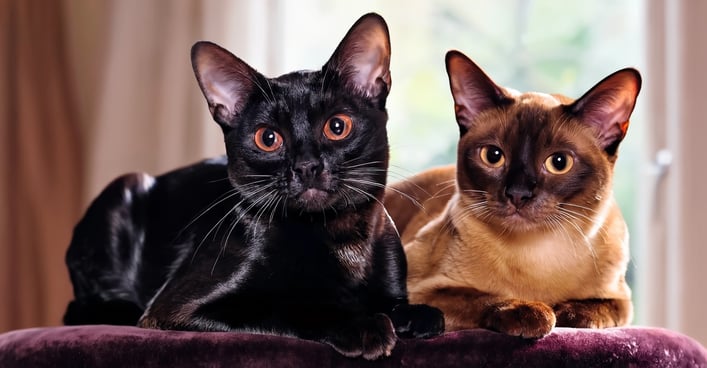
Bombay vs Burmese Cat: Your 2026 Guide to Mini Panthers & Satin Companions
Deciding between a Bombay and a Burmese cat? Compare their panther-like beauty, affectionate personalities, and care needs to find your perfect feline soulmate.
Share this page
Bombay vs Burmese Cat: Your 2026 Guide to Mini Panthers & Satin Companions
Meta Description: Discover the key differences between Bombay and Burmese cats. This 2026 guide compares their temperaments, health, care, and unique personalities to help you choose your ideal feline companion.
Bombay and Burmese cats are two of the most affectionate and people-oriented breeds you can welcome into your home. While they share a genetic heritage and a similar compact, muscular build, they offer distinct experiences. The Bombay, a deliberate creation, is the quintessential "miniature black panther" with a singular, stunning look. The Burmese, with its ancient lineage, offers a wider palette of satin-coated colors and a famously playful, insistent personality. This comprehensive comparison will guide you to the perfect match for your lifestyle.
Breed Origins & History
The Bombay: A Designed Panther
Creator: Nikki Horner in Louisville, Kentucky
Development Era: 1953 to 1965
Foundation Breeds: Burmese crossed with American Shorthair
Primary Goal: To create a domestic "parlor panther"
Official Recognition: Granted by the Cat Fanciers' Association (CFA) in 1976
Unique Fact: The only cat breed specifically developed for a single, uniform color (black).
The Burmese: An Ancient Treasure
Geographic Origin: Burma (Myanmar) and Thailand region
Founding Cat: Wong Mau, imported to the United States in 1930
Key Developer: Dr. Joseph Thompson
Official Recognition: CFA recognition in 1936
Modern Types: American (contemporary, stockier) and European (traditional, more moderate)
Genetic Foundation: Developed through selective breeding with Siamese cats.
The Vital Connection: The Bombay breed contains significant Burmese genetics, which is why they share core personality traits like devotion and sociability.
Physical Characteristics: A Side-by-Side Look
Size and Build Comparison
Feature
Bombay
American Burmese
European Burmese
Weight (Male)
8-11 lbs (3.6-5 kg)
8-12 lbs (3.6-5.4 kg)
10-14 lbs (4.5-6.3 kg)
Weight (Female)
6-9 lbs (2.7-4 kg)
6-10 lbs (2.7-4.5 kg)
8-12 lbs (3.6-5.4 kg)
Body Type
Cobby, compact
Compact, rounded
More moderate, athletic
Overall Build
Dense and muscular
Stocky and substantial
Athletic and sleek
Bone Structure
Medium
Medium
Medium to fine
Coat: Glossy Black vs. Colorful Satin
The Bombay Coat:
Color: Exclusively a deep, patent-leather black from nose to tail.
Texture: Exceptionally fine, short, and satin-like.
Sheen: A high-gloss, polished appearance that catches the light.
Feel: Smooth as silk to the touch.
Details: Black whiskers, black paw pads, and black nose leather.
The Burmese Coat:
Colors: Sable (rich brown), Champagne, Blue, and Platinum.
Texture: Fine, short, and satin-like with a luxurious feel.
Sheen: Naturally glossy and polished.
Color Pattern: A subtle color point effect, where the face, ears, legs, and tail (points) are slightly darker than the body.
Facial Features & Expression
Feature
Bombay
American Burmese
European Burmese
Eyes
Copper to deep gold (deep color preferred)
Gold to yellow
Yellow to amber
Eye Shape
Large and round
Large, round, and expressive
Slightly oval
Head Shape
Rounded
Rounded with a short muzzle
Medium wedge shape
Ears
Medium-sized, rounded at tips
Medium, wide-set
Medium, set well apart
Overall Expression
Alert, intelligent, panther-like
Sweet, open, and innocent
Alert, intelligent, and engaging
Design Note: The Bombay was specifically bred to combine its black coat with striking copper eyes, achieving the ultimate panther-like aesthetic.
Temperament & Personality: Devotion in Different Styles
The Bombay Personality: The Shadow That Purrs
Activity Level: Moderate (6/10)
Playfulness: Enjoys interactive play but is not hyperactive.
Affection Style: A devoted, gentle lap cat who forms deep bonds.
Vocalization: Quiet to moderately conversational.
Sociability: Loves people and is generally good with respectful strangers.
Key Behavioral Traits:
The quintessential "Velcro cat" who follows you from room to room.
A supreme lap cat who seeks physical closeness.
Highly adaptable to various home environments.
Patient and tolerant, making them excellent with gentle children.
Intelligent and can learn tricks for positive reinforcement.
Possesses a moderate, manageable play drive.
Owner Insight:"My Bombay is a shadow that purrs. He's content just being near me, offering quiet companionship."
The Burmese Personality: The Canine Clown
Activity Level: Moderate to High (7/10)
Playfulness: Retains a playful, kitten-like energy throughout its life.
Affection Style: Demanding, insistent, and deeply devoted to their family.
Vocalization: Not loud, but uses a soft, charming rumble to communicate.
Sociability: Extremely devoted to their immediate family; can be reserved with strangers.
Key Behavioral Traits:
Demands attention and interaction; won't take "no" for an answer.
A lap cat on their terms, often when they need a recharge between play sessions.
Famous for their "clownish" antics and entertaining behavior.
Many enjoy playing fetch, much like a dog.
Curious and "into everything," requiring a stimulating environment.
Can become possessive of their favorite person.
Owner Insight:"My Burmese is convinced he's a dog in a cat's body. He fetches, follows commands, and is the center of every activity."
Temperament Comparison at a Glance
Trait
Bombay
Burmese
Affection Level
10/10
10/10
Activity Level
6/10
7/10
Playfulness
7/10
8/10
Vocalization
4/10
5/10
Independence
3/10 (Very Low)
2/10 (Extremely Low)
Intelligence
8/10
9/10
Child Friendly
9/10
9/10
Pet Friendly
7/10 (with proper intro)
7/10 (with proper intro)
Stranger Friendly
8/10
6/10
Care & Lifestyle Requirements
Grooming Needs
Both breeds are low-maintenance:
Coat Type: Short, fine, and satin-like.
Shedding: Minimal year-round.
Brushing: A weekly brushing with a soft rubber grooming mitt is sufficient to remove loose hair and distribute skin oils.
Bathing: Rarely needed due to their self-cleaning habits and coat texture.
Ear Cleaning: Check and clean gently on a monthly basis.
Exercise & Mental Stimulation
Bombay:
Thrives on moderate, daily play sessions with interactive wand toys or laser pointers.
Values lap time and companionship as much as active play.
Adapts well to the owner's activity level.
Burmese:
Requires more active, engaging play to burn off their higher energy.
Puzzle feeders, treat-dispensing toys, and games of fetch are highly recommended.
Needs consistent interaction to prevent boredom, which can lead to mischief.
Companionship Needs: The Non-Negotiable
Crucial for Both Breeds:
Extremely people-oriented and prone to separation anxiety.
Cannot be left alone for long hours regularly.
Ideally, someone should be home often, or they should have a feline companion.
They will follow you around the house, wanting to be involved in all activities.
They are true companion cats, not independent aloof pets.
Health & Lifespan Comparison
Bombay Health Profile
Generally a Robust Breed:
Benefits from a diverse genetic foundation.
Few major breed-specific genetic issues.
Health Considerations to Discuss with Your Breeder/Vet:
Craniofacial Defect: A rare developmental issue that responsible breeders have largely eliminated through testing.
Hypertrophic Cardiomyopathy (HCM): A form of heart disease; screening of breeding stock is recommended.
Potential for Sinus Issues: Due to selective breeding for a slightly flatter face in some lines.
Average Lifespan: 12 to 16 years.
Burmese Health Profile
Common Health Considerations:
Diabetes Mellitus: Burmese have a higher-than-average incidence. Weight management through diet and exercise is critical.
Hypokalemia (Burmese Hypokalemia): A hereditary condition causing low blood potassium levels. Reputable breeders test for this.
Flat-Chested Kitten Syndrome: A developmental condition that can affect some kittens; most outgrow it with proper care.
Gangliosidosis: A rare, fatal neurological disorder. DNA testing allows breeders to avoid producing affected kittens.
Average Lifespan: 10 to 16 years (with American Burmese often reaching the upper end).
Health Summary Table
Factor
Bombay
Burmese
Overall Health
Excellent
Good (with proactive management)
Diabetes Risk
Lower
Higher; requires vigilance
Known Genetic Issues
Minimal
Several, but testable
Typical Lifespan
12-16 years
10-16 years
Anticipated Veterinary Costs
Lower
Moderate (due to recommended screening)
Cost of Ownership (2026 Estimates)
Initial Acquisition Costs
Expense
Bombay
Burmese
Kitten (Pet Quality)
$500 - $1,000
$600 - $1,200
Kitten (Show/Breeding Quality)
$1,000 - $1,500
$1,200 - $2,000
Adopting an Adult
$200 - $600
$300 - $800
Estimated Annual Costs (For Either Breed)
Expense Category
Estimated Annual Cost
High-Quality Food
$600 - $900
Routine Veterinary Care
$300 - $600
Basic Grooming Supplies
$0 - $100
Cat Litter
$200 - $300
Toys, Treats, & Supplies
$100 - $200
Total Annual Range
$1,200 - $2,100
Pros and Cons Summary
Bombay Cat: Pros & Cons
Advantages (✅):
Stunning Appearance: The unique "mini panther" look with a glossy black coat and copper eyes is breathtaking.
Sweet Temperament: A devoted, adaptable, and patient companion ideal for families and singles alike.
Generally Healthy: A robust breed with fewer hereditary concerns and a good lifespan.
Low Maintenance: Easy-care coat and a moderate energy level that fits many lifestyles.
Disadvantages (❌):
Rarer Breed: Fewer breeders can mean longer waitlists and potentially higher travel costs.
No Color Variety: If you love the look of a black cat, it's perfect. If you desire color options, look elsewhere.
Burmese Cat: Pros & Cons
Advantages (✅):
Beautiful Color Options: Choose from Sable, Champagne, Blue, or Platinum—all with a gorgeous satin sheen.
Playful & Entertaining: Lifelong kitten energy and clownish antics provide constant amusement.
Extremely Affectionate: Forms intensely devoted bonds and demands (and gives) endless love.
Excellent Family Cat: Patient, interactive, and thrives in engaged, active households.
Disadvantages (❌):
Cannot Tolerate Solitude: Prone to severe separation anxiety; not suitable for people who are away from home frequently.
More Health Considerations: Requires a committed owner willing to pursue recommended health screenings and weight management.
Demanding Nature: Their need for interaction is insistent; they are not a "hands-off" pet.
Which Breed Is Right for You?
Choose a Bombay Cat If You Want:
A living piece of art with a panther-like aesthetic.
A deeply devoted but slightly calmer and more adaptable companion.
The allure and uniqueness of a rarer breed.
Low-maintenance beauty with an easy-care coat.
A gentle, patient presence in a home with children.
Choose a Burmese Cat If You Want:
A playful, entertaining personality that remains kitten-like for life.
A cat that will play fetch and engage in interactive games.
A deeply affectionate "velcro cat" who insists on being the center of your world.
A choice of beautiful coat colors.
A home where someone is present most of the time, or you can provide a feline friend.
Special Considerations for Modern Lifestyles
For Working Professionals & Busy Households
Important Warning: Neither breed is suitable for owners who work long hours outside the home or travel frequently without their pet.
Potential Solutions if You're Set on These Breeds:
Adopt two kittens/cats together so they can keep each other company.
Employ a pet sitter or cat walker for midday visits.
Consider if a work-from-home or hybrid schedule is possible.
Honestly assess if a more independent breed would be a better fit.
For Families with Children
Both breeds can be excellent, but with nuances:
Bombay: Often praised for its slightly more patient and adaptable nature, making it a wonderfully tolerant family member.
Burmese: Brings higher energy and playful antics that older children may adore, but their demanding nature requires teaching kids about respectful interaction.
Finding a Reputable Breeder in 2026
Essential Questions to Ask Any Breeder:
What specific health screening do you perform on your breeding cats? (For Burmese: ask about Hypokalemia and HCM testing).
Can I meet the parent cats to observe their temperament?
How do you socialize your kittens?
Do you have an indoor-only policy for your cats and kittens?
Are the kittens sold with registration papers and a detailed health guarantee?
Major Red Flags to Avoid:
Breeders who allow their cats to live or go outdoors.
An inability or unwillingness to provide health clearances for parent cats.
Catteries that breed multiple, unrelated breeds.
"Always available" kittens with no waiting list.
Prices significantly below the market average.
Last Updated: 2026 | Both the Bombay and Burmese cats require committed, indoor-only homes with owners who can provide the daily companionship and interaction these devoted breeds crave.
Get expert advice about cat care, behavior, nutrition, grooming, and training. Ask our AI cat care expert anything about your cat and receive professional guidance.