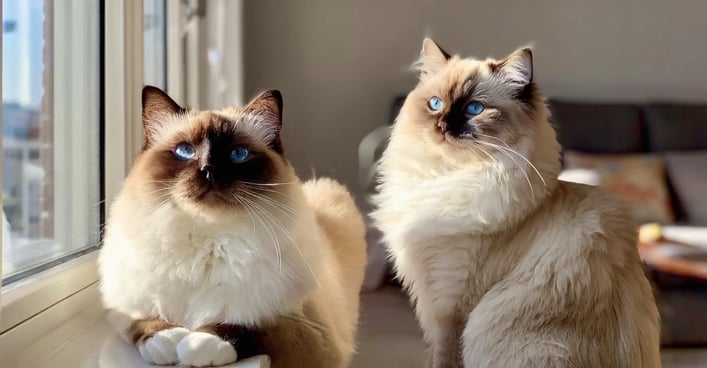
Birman vs Ragdoll: A Complete 2026 Breed Comparison Guide
Can't decide between a Birman and a Ragdoll? This detailed guide compares their history, temperament, health, and care to help you choose your perfect feline companion.
Share this page
Birman vs Ragdoll: A Complete 2026 Breed Comparison Guide
When considering long-haired, colorpoint breeds with captivating blue eyes, the Birman and Ragdoll are often top contenders. While they share a stunning appearance, these two magnificent breeds have distinct histories, temperaments, and care needs. This comprehensive guide will help you understand their differences and choose the ideal feline companion for your lifestyle.
Breed Overview
Birman Cats
Origin and History
The Birman, also known as the "Sacred Cat of Burma," is shrouded in legend. According to Burmese folklore, these cats were temple companions to priests. Their documented history began in France in the early 20th century, following their importation from Burma (modern-day Myanmar). The breed nearly faced extinction during World War II but was revived through careful breeding programs with Siamese and Persian cats, eventually gaining recognition from major cat associations.
Distinctive Feature: Pure white "gloves" on all four paws
Eyes: Deep, almost round sapphire blue
Lifespan: 12-16 years
Body Type: Medium, stocky, and rectangular
Ragdoll Cats
Origin and History
The Ragdoll is a relatively modern American breed, developed in Riverside, California, during the 1960s by breeder Ann Baker. The foundation cat, Josephine, was a white domestic longhair known for her exceptionally docile nature. Through selective breeding, Baker established a large, semi-longhaired breed with pointed coloration and the famously relaxed temperament that inspired the name "Ragdoll." Despite early controversy, the breed gained formal recognition in the 1970s and is now one of the world's most popular cat breeds.
Coat: Semi-long, silky with a plush, rabbit-like texture
Colors: Seal, blue, chocolate, lilac, red, and cream
Patterns: Colorpoint, mitted, bicolor
Eyes: Always vivid blue, large and oval-shaped
Lifespan: 12-17 years
Body Type: Large, substantial, and rectangular
Temperament and Personality Comparison
Birman Personality
Gentle and Affectionate: Birmans form strong bonds with their families and enjoy being involved in household activities without being overly demanding.
Quiet and Soft-Spoken: They are not particularly vocal, using soft, melodic chirps or purrs to communicate.
Intelligent and Curious: These smart cats enjoy exploring and solving puzzles, retaining a playful, kitten-like attitude into adulthood.
Social but Respectful: They love companionship and will follow you around, but they typically respect personal space and aren't constant lap-demanders.
Family-Friendly: Their patient nature makes them excellent with respectful children, other cats, and cat-friendly dogs.
Moderate Energy: They enjoy interactive play sessions but are equally content with quiet observation.
Ragdoll Personality
Exceptionally Docile: Ragdolls are famous for their calm, laid-back temperament and tendency to go limp when held—true to their name.
Dog-Like Loyalty: They often follow their owners like puppies, greet them at the door, and form extremely strong attachments.
Gentle and Patient: Exceptionally tolerant, they rarely use their claws during play and handle interactions with children very well.
Strictly Indoor: Their trusting nature and lack of defensive instincts make them vulnerable outdoors; they should be indoor-only cats.
Quiet and Peaceful: They have soft, sweet voices and vocalize sparingly, usually with polite chirps or meows.
Low to Moderate Energy: While they enjoy gentle play, Ragdolls are profoundly content with lounging and quiet companionship.
Temperament Summary
Trait
Birman
Ragdoll
Energy Level
Moderate
Low to Moderate
Playfulness
Moderate to High
Moderate
Affection Level
High
Very High
Independence
Moderate
Low
Vocalization
Low
Low
Intelligence
High (curious/problem-solver)
Moderate (people-oriented)
Good with Children
Excellent
Excellent
Good with Other Pets
Very Good
Very Good
Lap Cat Tendency
Moderate
Very High
Physical Characteristics Comparison
Size Differences
Birman: A medium-sized breed. Males: 10-12 lbs; Females: 6-10 lbs.
Key Takeaway: The Ragdoll is significantly larger and more substantial than the Birman.
Coat & Grooming
Aspect
Birman
Ragdoll
Coat Length
Medium-long
Semi-long
Texture
Silky, lies flat
Silky, plush "rabbit-like" texture
Undercoat
Minimal
Minimal
Matting Tendency
Low-Moderate
Low
Grooming Frequency
2-3 times per week
2-3 times per week
Shedding
Moderate
Moderate
Distinctive Feature
White gloves on all paws
Colorpoint patterns (mitted, bicolor)
The Birman's "Gloves": This is the breed's signature trait. All four paws have pure white, symmetrical markings covering the toes, sometimes with "laces" extending up the back of the hind legs. This feature is unique to Birmans.
Health and Lifespan
Birman Health Overview
General Health: Good, but with some breed-specific concerns.
Common Issues:
Hypertrophic Cardiomyopathy (HCM): A genetic heart condition. Screening of breeding cats is essential.
Blood Clotting Disorders: Present in some lines; DNA testing is available.
Lifespan: 12-16 years
Ragdoll Health Overview
General Health: Good, with one major hereditary concern.
Common Issues:
Hypertrophic Cardiomyopathy (HCM): The most significant health risk. A genetic mutation has been identified, making DNA testing and annual cardiac screening crucial.
Bladder Stones: Some predisposition to calcium oxalate stones.
Obesity: Their relaxed lifestyle requires careful portion control.
Lifespan: 12-17 years
Health Comparison
Health Factor
Birman
Ragdoll
Overall Health
Good
Good
Primary Health Risk
HCM, Kidney Disease
HCM (genetic test available)
Lifespan
12-16 years
12-17 years
Crucial Note: Always choose a reputable breeder who performs and documents health screenings for both parents.
Lifestyle and Care Requirements
Exercise & Activity
Birman: Has moderate energy. Enjoys 15-20 minutes of daily interactive play, climbing structures, and puzzle toys.
Ragdoll: Has low to moderate energy. Requires 10-15 minutes of gentle daily play and may need encouragement to stay active to prevent weight gain.
Living Environment
Both Breeds: Should be kept strictly indoors for their safety and longevity.
Birman: Adaptable to apartments or houses, appreciates vertical space for climbing.
Ragdoll: Thrives in a calm indoor environment with plenty of cozy resting spots; their trusting nature makes them vulnerable outdoors.
Training & Intelligence
Birman: Highly intelligent and curious. Responds well to positive reinforcement training for tricks, leash walking, and puzzle games.
Ragdoll: Intelligent in a people-pleasing way. Easily learns routines, can play fetch, and is highly attuned to human emotions.
Cost Comparison (2026 Estimates)
Initial Costs
Expense
Birman
Ragdoll
Kitten from Reputable Breeder
$800 - $2,000
$1,200 - $3,000
Initial Vet Visit & Vaccinations
$100 - $300
$100 - $300
Spay/Neuter
$200 - $500
$200 - $500
Initial Supplies (carrier, bed, etc.)
$300 - $500
$300 - $500
Total Initial Investment
$1,400 - $3,300
$1,800 - $4,300
Annual Ongoing Costs
Expense
Birman
Ragdoll
High-Quality Food
$500 - $1,000
$600 - $1,200
Litter
$150 - $300
$150 - $300
Routine Veterinary Care
$400 - $700
$400 - $800
Pet Insurance
$300 - $600
$300 - $600
Grooming & Supplies
$100 - $200
$100 - $200
Total Annual Cost
~$1,450 - $2,800
~$1,550 - $3,100
*Note: Ragdolls may incur higher vet costs for recommended cardiac screening. An emergency fund of $2,000-$5,000 is advised for any pet.
Which Breed Is Right for You?
Choose a Birman If You Want:
A medium-sized, intelligent, and moderately active companion.
A cat that is affectionate but not overly clingy, respecting personal space.
The unique and beautiful signature white gloves.
A playful, curious personality that remains kitten-like.
A cat with a legendary, mystical history.
Choose a Ragdoll If You Want:
A large, impressively gentle "gentle giant."
The ultimate lap cat with a famously relaxed, floppy demeanor.
A profoundly loyal, dog-like companion that follows you everywhere.
A lower-energy cat perfect for a calm, relaxed household.
An exceptionally patient and tolerant family pet.
Final Conclusion
Both the Birman and Ragdoll offer stunning beauty, captivating blue eyes, and loving, gentle temperaments. Your choice ultimately depends on your lifestyle preferences:
The Birman is your match if you seek a moderately active, intelligent, and graceful companion with a unique look and a touch of playful curiosity.
The Ragdoll is ideal if you dream of a large, supremely relaxed, and devoted lap cat whose calm presence and puppy-like loyalty will define your home.
Whichever breed you choose, you are welcoming a devoted, affectionate feline friend who will provide years of companionship and joy. Always prioritize adopting from shelters or responsible breeders who prioritize health and temperament.
Disclaimer: Individual cats may vary. This guide provides general breed standards and information. Always meet a kitten and its parents when possible and ensure your chosen breeder conducts all recommended health screenings.
Get expert advice about cat care, behavior, nutrition, grooming, and training. Ask our AI cat care expert anything about your cat and receive professional guidance.