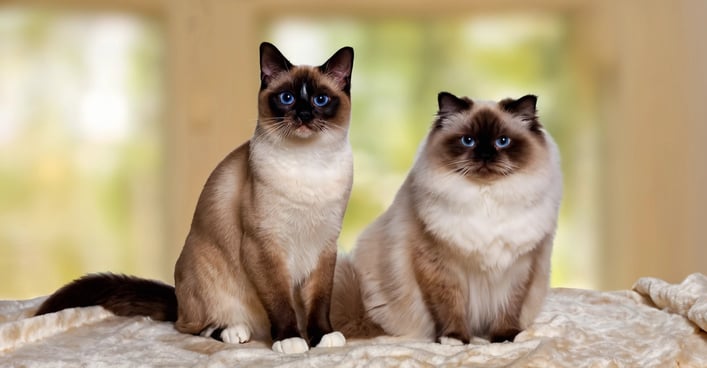
Birman vs Ragdoll: The Ultimate 2026 Breed Comparison Guide
Discover the key differences between Birman and Ragdoll cats, from temperament and grooming to health and costs, to find your perfect feline companion.
Share this page
Birman vs Ragdoll: The Ultimate 2026 Breed Comparison Guide
The Birman and Ragdoll are two of the most beloved semi-longhaired, colorpoint cat breeds, renowned for their gentle natures and captivating blue eyes. While they share a similar aesthetic, their origins, personalities, and care needs are distinctly unique. This comprehensive guide will help you decide which breed aligns with your lifestyle.
Breed Origins and History
Birman Origins: The Sacred Cat of Burma
Legend and Lore:
The Birman's history is steeped in enchanting mythology. Legend tells of pure white cats residing in Burmese temples who were transformed—gaining golden points and white "gloves"—when a priest's soul entered his devoted feline companion upon death.
Documented History:
First officially recorded in France in 1919.
Brought to the brink of extinction during World War II.
The breed was revitalized through strategic crossbreeding with Persians and Siamese.
Officially recognized by the Cat Fanciers' Association (CFA) in 1967.
Birman vs Ragdoll: The Ultimate 2026 Breed Comparison Guide - Articles
Often referred to as the "Sacred Cat of Burma."
Genetic Background:
While their exact ancestry remains partially mysterious, genetic influence from Siamese and Persian breeds is evident. They have been established as a distinct breed for over a century.
Ragdoll Origins: A Modern American Creation
A Documented Beginning:
Unlike many ancient breeds, the Ragdoll has a well-documented, recent origin story.
Key Facts:
Creator: Ann Baker of Riverside, California.
Founding Cat: A white domestic longhair named Josephine.
Development Era: The 1960s.
The Creation Story:
After surviving an accident, Josephine produced kittens with remarkably docile and placid temperaments. Ann Baker selectively bred these cats, emphasizing their gentle nature, large size, and colorpoint patterns. She established strict breeding protocols and even trademarked the breed name.
Officially recognized by the CFA in 1993.
Name Origin:
The breed earned its name from its tendency to go completely limp and relaxed—like a rag doll—when picked up.
Physical Characteristics: A Side-by-Side Look
Size and Build Comparison
Feature
Birman
Ragdoll
Male Weight
10-15 lbs (4.5-6.8 kg)
15-20 lbs (6.8-9 kg)
Female Weight
6-10 lbs (2.7-4.5 kg)
10-15 lbs (4.5-6.8 kg)
Body Type
Medium, rectangular, balanced
Large, heavy-boned, semi-cobby
Overall Impression
Elegant and proportionate
Substantial, powerful, and imposing
Key Takeaway: Ragdolls are significantly larger and heavier-boned than the medium-sized, more refined Birman.
Head and Facial Features
Feature
Birman
Ragdoll
Head Shape
Strong, rounded, broad
Broad, modified wedge with flat planes
Profile
Roman nose with a slight dip
Gentle curve with no break
Eyes
Almost round, deep sapphire blue
Large, oval, vivid blue
Expression
Sweet, open, and alert
Gentle, soft, and innocent
Coat Characteristics and Grooming
Feature
Birman
Ragdoll
Length & Texture
Medium-long, silky, single coat
Semi-long, plush, rabbit-like fur
Undercoat
Minimal
Moderate to dense
Matting Tendency
Low
Moderate (requires vigilance)
Shedding
Moderate
Moderate to heavy, especially seasonally
Grooming Frequency
1-2 times weekly
2-3 times weekly
Key Coat Difference: The Birman's single, silky coat is easier to maintain. The Ragdoll's denser, plusher coat requires more frequent brushing to prevent mats and tangles.
Color, Patterns, and Markings
Shared Traits:
Both breeds display the colorpoint pattern (darker extremities) and must have blue eyes. Accepted point colors include seal, blue, chocolate, lilac, red, cream, and their lynx (tabby) and tortie variations.
Birman Hallmarks:
White Gloves: Symmetrical white paws on all four feet are mandatory.
Laces: White extensions on the back of the hind legs.
Sacred "M": A darker marking on the forehead.
Ragdoll Patterns:
Colorpoint: Dark points with a lighter body.
Mitted: Similar to Birmans but with less strict white marking requirements.
Bicolor: White inverted "V" on the face, white chest, stomach, and legs.
Temperament and Personality: Heart of the Breed
Birman Personality: The Gentle Companion
Core Traits:
Affectionate and social, but not overly demanding.
Intelligent, curious, and moderately playful.
Adaptable to various households, including those with respectful children.
Known for a soft, chirping voice.
Behavioral Notes:
They enjoy being near their people, often following them from room to room, but are not always "lap cats." They can be somewhat reserved with strangers initially but form deep bonds with their family.
Ragdoll Personality: The Ultimate "Puppy Cat"
Core Traits:
Exceptionally docile, placid, and devoted.
Famous for going completely limp when held.
Exhibits dog-like behaviors: greeting owners at the door, playing fetch, and following closely.
Extremely tolerant and excellent with children, dogs, and other pets.
Critical Consideration: Their non-confrontational nature means they must be indoor-only cats, as they lack defensive instincts.
Temperament Comparison Summary
Trait
Birman
Ragdoll
Affection Level
High
Very High / Velcro-like
Activity Level
Moderate
Low to Moderate
Independence
Moderate
Low
Playfulness
Moderate
Low-Moderate
Good with Children
Very Good
Excellent
Good with Dogs
Good
Excellent
Vocalization
Soft chirps
Very quiet, soft meows
Health and Lifespan Comparison
Birman Health Profile
Generally Healthy: Birmans are considered a robust breed with few major genetic issues.
Conditions to Monitor:
Hypertrophic Cardiomyopathy (HCM): Heart screening is recommended.
Congenital Hypotrichosis: A rare condition causing hair loss.
Kidney Function: Annual blood work is advised.
Lifespan: 12-16 years.
Ragdoll Health Profile
Primary Concern:
Hypertrophic Cardiomyopathy (HCM): A significant concern. A specific genetic mutation (HCM1) is known in the breed. DNA testing and annual echocardiograms are strongly recommended.
Other Considerations:
Urinary Tract Health: Prone to crystals/stones; urinary-support diets can help.
Obesity: Their laid-back nature necessitates careful portion control to prevent weight gain.
Lifespan: 12-17 years, with proactive health management.
Recommended Health Screening
Test
Birman
Ragdoll
HCM Echocardiogram
Recommended
Essential (Annual)
HCM DNA Test
Optional
Strongly Recommended
Annual Wellness Bloodwork
Recommended
Recommended
Care and Ownership Requirements
Grooming Commitment
Birman: Weekly brushing with a metal comb is usually sufficient. Bathing is rarely needed.
Ragdoll: Brushing 2-3 times a week with a wide-tooth comb and slicker brush is crucial to manage their dense coat and prevent mats.
Exercise and Environment
Birman: Enjoy interactive play, climbing structures, and puzzle toys. They retain more of a playful, hunting instinct.
Ragdoll: Have lower exercise needs but still require short, daily play sessions to prevent obesity. They appreciate gentle play and comfortable perches.
Both Breeds Benefit From:
Tall cat trees and vertical space.
Interactive toys and puzzle feeders.
A secure, indoor-only environment.
Nutritional Needs
Birman: Do well on high-quality commercial cat food. Monitor weight due to moderate activity.
Ragdoll: Require careful portion control and may benefit from weight-management or urinary health formulas. Measured meals are key.
Cost of Ownership Breakdown (2026 Estimates)
Initial Startup Costs
Expense
Birman
Ragdoll
Kitten from Reputable Breeder
$800 - $1,800
$1,000 - $2,500
Initial Vet Visit & Vaccinations
$150 - $300
$150 - $300
Spay/Neuter
$200 - $500
$200 - $500
Microchip
$50 - $75
$50 - $75
Starter Supplies (Carrier, Litter Box, etc.)
$200 - $400
$200 - $400
Total Initial Investment
$1,400 - $3,075
$1,600 - $3,775
Estimated Annual Costs
Expense
Birman
Ragdoll
High-Quality Food
$500 - $800
$600 - $900
Litter
$200 - $300
$200 - $300
Routine Veterinary Care
$200 - $400
$400 - $700 (incl. HCM screen)
Pet Insurance
$300 - $600
$350 - $650
Grooming Supplies/Tools
$50 - $100
$75 - $150
Toys & Miscellaneous
$100 - $200
$100 - $200
Total Annual Cost
$1,350 - $2,400
$1,725 - $2,900
Making Your Choice: Which Breed is Right for You?
Choose a Birman If You Want:
A graceful, medium-sized cat with a striking, gloved appearance.
A balanced companion that is affectionate but not overly clingy.
Lower grooming maintenance.
A breed with generally fewer severe hereditary health concerns.
A cat with a touch of mystical history and reserved elegance.
Choose a Ragdoll If You Want:
A large, impressively fluffy and gentle giant.
An extremely docile, lap-loving "velcro" cat that goes limp in your arms.
The ultimate family pet that gets along famously with kids and dogs.
Are committed to regular grooming and proactive health screening (especially for HCM).
Can diligently manage their diet and weight.
Conclusion
Both the Birman and Ragdoll offer unparalleled companionship, beauty, and gentle spirits. Your decision ultimately hinges on your lifestyle preferences.
The Birman is for those who admire elegant mystique, moderate independence, and slightly easier care in a stunning package.
The Ragdoll is for those seeking extreme devotion, a placid temperament, and a large, huggable presence, accepting the associated grooming and health vigilance.
Whichever you choose, ensure you source your kitten from a responsible, ethical breeder who performs all recommended health screenings. Both breeds will reward a loving home with a lifetime of serene and beautiful companionship.
Get expert advice about cat care, behavior, nutrition, grooming, and training. Ask our AI cat care expert anything about your cat and receive professional guidance.