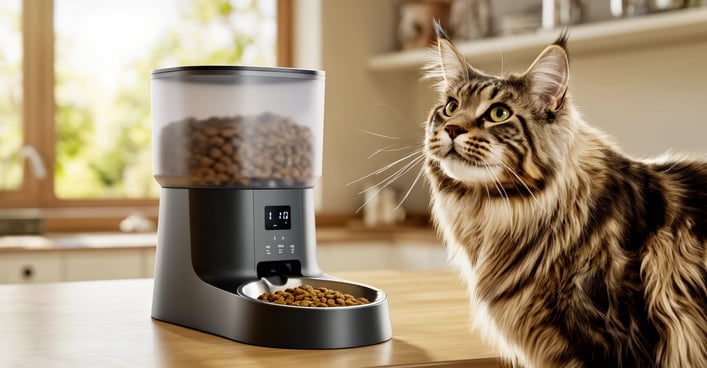
Best Automatic Cat Feeders: 2026 Reviews and Buying Guide
Find the perfect automatic cat feeder for your needs. Our 2026 guide reviews top models, explains types, and provides expert buying advice for portion control, scheduling, and multi-cat homes.
Share this page
Best Automatic Cat Feeders: 2026 Reviews and Buying Guide
Modern automatic cat feeders are sophisticated tools that provide consistency, control, and convenience. From basic timers to smart, app-connected devices, the right feeder can manage your cat's diet, maintain schedules while you're away, and solve multi-cat household challenges. This definitive guide will help you navigate the options and select the ideal model for your feline friend.
Why Use an Automatic Cat Feeder?
Key Benefits
Consistent Scheduling:
Deliver meals at precise times, even during a busy day or while traveling.
Maintain your cat's daily routine, reducing anxiety.
Eliminate early morning wake-up calls for food.
Precise Portion Control:
Measure exact portions to support weight loss or maintenance goals.
Best Automatic Cat Feeders: 2026 Reviews and Buying Guide - Articles
Ultimate Convenience:
Ensure your cat is fed when you're at work or running errands.
Enjoy uninterrupted sleep on weekends.
Gain peace of mind during vacations or short trips.
Multi-Cat Management:
Implement individual feeding programs for each cat.
Use RFID or microchip technology to prevent food stealing.
Monitor exactly which cat ate and how much.
Types of Automatic Cat Feeders
1. Gravity Feeders
How They Work:
Food replenishes the bowl via gravity as it empties.
Simple, entirely mechanical operation.
Requires no electricity or batteries.
Pros:
Very inexpensive ($15-$40).
No power source needed.
Large capacity for less frequent refills.
Extremely simple to set up and use.
Cons:
Offers no portion control.
Encourages free-feeding, which can lead to overeating.
Exposed food can become stale.
Not suitable for wet food.
Best For: Owners of cats who successfully free-feed dry food and do not require diet management.
2. Timer-Based Feeders
How They Work:
Pre-program meal times and portion sizes.
Powered by battery or a plug-in adapter.
Automatically dispenses a set amount of food at scheduled intervals.
Pros:
Affordable ($30-$80).
Provides basic portion control and scheduling.
Typically allows for multiple meals per day.
Reliable, straightforward mechanism.
Cons:
Programming options are often limited.
Prone to food jamming with certain kibble.
Lacks smartphone connectivity or advanced features.
Interface can be basic.
Best For: Budget-conscious owners who need reliable scheduled feeding without smart features.
3. Smart/WiFi Feeders
How They Work:
Connect to your home WiFi network.
Controlled and monitored via a smartphone app.
Often include cameras, voice recording, and detailed activity logs.
Pros:
Schedule or trigger feedings from anywhere.
Live video monitoring of your cat at meal times.
Highly precise portion control.
Tracks comprehensive feeding history.
Can grant access to family members or pet sitters.
Cons:
Most expensive option ($100-$300+).
Requires a stable WiFi connection.
May have a learning curve for setup.
Potential for technical glitches.
Best For: Tech-savvy owners who desire maximum control, monitoring, and connectivity.
4. RFID/Microchip Feeders
How They Work:
Identify individual cats via their implanted microchip or a provided collar tag.
The lid only opens for the authorized cat, keeping food secure.
Ideal for keeping wet food fresh or managing special diets.
Pros:
Effectively prevents food stealing in multi-cat homes.
Enables personalized diet management for each cat.
Sealed bowl keeps wet food fresher longer.
Monitors individual eating habits.
Cons:
High cost ($100-$200).
Only one cat can eat at a time per unit.
Requires cat to be microchipped or wear a collar tag.
Bowl capacity is often limited.
Best For: Multi-cat households with cats on different diets, or homes with food-aggressive or food-stealing cats.
5. Wet Food Feeders
How They Work:
Utilize refrigerated compartments or ice packs to keep food cool.
A timer rotates a lid or opens a compartment to reveal food at set times.
Designed specifically for automatic wet food dispensing.
Pros:
One of the few ways to automate wet food feeding.
Integrated cooling keeps food safe and palatable.
Allows for multiple pre-programmed meals.
Cons:
Limited meal capacity (typically 2-5 meals max).
Requires regular freezing/replacement of ice packs or constant power.
Higher maintenance for cleaning.
More expensive than basic dry food feeders ($80-$200).
Best For: Cats on wet-food-only or prescription diets, or for administering medication mixed with food.
Top Automatic Cat Feeder Reviews for 2026
Best Overall: Petlibro Automatic Feeder
Price: $69-$89
Key Features:
4L capacity (holds approximately 16 cups of dry food).
Program 1-4 meals per day.
Dispense 1-50 portions per meal (each portion ~5g).
10-second voice message recorder.
Dual power: AC adapter with 3x D-cell battery backup.
Infrared sensor helps prevent food jams.
Pros:
Exceptionally reliable dispensing mechanism.
Intuitive, easy-to-use programming.
Excellent portion control for the price.
Great value for money.
Cons:
No built-in camera.
App on WiFi model is functional but basic.
For dry food only.
Our Rating: 4.5 / 5
Best Smart Feeder: Feeder-Robot by Whisker
Price: $299
Key Features:
Full WiFi connectivity with app control.
Large 24-cup (approx. 6L) capacity.
Advanced anti-jam technology works with any kibble shape.
Includes an 8+ cup backup battery.
Detailed feeding logs and notifications.
Pros:
Unmatched reliability and consistency.
Excellent, user-friendly app interface.
Huge capacity reduces refill frequency.
Outstanding customer service and support.
Cons:
Premium price point.
Overkill for owners with simple needs.
Has a large physical footprint.
Our Rating: 4.7 / 5
Best Budget: Amazon Basics Automatic Feeder
Price: $35-$45
Key Features:
6L large capacity.
Programmable meal times and portion sizes.
Voice recording function.
Dual power (adapter or 3x D batteries).
Clear LCD display.
Pros:
Extremely affordable entry point.
Simple to set up and program.
Large hopper for extended use.
Generally reliable for the price.
Cons:
Offers only basic features.
No WiFi or smart connectivity.
Occasional reports of food jamming.
Build materials are less durable than premium models.
Our Rating: 4.0 / 5
Best for Multi-Cat: SureFeed Microchip Pet Feeder
Price: $149-$199
Key Features:
Opens only for your cat's microchip or RFID collar tag.
Sealed bowl keeps food fresh and odors contained.
Includes a training mode for hesitant cats.
Compatible with all common microchip frequencies.
Backed by a 3-year warranty.
Pros:
Perfectly solves food-stealing problems.
Excellent build quality and design.
Ideal for cats on prescription or special diets.
Effectively keeps wet food fresh for hours.
Cons:
Designed for one cat at a time.
Expensive for single-cat households.
Bowl capacity is on the smaller side.
Runs on batteries (4x C-cell).
Our Rating: 4.6 / 5
Best for Wet Food: Cat Mate C500
Price: $65-$85
Key Features:
5 separate meal compartments.
Includes two reusable ice packs.
Digital timer for precise scheduling.
All trays are dishwasher-safe.
Battery operated (requires 4x AA).
Pros:
Reliably dispenses wet or semi-moist food.
Ice packs keep food fresh for 24+ hours.
Easy to disassemble and clean.
Simple, dependable timer mechanism.
Cons:
Limited to a maximum of 5 meals before refill.
Requires planning to freeze ice packs.
No app connectivity or remote features.
Battery-powered only; no AC adapter option.
Our Rating: 4.3 / 5
Comprehensive Buying Guide
Capacity & Refill Frequency
How to Calculate Your Needs:
Determine your cat's total daily food amount (in cups or grams).
Multiply by the number of days you wish to go between refills.
Add a 20% buffer for safety.
Common Size Guide:
3L Capacity: Lasts ~4-6 days for an average cat.
6L Capacity: Lasts ~8-12 days.
10L+ Capacity: Can last 2 weeks or more.
Food Compatibility
Dry Food Considerations:
Kibble Size & Shape: Some feeders have size limits; irregular shapes (like squares) may jam more easily than rounds.
Moisture/Oil Content: Very oily foods can clump and cause dispensing issues.
Wet Food Considerations:
Requires a Specialized Feeder with cooling technology.
Programming is usually limited to the number of compartments (e.g., 2-5 meals).
Expect more frequent cleaning and maintenance.
Power Source
Plug-In (AC Adapter) Only:
Pros: Most reliable; no battery costs.
Cons: Feeder is useless during a power outage unless it has a backup battery.
Battery Only:
Pros: Portable; works during power outages.
Cons: Ongoing cost of battery replacement; risk of dying unnoticed.
Dual Power (Recommended):
Pros: Uses AC adapter as primary, with batteries as backup. Offers maximum reliability.
Cons: Slightly higher initial cost.
Programming & Features
Basic Programming (Timer-Based Feeders):
Set meal times (usually up to 4 per day).
Adjust portion size (often in "portions" or increments).
Simple button and LCD screen interface.
Advanced Programming (Smart Feeders):
Full control via smartphone app.
Schedule 6+ meals per day.
Customize portion sizes in grams or precise measurements.
Review feeding history logs.
Use integrated cameras for live monitoring.
Setup, Maintenance, and Safety
Initial Setup Checklist
1. Optimal Placement:
On a flat, stable, and vibration-free surface.
Away from walls to ensure food dispenses cleanly.
In a dry area, protected from direct sunlight and humidity.
Easily accessible for your cat but not in a high-traffic zone.
2. Programming & Testing:
Set the correct internal clock.
Program all meal times and test portion sizes into a bowl to verify accuracy.
Record a calming voice message if the feature is available.
3. The Transition Period (1 Week):
Run the automatic feeder alongside your cat's normal feeding routine.
Closely monitor to ensure your cat is eating from the new feeder.
Adjust portion sizes based on your cat's actual consumption.
Essential Maintenance Schedule
Frequency
Task
Daily
Check food level; ensure the bowl is clean; confirm scheduled meals dispensed.
Weekly
Empty and wash the food bowl with soap; wipe down the exterior; check for food debris in the dispensing chute.
Monthly
Perform a full deep clean: disassemble, wash all food-contact parts, inspect the mechanism, replace batteries in backup system.
Critical Safety Considerations
Food Safety:
Never exceed the recommended food storage time in the hopper (check manufacturer guidelines).
Regular cleaning is non-negotiable to prevent bacterial and mold growth.
Always discard old food before refilling the hopper with fresh kibble.
Cat & Household Safety:
Ensure the feeder has a stable, non-slip base that cannot be tipped over.
Check for any small, removable parts that could be a choking hazard.
Use a grounded outlet if plug-in, and keep cords out of reach.
Always have a backup plan (e.g., a neighbor on call, a spare gravity feeder) in case of a power failure or mechanical issue.
Conclusion & Final Recommendations
An automatic cat feeder is an investment in your cat's health and your peace of mind. The ideal model provides the right balance of features, reliability, and value for your specific situation.
Our Top Picks for 2026:
🏆 Best Overall Value:Petlibro Automatic Feeder – Reliable, feature-rich, and fairly priced.
⚡ Best Premium/Smart Feeder:Feeder-Robot by Whisker – The most advanced and reliable connected feeder on the market.
💰 Best Budget Choice:Amazon Basics Automatic Feeder – Proven functionality at a minimal cost.
🐱🐱 Best for Multi-Cat Homes:SureFeed Microchip Pet Feeder – The definitive solution for personalized feeding and preventing food theft.
🍖 Best for Wet Food:Cat Mate C500 – A simple, effective system for automating moist meals.
Pro Tips for Success:
Test Thoroughly Before Travel: Run the feeder for at least a week while you are home to ensure it works flawlessly.
Monitor Your Cat's Weight: Especially when starting, to ensure portion sizes are correct.
Prioritize Cleaning: A clean feeder is a reliable and safe feeder.
Keep the Manual: Save instructions for troubleshooting and deep-cleaning steps.
By carefully considering your needs and choosing from our recommended models, you can ensure your cat enjoys consistent, timely, and properly portioned meals, giving you both greater freedom and routine.
Get expert advice about cat care, behavior, nutrition, grooming, and training. Ask our AI cat care expert anything about your cat and receive professional guidance.