Bengal vs Savannah Cat: Which Exotic Breed Is Right for You? (2026 Guide)
Compare Bengal and Savannah cats: wild ancestry, personality, care needs, and legalities to find the perfect exotic feline companion for your lifestyle.
Share this page
Bengal vs Savannah Cat: Which Exotic Breed Is Right for You? (2026 Guide)
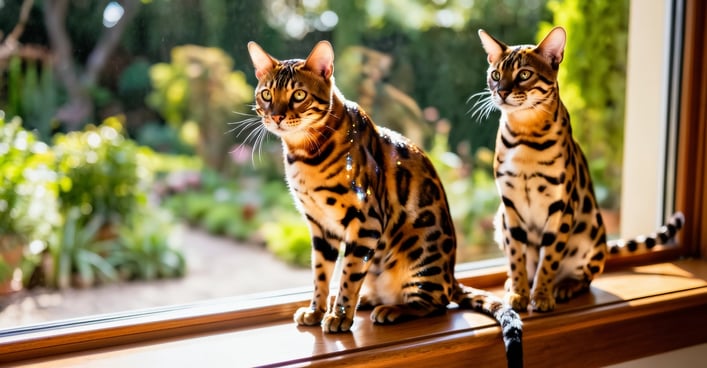
For cat enthusiasts seeking a touch of the wild, the Bengal and Savannah breeds represent the pinnacle of exotic domestic felines. Both captivate with their striking spotted coats, athletic builds, and boundless energy, bringing a slice of the jungle into your home. However, their origins, care demands, and suitability for the average household differ significantly. This comprehensive 2026 guide will help you determine which of these extraordinary cats aligns with your lifestyle.
Bengal vs Savannah Cat: Which Exotic Breed Is Right for You? (2026 Guide) - Articles
Feature
Bengal
Savannah
Wild Ancestry
Asian Leopard Cat (Prionailurus bengalensis)
Serval (Leptailurus serval)
Wild Percentage
F4+ generations (6.25% or less wild)
F1-F7 generations (3-50%+ wild)
Size
Medium (8-15 lbs)
Medium to Large (12-25+ lbs)
Height
Standard domestic cat height
Exceptionally tall and long-legged
Coat
Spotted or marbled, often with a glitter sheen
Bold spots, typically with a coarser texture
Ears
Small to medium, rounded
Very large, rounded, and high-set (serval-like)
Activity Level
Extremely high
Extremely high to intense
Trainability
Highly trainable, dog-like
Highly trainable and intelligent
Legal Restrictions
Minimal in most regions
Varies significantly by state and country
Average Price Range
$1,000 - $4,000+
$1,000 - $20,000+ (varies greatly by generation)
Historical Origins
Bengal: The Asian Leopard Cat Cross
Origin: United States
Founder: Jean Mill (née Sugden)
Development Era: Initial crosses in the 1960s; serious breed development in the 1970s-80s
Primary Goal: To create a domestic cat with the stunning appearance of a wild leopard cat.
Major Recognition: Accepted by The International Cat Association (TICA) in 1986 and by the Cat Fanciers' Association (CFA) in 2016.
Current Status: A popular, established breed worldwide, with modern Bengals many generations removed from their wild ancestors.
Savannah: The Serval Hybrid
Origin: United States
First Cross: Produced by Judee Frank in 1986.
Breed Development: Pioneered by breeders like Patrick Kelley.
Primary Goal: To develop a tall, exotic domestic cat that retains the striking physical features of the serval.
Major Recognition: Granted championship status by TICA in 2001.
Current Status: A breed of growing popularity, with earlier generations remaining closer to their wild roots.
Physical Characteristics
Size and Build
Bengal:
Weight: 8-15 pounds (males are typically larger)
Body: Long, muscular, and remarkably athletic.
Height: Standard for a domestic cat.
Overall Build: Balanced, agile, and graceful.
Savannah:
Weight: 12-25+ pounds (highly dependent on generation)
Body: Lean, tall, and elongated.
Height: Significantly taller than most domestic cats.
Overall Build: Long-legged, deep-chested, with a distinctly serval-like silhouette.
Distinctive Features
Bengal:
Coat Patterns: Beautiful rosettes or marbling.
Glitter: A unique, iridescent sheen on the coat hairs.
Belly: Spotted, a classic wildcat trait.
Whisker Pads: Prominent and puffy.
Savannah:
Ears: The most distinctive feature—very large, rounded, and set high on the head.
Neck: Long and slender.
Ocelli: Eye-like markings on the back of the ears.
Stature: They truly tower over other domestic cat breeds.
Understanding Generations (Filial)
Bengal Generations:
Modern pet Bengals are typically F4 (fourth filial generation) and beyond.
They are far removed from their wild ancestry, resulting in stable, predictable domestic temperaments.
Generally face no special legal restrictions.
Savannah Generations:
F1 (First Cross): 50% serval. Largest, most exotic, and most challenging.
F2: 25% serval. Still very large and demanding.
F3: 12.5% serval. More manageable but exceptionally active.
F4+: 6.25% serval or less. Most commonly recommended for typical pet homes.
Personality and Temperament
Energy and Activity
Bengal:
Possesses extremely high energy levels.
Retains a kitten-like playfulness well into old age.
Requires a minimum of 2-3 hours of dedicated play and interaction daily.
Can become mischievous or destructive if under-stimulated.
Savannah:
Exhibits even higher energy, particularly in F1-F3 generations.
Famous for incredible jumping ability (8+ feet vertically).
Requires extensive vertical space and constant mental challenges.
Their intensity can be overwhelming for an unprepared home.
Behavioral Traits
Bengal:
Affectionate: Deeply bonded and loving with their family.
Social: Often quite friendly with visitors.
Aquatic: Many have a fascination with water.
Vocal: Communicates with a wide range of chirps and meows.
Dog-like: Enjoys games of fetch and can be leash-trained.
Savannah:
Loyal: Forms deep, selective bonds with their owners.
Assertive: Confident and can be demanding.
Intelligent: Expert problem-solvers and escape artists.
Wild Streak: May retain more instinctive hunting and territorial behaviors.
Compatibility with Families and Pets
Bengal:
Best with older, respectful children.
Can coexist with other pets, including cat-friendly dogs, with proper introductions.
May play too roughly for very small animals like rodents or birds.
Savannah:
Recommended only for homes with older children.
A strong prey drive means they often cannot safely live with small pets.
Can live with dogs but may attempt to dominate them.
Early, extensive socialization is absolutely critical.
Care and Lifestyle Requirements
Ideal Living Environment
Bengal:
Needs ample space to run, climb, and explore.
Tall, sturdy cat trees are essential.
Secured outdoor enclosures (catios) are highly beneficial.
Savannah:
Requires LOTS of space—small apartments are generally unsuitable.
Needs very tall climbing structures, preferably reaching the ceiling.
A secure outdoor enclosure is strongly recommended for their well-being.
Exercise and Enrichment
Bengal:
Daily interactive play sessions with wand toys, lasers, etc.
Leash walking for supervised outdoor exploration.
Puzzle feeders and food-dispensing toys for mental stimulation.
Regular rotation of toys to prevent boredom.
Savannah:
Requires 3+ hours of varied activity daily.
Must have opportunities for high vertical jumps.
Advanced puzzle toys and agility-style training are excellent.
Multiple play sessions throughout the day are often necessary.
Dietary Considerations
Bengal:
Thrives on a high-protein diet (40%+).
High-quality commercial, raw, or homemade diets are suitable.
Their high metabolism may require more food than an average cat.
Savannah:
Has even higher protein requirements, especially in early generations.
Many owners feed raw diets or whole prey, following breeder guidance.
Always consult your breeder for generation-specific nutritional advice.
Legal and Financial Considerations
Legality
Bengal:
Legal to own in most places without restrictions.
Notable exceptions include Hawaii and some cities with exotic pet laws.
Some countries, like Australia, restrict early-generation imports.
Savannah:
Laws vary widely by city, state, and country.
F1-F3 generations are restricted or banned in many areas (e.g., New York State, Georgia).
F4+ generations are usually treated as domestic cats.
Some jurisdictions require special permits or enact complete bans.
Crucial Advice: Always verify local and state ordinances before pursuing ownership of either breed.
Cost Breakdown
Initial Purchase Price:
Bengal: $1,000 - $4,000+ for a pet-quality kitten from a reputable breeder.
Savannah: $1,000 - $4,000 for F4+; $5,000 - $20,000+ for F1-F3 generations.
Estimated Annual Costs:
Expense
Bengal
Savannah
High-Quality Food
$500 - $900
$600 - $1,000+
Routine Veterinary Care
$300 - $700
$400 - $1,000
Pet Insurance
$400 - $800
$500 - $1,000
Toys & Enrichment
$200 - $500
$300 - $600
Total (Approx.)
$1,400 - $2,900
$1,800 - $3,600+
Which Breed Is Right for You?
Choose a Bengal If You:
✅ Desire exotic beauty with a slightly more predictable domestic temperament.
✅ Can dedicate 2-3 hours daily to interactive play and engagement.
✅ Enjoy training cats to perform tricks, walk on a leash, or play fetch.
✅ Want a social, affectionate, and talkative companion.
✅ Have adequate indoor space but not necessarily a sprawling home.
✅ Prefer to avoid complex legal restrictions on pet ownership.
✅ Are captivated by their unique glittering coat.
Choose a Savannah If You:
✅ Seek the most exotic, dog-like feline companion possible.
✅ Have an expansive home with high ceilings and ample running space.
✅ Can provide a large, secure outdoor enclosure (catio).
✅ Are an experienced cat owner who understands feline behavior deeply.
✅ Have thoroughly verified that ownership is legal in your area.
✅ Can commit to 3+ hours of daily interaction and specialized care.
✅ Are prepared for the unique challenges of early-generation (F1-F3) cats.
Important Final Considerations
Not Recommended For:
First-time cat owners.
Busy households where the cat will be left alone for long periods.
Homes with very limited space or no vertical climbing options.
Individuals seeking a quiet, sedentary lap cat.
Households with small prey animals like birds, hamsters, or fish.
Both Breeds Require:
A significant and consistent time investment.
A solid financial commitment for purchase and lifelong care.
A meticulously cat-proofed home.
An owner who understands and appreciates high-energy, intelligent animals.
Infinite patience for their demanding and sometimes challenging behaviors.
Acceptance of their wild-inspired instincts.
Conclusion
Both the Bengal and Savannah offer a uniquely rewarding companionship for the right, prepared owner. The Bengal delivers breathtaking wild aesthetics with a generally more manageable intensity, making it a superb choice for many dedicated enthusiasts. The Savannah offers an unparalleled exotic presence and deep loyalty, accompanied by greater demands in space, activity, and owner experience.
For most households, a Bengal (F4 or later) provides the ideal balance of wild appearance and domestic adaptability. They are more widely legal, accessible, and suited to an active family life while losing none of their exotic charm.
The Savannah is the ultimate choice for the exceptionally experienced owner who has the resources, space, and dedication to meet the needs of a cat that walks the line between domestic and wild. If you choose a Savannah, opting for an F4 or later generation is strongly advised for a first-time owner of this breed.
Whichever path you choose, committing to either a Bengal or Savannah promises a life filled with adventure, intelligence, and breathtaking beauty. Ensure you are fully prepared for the lifelong responsibility before welcoming one of these extraordinary felines into your home.
Get expert advice about cat care, behavior, nutrition, grooming, and training. Ask our AI cat care expert anything about your cat and receive professional guidance.