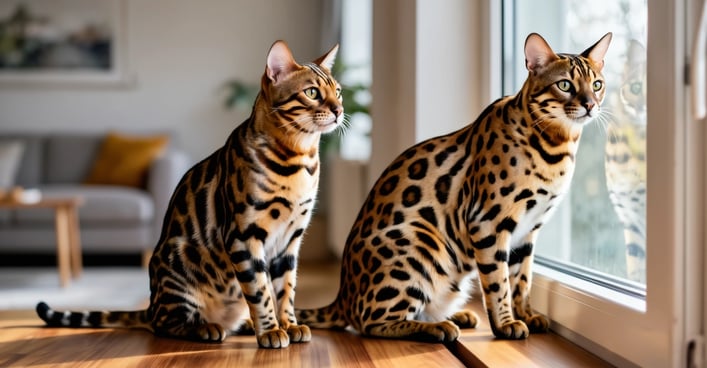
Bengal vs Savannah Cat: The Ultimate 2026 Comparison Guide
Discover the key differences between Bengal and Savannah cats. This guide compares their wild origins, high-energy personalities, care needs, and which exotic breed might be right for your home.
Share this page
Bengal vs Savannah Cat: The Ultimate 2026 Comparison Guide
By Thomas Anderson, Hybrid Cat Specialist | Updated: 2026 | Reading Time: 15 minutes
Introduction
Bengal and Savannah cats captivate owners with their exotic, wildcat appearances and dynamic personalities. Both breeds offer the allure of the wild with the companionship of a domestic pet, but they are distinctly different in size, energy, and ownership demands.
This definitive guide provides a detailed comparison to help you understand the unique characteristics, care requirements, and suitability of these remarkable hybrid breeds.
Development Story:
Jean Mill pioneered the breed by crossing an Asian Leopard Cat with domestic cats, aiming to create a cat with a wild appearance and a gentle temperament. Early generations (F1-F3) retain more wild traits, while modern Bengals are typically F4 or later (SBT - Stud Book Tradition).
Naming:
The breed name derives from the scientific name of the Asian Leopard Cat (Prionailurus bengalensis).
Savannah Origins
Serval Hybrid:
Origin: United States (1986)
Founder: Judee Frank
Foundation: Serval × Domestic Cat (Siamese)
Recognition: 2001 onward
Development Story:
The first Savannah was born in 1986 from a cross between a Serval and a Siamese cat. The breed quickly gained fame for its striking looks and interactive, dog-like personality. Early generations (F1, F2) are notably larger and exhibit more wild behaviors.
Naming:
The name honors the African Savannah, the natural habitat of the Serval.
Physical Characteristics Comparison
Size and Build
Feature
Bengal
Savannah
Which is Larger?
Male Weight
10-15 lbs
12-25 lbs (F1-F2 larger)
Savannah
Female Weight
8-12 lbs
9-17 lbs
Savannah
Height
Medium
Tall and Lanky
Savannah
Body Type
Athletic, Muscular
Lean, Long-Legged
Savannah is Taller
Bone Structure
Substantial
Long and Lean
Different Builds
Important Note: Savannah size is highly generation-dependent. F1-F2 Savannahs can reach 20-30 lbs, while later generations (F4+) are closer in size to Bengals.
Coat Characteristics
Bengal Coat:
Pattern: Spotted or marbled (rosettes are highly prized)
Texture: Exceptionally soft, pelt-like feel
Glitter: Unique gold-tipped hairs create a sparkling effect
Colors: Brown, snow (lynx, mink, sepia), silver
Shedding: Minimal
Grooming: Weekly brushing
Savannah Coat:
Pattern: Bold, solid spots
Texture: Varies from coarse (early gens) to soft (later gens)
Colors: Brown, silver, black, smoke
Shedding: Minimal to moderate
Grooming: Weekly brushing
Head and Facial Features
Bengal:
Modified wedge-shaped head
Small, rounded ears
Large, oval to round eyes
Prominent whisker pads
Thick tail with a black tip
Distinct "wild" expression
Savannah:
Extremely large, tall ears
Long, elegant neck
Hooded eyes
Deep nose leather
Long legs with a taller-than-long body proportion
Distinctive Features
Bengal Unique Traits:
Glitter gene (a breed hallmark)
Rosetted spots resembling a leopard
White belly and undersides
Muscular, athletic physique
Often fascinated by water
Savannah Unique Traits:
Largest ears of any domestic cat breed
Tallest domestic cat (long legs)
Unique "snap" hiss
Remarkable vertical leap (8+ feet)
Dog-like loyalty and following behavior
Temperament Comparison
Personality Traits
Trait
Bengal
Savannah
Activity Level
Very High
Extremely High
Intelligence
Very High
Extremely High
Vocalization
Moderate, varied sounds
Vocal, with unique chirps and trills
Affection
Affectionate on their terms
Loyal, often described as "dog-like"
Independence
Moderate
Moderate to Low (very social)
Trainability
Highly Trainable
Exceptionally Trainable
Energy Levels
Bengal:
Possess very high energy.
Natural athletes and climbers who love vertical space.
Many exhibit a fascination with water.
Remain playful and active throughout their lives.
Savannah:
Exhibit extremely high energy, often surpassing Bengals.
Acrobatic leapers with seemingly endless stamina.
Require extensive, daily physical and mental exercise.
Behavioral Characteristics
Bengal:
Love high perches and climbing.
Often enjoy playing with water.
Can learn to fetch and solve puzzle toys.
May "converse" with their owners.
Can be demanding for attention and play.
Savannah:
Tend to follow their owners from room to room.
Readily learn tricks, walk on a leash, and play fetch.
Often social and may greet visitors.
Display affectionate head-butting ("head pokes").
Care Requirements Comparison
Exercise & Stimulation Needs
Bengal:
Require 2-3 active play sessions daily (20-30 mins each).
Vertical space (cat trees, shelves) is essential.
Benefit from puzzle toys and interactive games.
Leash training is possible for safe outdoor exploration.
Savannah:
Need 3-4 active play sessions daily of longer duration.
Vertical space is critical; multi-level cat furniture is a must.
Require challenging toys to prevent boredom.
Leash training and secure outdoor enclosures are highly recommended.
Activity Level Summary:
Requirement
Bengal
Savannah
Minimum Daily Play
45-60 minutes
60-90 minutes
Vertical Space
Essential
Critical
Puzzle/Interactive Toys
Recommended
Essential
Outdoor Enclosure
Beneficial
Highly Recommended
Companion Animal
Helpful
Often Necessary
Space Requirements
Bengal:
Need an active indoor environment with room to run.
Are not ideal for very small apartments without significant enrichment.
Thrive with cat trees, window perches, and climbing routes.
Savannah:
Require substantial indoor space.
Can become destructive if confined without adequate stimulation.
Outdoor enclosures (catios) are highly beneficial for their wellbeing.
Mental Stimulation
Both Breeds:
Are extremely intelligent and require constant mental engagement.
Need puzzle feeders, training sessions, and frequent toy rotation.
Without proper stimulation, they may develop destructive behaviors.
Health Comparison
Bengal Health Concerns
Common Issues:
Hypertrophic Cardiomyopathy (HCM): A form of heart disease.
Progressive Retinal Atrophy (PRA): An inherited eye disorder (DNA test available).
Pyruvate Kinase Deficiency (PKD): A genetic anemia (rare).
Patellar Luxation: Slipping kneecap.
Average Lifespan: 12-16 years
Savannah Health Concerns
Common Issues:
Hypertrophic Cardiomyopathy (HCM): Heart disease.
Progressive Retinal Atrophy (PRA): Eye disease.
Urinary Issues: Such as crystals.
Digestive Sensitivity: In some bloodlines.
Average Lifespan: 12-20 years (may be shorter for F1-F2 generations)
Recommended Health Testing
For Both Breeds:
Annual HCM screening via echocardiogram.
PRA DNA testing.
Regular veterinary check-ups and patella evaluations.
Cost Comparison
Initial Acquisition Cost
Generation
Bengal
Savannah
Pet Quality (SBT/F4+)
$1,500 - $4,000
$1,000 - $3,000
Show Quality
$3,000 - $8,000
$2,500 - $6,000
F1-F3 Savannah
N/A
$4,000 - $20,000+
Note: Early-generation Savannahs (F1-F3) are significantly more expensive and come with specialized care requirements.
Estimated Annual Care Costs
Expense
Bengal
Savannah
High-Quality Food
$600 - $900
$700 - $1,000
Veterinary Care
$400 - $700
$400 - $800
Toys & Enrichment
$200 - $400
$300 - $500
Equipment (Trees, etc.)
$150 - $300
$200 - $400
Total Annual
$1,350 - $2,300
$1,600 - $2,700
Living Environment Suitability
Ideal Home for a Bengal
Best For:
Active individuals or families.
Owners who work from home or are present frequently.
Homes with ample vertical space and climbing opportunities.
Those committed to daily interactive play and puzzle toys.
Experienced cat owners.
Challenging For:
Sedentary lifestyles or long work hours away from home.
Very small apartments without enrichment.
First-time cat owners (due to their high energy and demands).
Ideal Home for a Savannah
Best For:
Extremely active, dedicated owners seeking a "dog-like" cat.
Homes with significant indoor space and a secure outdoor enclosure.
Multi-pet households (often do well with canine companions).
Owners with time for extensive daily interaction, training, and play.
Challenging For:
Small living spaces or apartments.
Owners who are away from home for long periods.
Those seeking a quiet, low-maintenance pet.
Inexperienced pet owners.
Legal & Ownership Considerations
Savannah Ownership Laws
Crucial Information:
Laws vary by state, city, and country. Always check current local regulations.
Early generations (F1-F4) are often restricted or banned.
F5 and later generations are typically treated as domestic cats.
Some areas require special permits or have homeowners insurance implications.
Bengal Restrictions
Generally face fewer restrictions than Savannahs.
SBT Bengals (F4+) are widely accepted as domestic cats.
Always verify local ordinances, as some areas may have specific rules.
Which Breed Is Right For You?
Choose a Bengal If You:
Desire an athletic, playful cat with a wild leopard-like appearance.
Can dedicate significant time to interactive play daily.
Have vertical space for climbing and exploring.
Appreciate intelligence and trainability.
Are prepared for a high-energy, vocal companion.
Choose a Savannah If You:
Want the ultimate "dog-like" feline companion.
Have a large home, ideally with a secure outdoor area.
Can provide extensive daily interaction, exercise, and mental stimulation.
Are fascinated by their tall, striking appearance and unique behaviors.
Are prepared to navigate potential legal restrictions and higher care demands.
Conclusion
Bengal and Savannah cats offer an unparalleled blend of exotic beauty and engaging intelligence. The Bengal delivers a wild aesthetic with slightly more manageable domestic adaptability, while the Savannah provides remarkable loyalty and athleticism in a feline package.
Neither breed is suitable for the casual owner. They demand substantial time, space, and commitment. In return, they offer 12-20 years of dynamic, interactive companionship that is both challenging and deeply rewarding.
For most households, the Bengal presents a more accessible entry into hybrid cat ownership. The Savannah is best reserved for dedicated enthusiasts ready to meet its exceptional needs. Whichever you choose, ensure you are fully prepared for a lifelong adventure with a truly extraordinary pet.
Get expert advice about cat care, behavior, nutrition, grooming, and training. Ask our AI cat care expert anything about your cat and receive professional guidance.