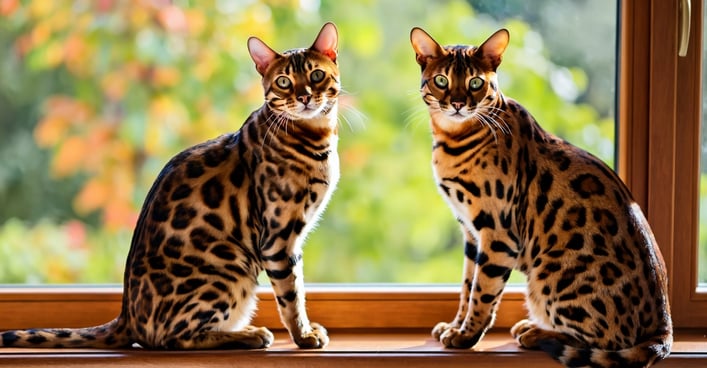
Bengal vs. Savannah Cat: The 2026 Breed Comparison Guide
Discover the key differences between Bengal and Savannah cats, from their wild ancestry and legal status to their unique personalities and care needs, to find your perfect exotic feline companion.
Share this page
Bengal vs. Savannah Cat: The 2026 Breed Comparison Guide
Both the Bengal and Savannah cat captivate with their exotic, wild appearances and dynamic personalities. These breeds appeal to owners seeking an extraordinary companion—one that is athletic, intelligent, and visually stunning. However, their distinct wild heritage creates unique considerations for prospective owners. This comprehensive guide compares every aspect to help you determine which of these remarkable breeds aligns with your lifestyle.
Origins and Wild Ancestry
Bengal Origins
Foundation: Asian Leopard Cat (Prionailurus bengalensis)
Developed by Jean Mill (formerly Sugden) from the 1960s to the 1980s, the Bengal breed was created by crossing domestic cats with the small Asian Leopard Cat. The goal was to produce a domestic cat with the striking appearance of a wild leopard but a dependable, tame temperament.
Bengal vs. Savannah Cat: The 2026 Breed Comparison Guide - Articles
Development Timeline:
1963: First documented cross between a Leopard Cat and a domestic cat.
1980s: Jean Mill established a formal breeding program.
1986: The breed gained championship status with The International Cat Association (TICA).
Modern Bengals: Typically F4-F6 generations from wild ancestry, considered fully domesticated.
Legal Status: Fully legal in all 50 U.S. states for domesticated generations.
Savannah Origins
Foundation: Serval (Leptailurus serval)
The Savannah breed began in 1986 when breeder Judee Frank crossed a male Serval with a Siamese domestic cat. This produced the first-generation (F1) Savannah, a cat larger and more exotic than any traditional domestic breed.
Generation Classifications:
F1: 50% Serval (Serval father, domestic mother).
F2: 25-37% Serval (F1 mother, domestic father).
F3: 12.5-20% Serval.
F4+: Considered domestic Savannahs.
Legal Restrictions:
F1-F3 generations are banned or heavily restricted in many states and municipalities.
Some regions ban all generations.
Crucial: Always verify local and state laws before considering ownership.
Physical Characteristics
Size Comparison
Generation/Feature
Bengal
Savannah
Male Weight
10-18 lbs
12-25 lbs (F1-F2 significantly larger)
Female Weight
6-12 lbs
9-17 lbs
Height
Medium
Tall (F1-F2 are exceptionally tall)
Body Length
Medium
Long (especially in early generations)
Savannah Size by Generation:
F1: 17-25 lbs, very tall and leggy.
F2: 15-22 lbs.
F3: 13-19 lbs.
F4+: 10-17 lbs (size more comparable to a large Bengal).
Body Structure
Bengal:
Athletic, muscular, and powerful build.
Long, substantial body.
Hind legs are slightly longer than the front.
Medium-length tail with a characteristic black tip.
Rounded head with relatively small ears.
Possesses a wild, alert expression.
Savannah:
Tall, lean, and elegantly built.
Notably long neck and legs.
Large, prominent upright ears (a direct Serval trait).
Long body.
Hooded eyes often with distinctive "tear mark" lines.
Triangular head shape.
Coat Characteristics
Bengal Coat:
Patterns: Spotted or marbled.
Spotted: Rosettes resembling those of a leopard.
Marbled: Swirled, flowing patterns.
Colors:
Brown spotted (most common).
Snow (seal lynx, seal mink, seal sepia).
Silver.
Blue (a dilute color).
Melanistic (black on black).
Texture: Unique pelt-like feel, soft, with a possible glitter sheen.
Savannah Coat:
Pattern: Spotted only.
Colors:
Brown spotted tabby (most common).
Silver spotted.
Black (melanistic).
Snow (rare).
Texture: Can be coarser, especially in early generations.
Markings: Bold, dark spots, sometimes accompanied by Serval-like stripes on the legs.
Temperament and Personality
Shared Traits
Both breeds inherit remarkable traits from their wild ancestors:
High Energy: Extremely active and athletic. They require extensive daily exercise and retain playful "kitten energy" well into adulthood.
High Intelligence: Exceptionally trainable with strong problem-solving skills. They enjoy puzzle toys and can learn to open doors and cabinets.
Water Attraction: Unlike most cats, they are often fascinated by water—playing in faucets, joining owners in the shower, or even swimming.
Vocalization: More vocal than the average cat, using unique chirps, trills, and meows to communicate.
Bengal Personality
Key Traits:
Dog-like Loyalty: Often forms a strong bond and follows owners from room to room.
Playful & Mischievous: Curious and into everything, providing constant entertainment.
Affectionate: Tends to bond closely with the entire family.
Confident & Curious: Not easily intimidated and investigates every novelty.
Behavior Characteristics:
Excellent jumpers who love vertical space and climbing.
Often enjoy games of fetch.
Can be trained to perform tricks easily.
Generally good with respectful children and other pets.
Can become affectionate lap cats when sufficiently exercised.
Savannah Personality
Key Traits:
Extremely Loyal: Forms deep, sometimes exclusive bonds, often with one primary person.
Adventurous & Bold: Exhibits higher wanderlust and fearlessness than most breeds.
Highly Active: Requires even more vigorous exercise than the Bengal.
Intelligent but Stubborn: Highly trainable, but often on their own terms.
Behavior Characteristics:
Capable of the highest vertical jump of any domestic cat (up to 8 feet).
Strong desire to be up high; needs very tall cat trees.
Can be trained to walk on a harness and leash.
May be more selective or reserved with strangers and other pets.
Temperament Comparison
Trait
Bengal
Savannah
Energy Level
Very High
Extremely High
Affection Level
High
High (can be selective)
Trainability
Very High
High
Independence
Moderate
Moderate to High
Vocalization
Moderate
High (can be loud)
Dog Friendly
Generally Good
Variable
Child Friendly
Very Good
Good (supervision recommended)
Stranger Friendly
Typically Friendly
Reserved to Friendly
Exercise and Enrichment Needs
Bengal Requirements
Daily Needs:
Minimum of 2-3 hours of active, interactive play.
High climbing structures (6+ feet).
Interactive toys like wand teasers and laser pointers.
Puzzle feeders and treat-dispensing toys.
Secure outdoor enclosure (a "catio") is highly beneficial.
Without Adequate Exercise: May exhibit destructive behavior, excessive vocalization, attention-seeking mischief, or signs of depression.
Savannah Requirements
Daily Needs:
3+ hours of dedicated active play and engagement.
Very tall cat trees (reaching toward the ceiling is ideal).
Outdoor walks on a secure harness and leash.
Challenging puzzle toys and training sessions.
High perches throughout the home.
A large, secure catio or supervised outdoor access is almost essential.
Special Considerations:
Early generations (F1-F3) have even higher space and stimulation requirements.
Possess a strong escape drive; homes must be meticulously secured.
Often benefit from having another high-energy cat as a companion.
Grooming Requirements
Both breeds have relatively low-maintenance, short coats.
Bengal Grooming
Coat Care: Weekly brushing is sufficient.
Shedding: Low to moderate.
Bathing: Occasional baths are tolerated well, and some individuals enjoy water.
Special Note: The "glitter" gene in some Bengals gives the coat a sparkling, iridescent sheen.
Savannah Grooming
Coat Care: Weekly brushing.
Shedding: Low.
Bathing: Rarely needed.
Both Breeds Also Require: Regular nail trimming, ear cleaning, and dental care.
Health Considerations
Bengal Health Issues
Hypertrophic Cardiomyopathy (HCM): A common heart condition; regular screening by a veterinarian is recommended.
Progressive Retinal Atrophy (PRA): A genetic eye disorder that can lead to blindness. DNA testing is available.
Pyruvate Kinase Deficiency (PKDef): A genetic anemia-causing disorder; DNA testing is available.
Patellar Luxation: Dislocation of the kneecap.
Average Lifespan: 12-16 years.
Savannah Health Issues
Hypertrophic Cardiomyopathy (HCM): Also a concern; regular cardiac screening is advised.
Liver Concerns: Some early-generation Savannahs may have sensitive livers; monitoring is important.
Reproductive Challenges: Early generations (F1-F3) often have fertility issues, contributing to their high cost.
Average Lifespan: 12-20 years (can vary significantly by generation).
Health Comparison
Factor
Bengal
Savannah
Major Health Concerns
HCM, PRA, PKDef
HCM, potential liver issues
Available Genetic Testing
Yes, for multiple conditions
More limited
Typical Lifespan
12-16 years
12-20 years
Routine Vet Costs
Standard for purebred cats
Standard for purebred cats
Legal Considerations
Bengal Legal Status
United States: Fully legal in all 50 states for domesticated generations (F4+).
International: Generally legal in most countries, though some may restrict early-generation imports.
Typically covered by standard homeowner's insurance policies.
Savannah Legal Status
This is a critical factor. Laws vary dramatically by state, county, and city, often based on the cat's generation.
Examples of Restrictions (Always verify current 2026 laws):
Some states (e.g., Georgia, Hawaii) ban all generations.
Others (e.g., Alaska, Massachusetts) restrict ownership of F1-F4 generations.
Cities like New York City may only allow F5+ generations.
Essential Checks Before Acquiring a Savannah:
State and local ordinances.
Homeowner's Association (HOA) rules.
Rental agreement clauses.
Homeowner's insurance policy coverage.
Consequences of Illegal Ownership: Can include substantial fines, confiscation of the cat, and in severe cases, euthanasia.
Catio construction or modification: $500 - $3,000+
Harness, leash, and training gear: $50 - $150
Investment in puzzle toys and secure window perches.
Living Environment Requirements
Ideal Bengal Environment
Minimum: Ample space for running and climbing, with tall cat trees and secure windows. They are escape artists.
Ideal: A home with consistent human interaction, another playful pet companion, and access to a secure outdoor enclosure (catio).
Ideal Savannah Environment
Minimum: More space than an average home, with extensive vertical territory (very tall cat trees), and an extremely secure, escape-proof home.
Ideal: A large home with high ceilings, an active and experienced owner, safe outdoor access (via catio or leash walks), and potentially another high-energy pet.
Apartment Living Suitability
Bengal: Possible with a dedicated commitment to daily, vigorous exercise and environmental enrichment.
Savannah: Only later generations (F4+) may adapt to apartment life, and only if their exceptional exercise needs are fully met.
Which Breed Is Right for You?
Choose a Bengal If You:
Desire an exotic appearance with a more predictable, established domestic temperament.
Enjoy a highly interactive, playful, and dog-like companion.
Can dedicate 2-3 hours daily to active play and engagement.
Are concerned about legal restrictions or insurance coverage.
Have a moderate budget for initial purchase and care.
Choose a Savannah If You:
Seek the most exotic-looking domestic cat possible and are captivated by Serval heritage.
Have proven experience with demanding, high-energy pets.
Can provide 3+ hours of daily activity and mental stimulation.
Have ample space for very tall climbing structures and have confirmed the breed is legal in your area.
Have a significant budget for both the high purchase price and ongoing premium care.
Consider Neither Breed If You:
Prefer a calm, low-energy lap cat.
Are away from home for long hours regularly.
Are a first-time cat owner.
Cannot commit to extensive daily playtime and environmental enrichment.
Have valuable, fragile home furnishings you are unwilling to risk.
Conclusion
The Bengal and Savannah cats offer an unparalleled blend of wild beauty and domestic companionship. The Bengal stands as a more accessible entry into exotic cat ownership, with fewer legal hurdles and a slightly more predictable personality, while still demanding significant engagement.
The Savannah represents the pinnacle of exotic feline ownership, offering unmatched appearance and a unique presence. This comes with greater challenges: stricter legal barriers, higher costs, and even more demanding care requirements.
Both breeds are lifelong commitments—spanning 12-20 years—that require dedicated time, financial investment, and a tailored living environment. They are not pets for the casual owner but can be immensely rewarding for the right person or family. Thoroughly and honestly assess your lifestyle, resources, and commitment before welcoming either of these extraordinary animals into your home.
Related Articles for 2026:
State-by-State Guide to Exotic Cat Breed Laws
How to Build the Perfect Catio for High-Energy Breeds
Essential Enrichment Toys for Intelligent Cats
A Complete Guide to Pet Insurance for Unique Cat Breeds
Get expert advice about cat care, behavior, nutrition, grooming, and training. Ask our AI cat care expert anything about your cat and receive professional guidance.