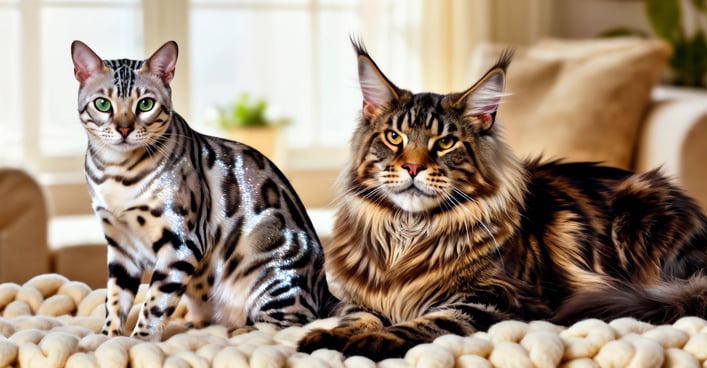
Bengal vs Maine Coon: The Ultimate 2026 Breed Comparison Guide
Deciding between a Bengal and a Maine Coon? Our complete guide compares their wild looks, gentle giant personalities, care needs, and costs to help you choose your perfect feline companion.
Share this page
Bengal vs Maine Coon: The Ultimate 2026 Breed Comparison Guide
Bengal and Maine Coon cats are two of the most visually stunning and sought-after breeds, offering dramatically different yet equally rewarding companionship. While both are larger-than-average felines with captivating presence, their origins, personalities, and care requirements are worlds apart. This definitive guide provides a detailed, side-by-side comparison to help you make an informed decision.
Historical Origins
Bengal Cat History
Hybrid Origins (1960s–1980s)
The Bengal is a meticulously engineered hybrid breed, developed by crossing domestic cats with the wild Asian Leopard Cat (Prionailurus bengalensis).
Development Timeline:
1963: Jean Mill pioneers the first cross between an Asian Leopard Cat and a domestic cat.
1970s: Dr. Willard Centerwall breeds hybrids for genetic research on feline leukemia.
Jean Mill acquires Centerwall's hybrids and advances the breeding program.
1983: The International Cat Association (TICA) accepts Bengals for registration.
1991: Bengals achieve TICA championship status.
Modern Era: Today's Stud Book Tradition (SBT) Bengals are at least four generations removed from their wild ancestors and are considered fully domesticated.
Name Origin:
Derived from the scientific name of the Asian Leopard Cat.
Modern Bengals:
SBT Bengals contain no wild blood.
They retain a wild, exotic appearance but possess a domestic temperament.
Ownership of early-generation hybrids (F1–F3) is restricted or illegal in many regions.
Maine Coon History
A Natural American Breed
The Maine Coon evolved naturally in the harsh climate of the northeastern United States, earning the title of official state cat of Maine.
Historical Timeline:
1800s: Hardy farm cats in Maine develop distinctive traits.
1861: First documented mention in a cat show catalog.
1895: A Maine Coon wins Best in Show at Madison Square Garden.
Early 1900s: Popularity wanes with the arrival of exotic Persian and Siamese breeds.
1950s–60s: Dedicated breeders lead a successful revival.
1976: The Cat Fanciers' Association (CFA) grants championship status.
Modern Era: Consistently ranks among the world's most popular cat breeds.
Origin Theories:
Natural Selection: Adaptation to the cold New England winters.
Viking Theory: Descended from Norwegian Forest Cats brought by seafarers.
Royal Legend: Linked to cats sent ahead by Marie Antoinette (unsubstantiated).
Raccoon Myth: A biologically impossible but folkloric explanation for the name.
State Recognition:
Official state cat of Maine, symbolizing resilience and gentle strength.
Physical Characteristics
Size and Build Comparison
Feature
Bengal
Maine Coon
Weight (Females)
8–12 lbs
8–12 lbs
Weight (Males)
10–15 lbs
13–18 lbs
Exceptional Males
Can reach 20+ lbs
Can reach 20–25+ lbs
Body Length
14–18 inches
19–32 inches (including tail)
Height
Medium
Tall (10–16 inches at shoulder)
Body Type
Athletic, muscular, sleek
Large, rectangular, substantial
Bone Structure
Medium, solid
Heavy, robust
Key Notes:
The Maine Coon is the largest domesticated cat breed by length.
The Bengal is a medium-to-large, powerfully muscular athlete.
Males of both breeds are significantly larger than females.
Coat Characteristics
Bengal Coat:
Length: Short to medium.
Texture: Incredibly soft, silky, and dense—often described as a "pelt."
Unique Trait: Many have a "glitter" effect, where hairs are gold-tipped.
Pattern: Spotted or marbled.
Shedding: Minimal; often marketed as hypoallergenic.
Maintenance: Very low.
Maine Coon Coat:
Length: Semi-longhair, shaggy.
Texture: Heavy, water-resistant, with a silky texture. Features a coarse topcoat over a soft undercoat.
Pattern: All colors and patterns are accepted.
Shedding: Moderate to heavy, with intense seasonal sheds.
Maintenance: Moderate; regular grooming is essential.
Defining Features
Bengal – The Wild Look:
Distinctive leopard-like spots or swirling marble patterns.
Glittering coat sheen.
Powerful, muscular neck and hind legs slightly longer than the front.
Alert, intense, and curious facial expression.
Prominent "wicked" whisker pads.
Maine Coon – The Gentle Giant:
Large, tufted ears with distinctive lynx tips.
Long, flowing, bushy tail.
Rectangular body shape with a broad chest.
Square muzzle and large, expressive eyes.
Tufted paws that act as natural snowshoes.
Colors and Patterns
Bengal:
Patterns: Spotted/Rosetted or Marbled.
Colors: Brown (most common), Snow (lynx, mink, sepia), Silver, Charcoal, Blue (rare), Melanistic.
Maine Coon:
Patterns: All are accepted, including solid, tabby, tortoiseshell, and calico.
Colors: All colors. Brown tabby is classic, but black, blue, red, cream, and white are also popular.
Head and Facial Features
Feature
Bengal
Maine Coon
Head Shape
Broad, modified wedge
Large, square-ish
Profile
Slight curve from forehead to nose
Gentle concave curve with high forehead
Ears
Small to medium, rounded tips
Large, wide-set, heavily tufted
Eyes
Large, oval, slightly almond-shaped
Large, expressive, wide-set
Expression
Alert, curious, wild
Sweet, open, gentle
Temperament and Personality
Bengal Personality
Core Traits:
Exceptionally intelligent, curious, and confident.
Highly active and energetic—retains kitten-like playfulness for life.
Affectionate and bonded to family but typically not a "lap cat."
Very vocal and communicative with a wide range of chirps and meows.
Typical Behaviors:
Master climbers and jumpers; require vertical space.
Famous for loving water—may join you in the shower or play in sinks.
Often learn to fetch, open doors, and turn lights on/off.
Demand interactive play and constant mental stimulation.
Ideal Home: Active households with experienced cat owners who can provide ample engagement and environmental enrichment.
Maine Coon Personality
Core Traits:
The quintessential "gentle giant"—calm, easygoing, and patient.
Highly intelligent and trainable, often showing dog-like devotion.
Quietly confident and good-natured.
Slow to mature, reaching full adulthood around 3–4 years.
Typical Behaviors:
Often follows owners from room to room.
Enjoys interactive play like fetch.
Typically gentle and tolerant with children, dogs, and other pets.
Known for soft chirps and trills rather than loud meows.
Ideal Home: Excellent for families, first-time owners, and multi-pet households. Adapts well to various living situations.
Temperament Comparison
Trait
Bengal
Maine Coon
Activity Level
Very High
Moderate
Playfulness
Very High
Moderate-High
Affection Level
Moderate (not always cuddly)
High (often dog-like)
Independence
Low (demands interaction)
Moderate
Intelligence
Very High
High
Vocalization
Moderate to High
Low (chirps/trills)
Child Friendly
Moderate (best with older kids)
Excellent
Pet Friendly
Selective (can be bossy)
Excellent
Water Interest
Loves it!
Often likes it
Health and Lifespan
Bengal Health Profile
Common Concerns:
Hypertrophic Cardiomyopathy (HCM): Prevalent; regular cardiac screening is crucial.
Patellar Luxation: Kneecap dislocation.
Progressive Retinal Atrophy (PRA): Genetic eye disease; DNA testing available.
Pyruvate Kinase Deficiency (PK Def): Causes anemia; DNA testing available.
Average Lifespan: 12–16 years.
Maine Coon Health Profile
Common Concerns:
Hypertrophic Cardiomyopathy (HCM): A significant concern; a specific genetic mutation exists, making DNA and regular echocardiogram screening vital.
Hip Dysplasia: More common in this large breed; can lead to arthritis.
Spinal Muscular Atrophy (SMA): Genetic disorder affecting mobility; DNA test available.
Polycystic Kidney Disease (PKD): Less common than in some breeds; DNA test available.
Average Lifespan: 12–15 years.
Health Comparison
Factor
Bengal
Maine Coon
Overall Robustness
High
High
Genetic Issue Prevalence
Moderate
Moderate
Average Lifespan
12–16 years
12–15 years
Key Screening Need
Heart (HCM) & Eyes
Heart (HCM) & Hips
Grooming and Care
Bengal Grooming
Effort: Very low maintenance.
Brushing: A weekly once-over is usually sufficient to remove loose hair.
Shedding: Minimal.
Bonus: Many enjoy baths, making occasional grooming easy.
Maine Coon Grooming
Effort: Moderate to high maintenance.
Brushing: Requires brushing 2–3 times per week to prevent mats and tangles, especially in the "britches" (hind legs) and tail.
Shedding: Moderate to heavy, with seasonal peaks.
Special Note: A large, high-sided litter box helps keep their long fur clean.
Grooming Comparison
Aspect
Bengal
Maine Coon
Weekly Time
~10 minutes
20–40 minutes
Shedding Level
Minimal
Moderate-Heavy
Matting Risk
Very Low
Moderate-High
Bathing
Often enjoys it
As needed, typically tolerates well
Living Environment & Costs
Ideal Home Setup
Bengal:
Must Have: Extensive vertical space (cat trees, wall shelves), interactive toys, and a secure catio or leash-training for safe outdoor exploration.
Best For: Active, experienced owners who are home often. Not ideal for small apartments without enrichment or for those seeking a quiet, low-energy pet.
Maine Coon:
Must Have: Sturdy furniture, large litter boxes, and space for a big cat to stretch out.
Best For: Almost any household—families, singles, first-time owners, and multi-pet homes. Adapts to apartments if given enough playtime.
Cost Comparison (2026 Estimates)
Initial Acquisition:
Source
Bengal
Maine Coon
Pet Quality
$1,500–$3,000
$1,000–$2,500
Show Quality
$3,000–$6,000+
$2,000–$5,000
Rescue/Adoption
Very Rare
$150–$400
Estimated Annual Costs:
Expense
Bengal
Maine Coon
High-Quality Food
$500–$900
$600–$1,000 (eats more)
Litter & Supplies
$250–$400
$300–$450
Routine Veterinary
$300–$600
$300–$600
Grooming
$50–$100
$150–$300 (or DIY time)
Pet Insurance
$400–$700
$400–$700
Toys/Enrichment
$200–$400
$150–$300
Total Annual
~$1,700–$3,100
~$1,900–$3,350
Training and Intelligence
Both breeds are highly intelligent but express it differently.
Bengal: Genius-level problem solvers. They learn tricks (fetch, high-five) quickly but can also learn to open cabinets. They require constant mental challenges to prevent boredom-driven mischief.
Maine Coon: Eager and willing pupils. They respond excellently to positive reinforcement and clicker training, learning tricks and even leash-walking for their desire to please and engage with their owner.
Making Your Decision
Choose a Bengal If You Want:
A living piece of wild art with a high-energy, interactive personality.
An intelligent companion that will keep you on your toes.
To invest significant time in daily play and environmental enrichment.
A cat that is more of an adventurous partner than a couch cuddler.
Choose a Maine Coon If You Want:
A majestic, large-bodied cat with a heart to match its size.
A gentle, adaptable, and patient family member.
A dog-like companion that follows you and is great with kids and pets.
A moderately active cat that enjoys play but also values cozy downtime.
Similar Breeds to Consider
If You Like the Bengal:
Savannah: Even more exotic and energetic (higher generations are regulated).
Egyptian Mau: Naturally spotted, agile, and domestic.
Ocicat: Domestic breed with a spotted coat and active demeanor.
If You Like the Maine Coon:
Norwegian Forest Cat: Similar size and coat, but with a more independent "Viking" spirit.
Ragdoll: Large, docile, and floppy with a plush coat.
Siberian: Large, semi-longhair, and known for being hypoallergenic.
Final Verdict
Bengal: 4.5/5 Stars
An extraordinary breed for the right, experienced owner. Their breathtaking beauty and brilliant minds offer a uniquely dynamic companionship. They are not for the faint of heart or the time-poor.
Maine Coon: 4.8/5 Stars
An exceptional all-around family cat. Their combination of majestic appearance, gentle temperament, and adaptable nature makes them one of the most reliably wonderful breeds for a wide variety of homes.
Ultimately, your lifestyle is the deciding factor. Choose the Bengal for an exhilarating adventure; choose the Maine Coon for devoted, gentle companionship.
Last Updated: 2026 | Both breeds are social and can benefit from a feline companion, especially if left alone for long periods.
Get expert advice about cat care, behavior, nutrition, grooming, and training. Ask our AI cat care expert anything about your cat and receive professional guidance.