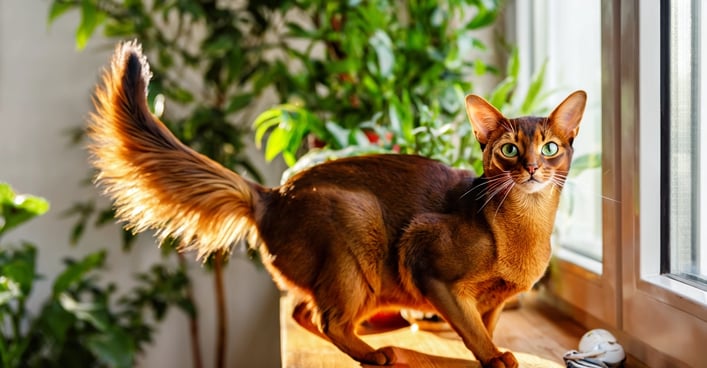
Abyssinian vs. Somali Cat: Which Ticked Tabby Breed Is Your Match?
Comparing the Abyssinian and Somali cat breeds? Discover how these intelligent, active cousins differ in coat length, grooming, and temperament to find your perfect match.
Share this page
The Abyssinian and Somali are essentially long-haired and short-haired versions of the same breed, sharing a common ancestry, personality, and appearance—with coat length being the primary distinction. This comprehensive guide helps prospective owners understand the nuances to choose the ideal lively, intelligent feline companion between these two stunning "ticked" tabby cats.
Breed Origins and History
Abyssinian Origins
Ancient Heritage:
Recognized as one of the oldest known cat breeds.
Bears a striking resemblance to felines depicted in ancient Egyptian art.
Named after Abyssinia (modern-day Ethiopia).
First officially exhibited in England in 1871.
Modern genetic studies suggest potential Southeast Asian origins.
Breed Development:
A natural breed refined through selective breeding.
Nearly driven to extinction in England during World War II.
Populations were rebuilt through dedicated breeding programs.
Received formal recognition from the Cat Fanciers' Association (CFA) in the early 1900s.
Somali Origins
Accidental Beginning:
Originated from long-haired kittens born in Abyssinian litters.
Initially considered undesirable by breeders focused on the short coat.
Gained recognition as a distinct breed in the 1970s.
Named after Somalia, reflecting its geographical connection to Abyssinia (Ethiopia).
Breed Development:
Breeders began intentionally developing the long-haired variety.
The Abyssinian and Somali are two magnificent expressions of the same core breed. Your choice ultimately hinges on a preference for coat length and a subtle variance in energy levels. The sleek, "wash-and-wear" Abyssinian offers breathtaking elegance with minimal grooming, while the luxurious Somali provides the same vibrant personality wrapped in a stunning, flowing coat.
Both breeds demand an engaged owner who can provide plentiful stimulation, vertical territory, and interactive play. They are companions, not ornaments—expect a lifelong partnership filled with curiosity, activity, and intelligent interaction. Whichever you choose, you welcome a piece of feline history and an endlessly entertaining friend into your home.
Successfully preserved the distinctive ticked coat pattern.
Established as a separate breed with its own standard.
Achieved full CFA recognition in 1979.
Genetic Relationship:
Both breeds share an identical gene pool. Breeding a Somali to an Abyssinian can produce kittens of both coat lengths. The Somali is fundamentally a semi-longhaired variant of the Abyssinian.
Physical Characteristics Comparison
Size and Build
Feature
Abyssinian
Somali
Male Weight
8–12 lbs (3.6–5.4 kg)
8–12 lbs (3.6–5.4 kg)
Female Weight
6–9 lbs (2.7–4 kg)
6–9 lbs (2.7–4 kg)
Body Type
Medium, lithe, muscular
Medium, lithe, muscular
Bone Structure
Fine but strong
Fine but strong
Overall Impression
Graceful, athletic
Graceful, luxurious
Identical Structure: Both breeds share the same elegant, medium-sized body type—the only significant difference is the coat.
Head and Face
Feature
Abyssinian
Somali
Head Shape
Modified wedge
Modified wedge
Profile
Gentle contour
Gentle contour
Ears
Large, alert, cupped forward
Large, alert, cupped forward
Eyes
Almond-shaped, gold or green
Almond-shaped, gold or green
Expression
Alert, curious, watchful
Alert, curious, watchful
Distinctive Features:
A subtle "M" shape on the forehead created by the ticking pattern.
Dark "eyeliner" effect that accentuates the eyes.
Large ears contribute to a perpetually alert and intelligent expression.
Coat Characteristics
Feature
Abyssinian
Somali
Length
Short, close-lying
Semi-long, soft
Texture
Dense, resilient, silky
Fine, very soft, silky
Undercoat
Minimal
Moderate
Shedding
Minimal
Moderate (seasonal)
Grooming Needs
Weekly brushing
Brushing 2–3 times weekly
The Ticked Tabby Pattern:
This is the hallmark of both breeds. Each individual hair has multiple alternating bands of light and dark color (agouti ticking), creating a warm, shimmering appearance without the stripes or spots seen on other tabby cats.
Common Colors:
Ruddy (Usual): Warm reddish-brown base with black ticking. The most common and iconic color.
Sorrel: A cinnamon or reddish-copper hue.
Blue: A soft, warm beige with slate blue ticking.
Fawn: A light, creamy cocoa color.
Silver Varieties: Includes silver ruddy, blue, and silver fawn, where the base color is a sparkling silver.
Tail Differences
Abyssinian:
Medium length.
Thick at the base, tapering to a point.
Fur lies close to the body.
Often has a darker tip.
Somali:
Medium length.
Very full, bushy, and plume-like.
Carried in a distinctive flag-like manner.
Famous for its luxurious "fox tail" appearance.
Temperament and Personality
Abyssinian Personality
Core Traits:
Extremely active and athletic.
Highly intelligent and skilled at problem-solving.
Inquisitively curious about their environment.
Affectionate but notably independent.
Possesses a "busy" personality, always on the move.
Natural-born climbers and explorers.
Behavioral Characteristics:
Known for getting "into everything."
Require access to high perches and cat trees.
Can learn to open cabinets, doors, and faucets.
Often enjoy games of fetch.
Frequently fascinated by running water.
Prefer to supervise household activities from a vantage point.
Typically not traditional lap cats due to high energy.
Will "help" with tasks and follow their owners closely.
Activity Level: Very High
Vocalization: Quiet chirps and trills
Independence: High
Intelligence: Exceptionally High
Somali Personality
Core Traits:
Active and playful.
Highly intelligent and curious.
Often described as slightly more relaxed than the Abyssinian.
Affectionate and engaging.
Retains a "busy" nature but is generally less frantic.
Maintains a kitten-like playfulness well into adulthood.
Behavioral Characteristics:
Just as inquisitive as the Abyssinian.
Loves climbing to high places.
Enjoys interactive play and fetching toys.
Shares the common water fascination.
More likely to seek out occasional lap time.
Slightly less intensely "busy" than their Abyssinian cousins.
Known for being playful and spirited throughout their life.
Activity Level: High
Vocalization: Quiet chirps and trills
Independence: Moderate to High
Intelligence: Exceptionally High
Temperament Comparison Summary
Trait
Abyssinian
Somali
Affection Level
Moderate
Moderate–High
Playfulness
Very High
Very High
Independence
High
Moderate–High
Good with Children
Good (with respectful kids)
Good (with respectful kids)
Good with Other Pets
Good
Very Good
Energy Level
Very High
High
Vocalization
Quiet
Quiet
Lap Cat Tendency
Low
Low–Moderate
Trainability
Very High
Very High
Key Difference: Somalis are generally perceived as slightly more relaxed and demonstratively affectionate, while Abyssinians are famously in constant motion.
Health Comparison
Shared Health Concerns
Both breeds are susceptible to the same genetic conditions due to their shared ancestry.
Pyruvate Kinase Deficiency (PKD):
A genetic enzyme deficiency affecting red blood cells.
Can lead to hemolytic anemia.
A reliable DNA test is available for screening.
Responsible breeders test for this condition.
Progressive Retinal Atrophy (PRA):
An inherited eye disease that causes gradual vision loss, leading to blindness.
A DNA test is available to identify carriers and affected cats.
There is no cure, but blind cats can adapt well in a stable environment.
Renal Amyloidosis:
A disease where abnormal protein (amyloid) is deposited in the kidneys, potentially causing kidney failure.
No definitive genetic test is currently available.
Management involves supportive care and monitoring kidney function.
Breed Health Summary
Condition
Available Testing
Management
PK Deficiency
DNA Test
Avoid breeding carriers; supportive care including blood transfusions if symptomatic.
Progressive Retinal Atrophy (PRA)
DNA Test
No treatment to halt progression; adapt home for a blind cat's safety.
Renal Amyloidosis
No genetic test
Supportive care for kidney disease; regular veterinary monitoring.
Overall Health: With responsible breeding practices that include genetic screening, both breeds are generally healthy and robust.
Average Lifespan:
Abyssinian: 12–15 years
Somali: 12–15 years
Approximate Health Testing Costs:
Breed-specific DNA panels: $50–$150
Annual wellness exam & bloodwork: $200–$400
Care Requirements
Grooming Needs
Abyssinian:
Frequency: Weekly brushing is sufficient.
Tools: A rubber curry brush or soft bristle brush works well.
Shedding: Minimal year-round.
Matting: Extremely rare due to the short coat.
Bathing: Rarely necessary.
Somali:
Frequency: Brushing 2–3 times per week is essential.
Tools: A fine-toothed metal comb and a slicker brush are ideal.
Shedding: Moderate, with increased seasonal sheds in spring and fall.
Matting: Can occur behind the ears, under the arms, and on the belly without regular care.
Bathing: Occasionally needed, especially during heavy shedding seasons.
Seasonal Considerations: Both breeds experience increased shedding during seasonal changes. The Somali's longer coat requires more diligent grooming during these periods to prevent mats and reduce loose hair in the home.
Exercise and Activity
Both Breeds Require:
Extensive vertical territory (cat trees, wall shelves, high perches).
Daily interactive play sessions (15–20 minutes, multiple times a day).
Puzzle feeders and food-dispensing toys to engage their intelligence.
Secure access to window views for mental stimulation.
Abyssinian-Specific Needs:
More demanding and constant activity requirements.
May develop destructive behaviors or anxiety if chronically bored or understimulated.
Often benefit from having another active cat (like another Abyssinian or Somali) for company.
Somali-Specific Needs:
High activity needs but often with a slightly better "off switch."
While they love play, they may be more capable of settling down after exercise.
May have slightly better potential as a solo pet for an engaged owner, though companionship is still recommended.
Recommended Activity Equipment:
Tall, multi-level cat trees: $150–$400+
Wall-mounted shelves and pathways: $100–$300+
Interactive electronic toys: $30–$150
Puzzle feeders and treat-dispensing toys: $20–$80
Nutrition
For Both Breeds:
High metabolism necessitates a quality, protein-rich diet.
Weight management is important to avoid obesity, especially in less active adults.
Using food puzzle toys can help satisfy their need for mental challenge.
Get expert advice about cat care, behavior, nutrition, grooming, and training. Ask our AI cat care expert anything about your cat and receive professional guidance.