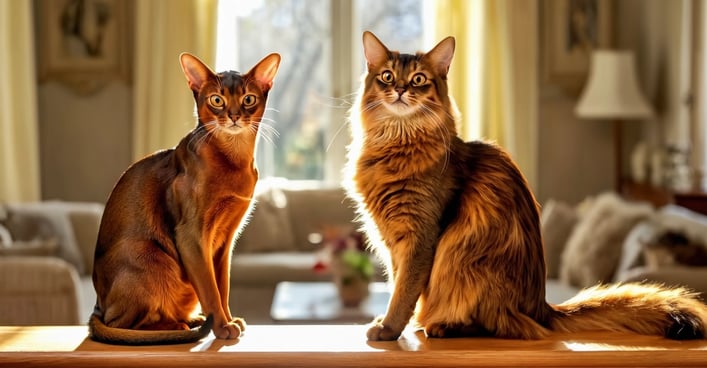
Abyssinian vs Somali Cat: Complete Breed Comparison (2026)
Deciding between an Abyssinian and Somali cat? Compare their origins, wild beauty, energy levels, and care needs to find your perfect ticked-tabby companion.
Share this page
Abyssinian vs Somali Cat: Complete Breed Comparison (2026)
Choosing between these two elegant, ticked-tabby breeds? The Abyssinian and Somali share a common ancestry and a captivating wild appearance, but they differ in coat length, personality intensity, and daily care. Both offer striking beauty and playful, intelligent companionship for active households.
Abyssinian vs Somali Cat: Complete Breed Comparison (2026) - Articles
Feature
Abyssinian
Somali
Origin
Ethiopia (Abyssinia)
United States (from a natural mutation)
Weight
6-10 lbs
6-12 lbs
Lifespan
13-15 years
11-16 years
Coat
Short, sleek, ticked, lies close to body
Medium-long, soft, ticked, full and flowing
Build
Lithe, athletic, and graceful
Lithe and athletic, enhanced by a full coat
Personality
Extremely active, inquisitive, and busy
Active and playful, but generally more laid-back
Grooming Needs
Minimal (weekly brushing)
Moderate (brushing 2-3 times per week)
Origins and History
Abyssinian History
The Abyssinian is celebrated as one of the oldest known cat breeds, with a regal history often linked to ancient Egypt. Modern genetic research suggests their origins lie in Southeast Asia and the Indian Ocean coast, rather than Ethiopia (historically Abyssinia). They were first imported to Britain in the 1860s, where they were developed as a formal breed.
Their distinctive ticked coat and graceful form closely resemble the cats depicted in ancient Egyptian art, making them a living link to feline history.
Somali History
The Somali is essentially a long-haired variant of the Abyssinian, resulting from a natural genetic mutation. For decades, long-haired kittens occasionally appeared in Abyssinian litters but were excluded from the show standard.
In the 1970s, breeders recognized the unique beauty of these cats and began selectively breeding them, establishing the Somali as a separate breed. Named for Somalia, Ethiopia's neighbor, the breed gained formal recognition by the late 1970s.
Physical Appearance
Abyssinian Appearance
Abyssinians possess the sleek, wild look of a miniature mountain lion:
Build: Medium-sized, lithe, and muscular.
Head: A modified wedge shape, showing alertness and grace.
Ears: Large, pointed, and wide-set.
Eyes: Almond-shaped, expressive, in shades of gold, green, or hazel.
Coat: Short, fine, and lying close to the body with a silky texture.
Ticking: Each hair is banded (agouti) with multiple colors, creating a warm, shimmering effect.
Colors: Ruddy (most common), red (sorrel), blue, and fawn.
Somali Appearance
Somalis share the Abyssinian's elegant physique but are adorned with a luxurious coat:
Build: Identical lithe and athletic body.
Head: Same graceful wedge shape.
Ears: Large and pointed, often with delightful lynx-like tufts.
Eyes: Almond-shaped, in gold or green.
Coat: Medium-long, exceptionally soft, and fine with full ticking.
Distinctive Features: A bushy "fox-like" tail, a full ruff, and breeches (longer fur on the hind legs).
Colors: The same palette as the Abyssinian: ruddy, red, blue, and fawn.
Coat Differences
Abyssinian Coat
Length: Very short and sleek.
Texture: Fine, silky, and resilient.
Grooming: Requires only a quick weekly brushing to remove loose hair.
Shedding: Minimal year-round.
Somali Coat
Length: Medium to long, creating a full, flowing silhouette.
Texture: Exceptionally soft and fine with no woolly undercoat, which reduces matting.
Grooming: Needs brushing 2-3 times weekly to prevent tangles and maintain the plume-like tail.
Shedding: Moderate, with seasonal increases.
Both coats showcase the beautiful agouti ticking, a hallmark of their wild ancestry.
Personality and Temperament
Abyssinian Personality
Think of the Abyssinian as a perpetual motion machine. They are:
Extremely Active: Constantly on the move, exploring and climbing.
Highly Intelligent: Curious problem-solvers who learn tricks and open cabinets.
Playful & Busy: Remain kitten-like throughout their lives and want to be involved in all household activities.
Social & People-Oriented: They thrive on interaction but are typically not "lap cats"—they'd rather play than cuddle for long periods.
Best For: Active individuals or families who can provide ample engagement and vertical space.
Somali Personality
The Somali offers a similar but slightly tempered version of the Abyssinian spirit:
Active & Playful: Energetic and loves interactive games, but may have more focused play sessions.
Intelligent & Inquisitive: Equally smart and curious about their surroundings.
More Affectionate: Often more inclined to be a lap cat and enjoy quiet companionship.
Entertaining & Mischievous: Possess a fun-loving, sometimes clownish personality.
Best For: Those who love the Abyssinian's looks and energy but prefer a somewhat more relaxed and cuddly companion.
Grooming Requirements
Abyssinian Grooming
Commitment: Minimal. A weekly brushing (5-10 minutes) is sufficient.
Bathing: Rarely necessary.
Overall: One of the easiest breeds to groom.
Somali Grooming
Commitment: Moderate. Brushing 2-3 times per week (about 10-15 minutes per session) is key.
Challenge: Their fine coat is less prone to severe matting than other longhairs, but regular care is essential to prevent knots, especially in the ruff and tail.
Bathing: Occasional baths help maintain coat cleanliness and texture.
Health and Lifespan
Common Health Considerations
Both breeds are generally robust but share some genetic predispositions. Responsible breeders screen for these conditions:
Progressive Retinal Atrophy (PRA): A genetic eye disease that can lead to blindness.
Pyruvate Kinase (PK) Deficiency: A metabolic disorder affecting red blood cells.
Renal Amyloidosis: A serious kidney condition, though less common in modern breeding lines.
Dental Issues: Such as gingivitis, requiring regular dental care.
Lifespan: Abyssinians typically live 13-15 years, while Somalis have a similar range of 11-16 years. Annual vet check-ups and a high-quality diet are crucial for longevity.
Exercise and Activity Needs
Abyssinian Activity Level
Requirement: Extremely High. They need multiple interactive play sessions daily (30+ minutes total).
Environment: Must have cat trees, shelves, and ample vertical space to climb and survey their domain.
Mental Stimulation: Puzzle feeders, clicker training, and rotating toys are essential to prevent boredom, which can lead to destructive behavior.
Somali Activity Level
Requirement: High, but More Manageable. Daily interactive play (20-30 minutes) is important.
Environment: Also loves climbing and exploring but may be slightly more content with periodic play.
Engagement: Enjoys games that stimulate their intelligence but may have slightly longer "off" periods than the Abyssinian.
Cost Comparison
Initial Costs (Kitten/Purchase)
Expense
Abyssinian
Somali
Kitten from Breeder
$500 - $1,200
$600 - $1,500
Adoption Fee
Rare
Rare
Initial Vet Visit & Vaccinations
$100 - $300
$100 - $300
Essential Supplies (carrier, litter box, etc.)
$150 - $400
$150 - $400
Estimated Annual Costs
Expense
Abyssinian
Somali
High-Quality Food
$300 - $600
$300 - $600
Routine Veterinary Care
$200 - $500
$200 - $500
Grooming Supplies/Professional Grooming
$50 - $100
$100 - $200
Litter
$150 - $300
$150 - $300
Toys, Scratching Posts, Enrichment
$150 - $300
$150 - $300
Pet Insurance
$200 - $500
$200 - $500
Estimated Annual Total for Either Breed: $1,050 - $2,300
Ideal Living Environment
Best Home for an Abyssinian
Active households with people home often.
Safe, indoor-only living with extensive vertical territory.
Owners who enjoy interactive play and training.
Homes without many fragile decorations.
Best Home for a Somali
Similar to the Abyssinian, but slightly more adaptable to slightly calmer routines.
Indoor living is strongly recommended.
Owners willing to commit to regular grooming.
Families or individuals who want an active but also affectionate companion.
Which Breed Is Right for You?
Choose an Abyssinian If You:
Desire an extremely active, "busybody" cat that is always involved.
Have significant time daily for interactive play and engagement.
Prefer a sleek, low-maintenance coat.
Appreciate a fiercely independent yet social personality.
Lead an active lifestyle yourself.
Choose a Somali If You:
Love the wild Abyssinian look but adore long, flowing fur.
Want a highly active cat with a slightly more relaxed, affectionate demeanor.
Don't mind a moderate grooming routine.
Are captivated by their "foxy" appearance and plumed tail.
Seek a playful companion who also enjoys quiet snuggle time.
Conclusion
The Abyssinian and Somali are two sides of the same magnificent coin. Both offer:
Ancient, Wild Beauty: The stunning ticked coat is a direct link to early feline history.
Brilliant Intelligence: They are among the smartest cat breeds, capable of learning tricks and solving puzzles.
Enduring Playfulness: Their kitten-like energy and curiosity last a lifetime.
Elegant Athleticism: Graceful, muscular builds that hint at their agile nature.
Hypoallergenic Qualities: Both breeds produce lower levels of the Fel d 1 allergen than many cats.
Your decision ultimately hinges on personal preference:
Coat & Grooming: Sleek and easy vs. luxurious and requiring regular care.
Energy & Engagement: Maximum intensity vs. high but slightly more manageable activity.
Affection Style: Companionable observer vs. cuddly participant.
Neither breed is suited for a sedentary home. However, if you can provide an engaging, loving environment, either the elegant Abyssinian or the foxy Somali will reward you with unparalleled companionship, beauty, and entertainment for years to come.
Get expert advice about cat care, behavior, nutrition, grooming, and training. Ask our AI cat care expert anything about your cat and receive professional guidance.