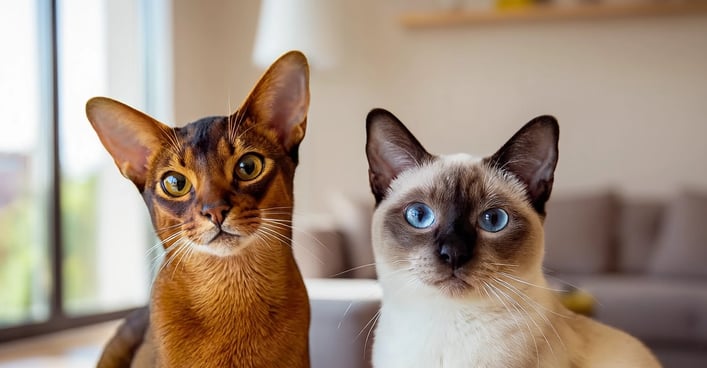
Abyssinian vs Siamese Cat: The 2026 Guide to Choosing Your Ancient Companion
Deciding between an Abyssinian and a Siamese cat? Compare their ancient origins, wildly different personalities, care needs, and costs to find your perfect active feline partner.
Share this page
Abyssinian vs Siamese Cat: The 2026 Guide to Choosing Your Ancient Companion
Abyssinian and Siamese cats are two of the most ancient and distinctive breeds in the feline world. While both boast histories spanning millennia, they offer radically different companionship experiences. The Abyssinian captivates with its wild, ticked coat and athletic independence, while the Siamese enchants with its vocal devotion and elegant drama. This comprehensive 2026 guide will help you decide which of these legendary breeds aligns with your lifestyle.
Ancient Origins and History
Abyssinian Background
Claimed Origin: Ethiopia (formerly Abyssinia)
Alternative Theory: Southeast Asia or Egypt
Historical Evidence: Resembles cats depicted in ancient Egyptian art
Modern Development: Refined in the United Kingdom during the 1800s
Registry Recognition: One of the oldest officially recognized cat breeds
Siamese Background
Origin: Thailand (formerly Siam)
Historical Status: Revered as royal cats and temple guardians
First Documented: Appears in the Tamra Maew (Cat-Book Poems) manuscripts from the 1350s
Western Arrival: First documented in the United States in 1878
Royal Heritage: Exclusively kept by Siamese royalty for centuries
Physical Characteristics
Size and Build
Tags
abyssinian catsiamese catcat breeds comparisonactive cat breedsvocal catscat care guide
Feature
Abyssinian
Siamese (Modern)
Siamese (Traditional/Applehead)
Weight (Male)
8-12 lbs
8-12 lbs
10-15 lbs
Weight (Female)
6-9 lbs
6-9 lbs
8-12 lbs
Body Type
Lithe, muscular, athletic
Wedge-shaped, slender, tubular
Moderate, muscular, less extreme
Bone Structure
Fine
Fine
Medium
Legs
Long and slender
Long and slender
Medium length
Both breeds are medium-sized, athletic cats, but their builds convey different styles of grace.
Coat Characteristics
Abyssinian Coat:
Signature Feature: Agouti (ticked) tabby pattern with no stripes
Appearance: Wild, warm "sun-kissed" look; each hair has multiple bands of color
Texture: Soft, fine, and silky, lying close to the body
Common Colors: Ruddy (usual), Red, Blue, Fawn
Grooming: Minimal—a weekly brushing suffices
Shedding: Moderate
Siamese Coat:
Signature Feature: Colorpoint pattern
Appearance: Cream/ivory body with distinctly darker "points" (face, ears, paws, tail)
Texture: Short, fine, and glossy
Common Colors: Seal, Chocolate, Blue, and Lilac points
Grooming: Minimal—weekly brushing is plenty
Shedding: Very minimal
Distinctive Features
Abyssinian:
Large, alert, cupped ears
Almond-shaped eyes in gold or green
Faint "M" marking on the forehead
Banded, ticked coat giving a cougar-like appearance
Overall wild, exotic aesthetic
Siamese:
Striking, deep blue almond-shaped eyes (a breed hallmark)
Large, pointed ears
Distinct wedge-shaped head (modern) or rounded head (traditional)
Sleek, colorpoint coat
Long, elegant, and graceful lines
Temperament and Personality Face-Off
Abyssinian Personality: The Inquisitive Athlete
Activity Level: Very High (9/10)
Playfulness: Extremely playful (10/10)
Affection Style: Friendly and engaging, but not needy
Independence: High (7/10)
Vocalization: Quiet (2/10)
Key Behavioral Traits:
Constantly in motion; a perpetual explorer
Insatiably curious about everything in its environment
Loves high vantage points
Exhibits a "helpful" nature, often following and supervising owners
Frequently enjoys dog-like games such as fetch
An intelligent problem-solver who may open cabinets
Owner Insight:"My Aby has two modes: full-speed adventure and deep sleep. There is no idle setting."
Siamese Personality: The Vocal Devotee
Activity Level: High (8/10)
Playfulness: Very playful (8/10)
Affection Style: Demanding, deeply bonded, and communicative
Independence: Low (2/10)
Vocalization: Extremely vocal (10/10)
Key Behavioral Traits:
"Talks" constantly with a loud, raspy voice
Demands attention and interaction
Follows owners from room to room (a true "velcro cat")
Prone to dramatic displays of emotion
Highly intelligent and easily bored
Can develop jealous tendencies
Often forms an intense bond with one special person
Owner Insight:"My Siamese provides a detailed, running commentary on her entire day. She's my most opinionated roommate."
Temperament Comparison at a Glance
Trait
Abyssinian
Siamese
Energy Level
9/10
8/10
Playfulness
10/10
8/10
Affection Level
7/10
9/10
Vocalization
2/10
10/10
Independence
7/10
2/10
Intelligence
10/10
9/10
Child Friendly
7/10 (better with older kids)
7/10
Pet Friendly
8/10
6/10 (can be selective/jealous)
Trainability
9/10
8/10
Activity and Exercise Needs
Abyssinian Exercise Requirements
Daily Essentials:
2-3 active play sessions (15-20 minutes each)
Vertical space is non-negotiable (cat trees, shelves, perches)
Puzzle toys and feeders to challenge their intellect
Many enjoy games of fetch
A secure outdoor catio is ideal for safe exploration
Managing Their Energy:
Without adequate stimulation, they may become destructive or create their own "projects."
Thrives with an engaged owner or an active companion pet.
Often described as having "forever kitten" energy.
Siamese Exercise Requirements
Daily Essentials:
2 interactive play sessions (15-20 minutes each)
Toys that mimic hunting (wand toys, lasers)
Mental stimulation is as crucial as physical play
Training sessions (tricks, harness walking) are highly beneficial
Social play with their human is a primary need
Managing Their Energy:
Energy is often expressed vocally as much as physically.
Becomes depressed, anxious, or loud if ignored or under-stimulated.
Demands interaction and companionship.
Exercise Comparison
Need
Abyssinian
Siamese
Daily Active Play
45-60 minutes
30-45 minutes
Vertical Space
Critical
Important
Interactive Toys
Essential
Very Important
Companion Pet
Helpful to have a playmate
Often necessary to prevent loneliness
Safe Outdoor Access
Highly beneficial (catio)
Risky due to theft; indoor-only is safest
Vocalization: The Quiet Explorer vs. The Chatty Companion
Abyssinian: The Quiet Athlete
Communicates with soft chirps and trills
Has a quiet, rumbling purr
Rarely meows demandingly
Prefers to communicate through action and presence
Siamese: The Conversationalist
Possesses a loud, distinctive, and raspy voice
Has a wide vocal range for different "conversations"
Will meow to comment, request, complain, and greet
The original "Meezer"—earned the nickname for a reason
Vocalization in Daily Life:
Situation
Abyssinian
Siamese
Morning Greeting
Silent rub or head-butt
Loud, dramatic announcement
Meal Request
Leads you to bowl or sits patiently
Full operatic performance
Litter Box Issue
May avoid box quietly
Will sound an alarm call
Wanting Play
Brings you a toy
Verbally demands attention
Evening Time
Peaceful coexistence
Recounts the story of their day
Grooming and Care
Both Breeds: Low-Maintenance Coats
Abyssinian Grooming:
Weekly brushing (5 minutes) to remove loose hair.
Moderate shedding.
Baths are rarely needed.
Siamese Grooming:
Weekly brushing (5 minutes) is sufficient.
Very minimal shedding.
An occasional wipe with a damp cloth keeps their coat glossy.
Grooming Comparison
Aspect
Abyssinian
Siamese
Brushing Frequency
Weekly
Weekly
Session Length
~5 minutes
~5 minutes
Shedding Level
Moderate
Minimal
Bathing Needs
Rare
Rare
Estimated Annual Grooming Cost
$0 - $100
$0 - $100
Health and Lifespan
Abyssinian Health Considerations
Pyruvate Kinase Deficiency (PKD): A genetic anemia. Reputable breeders test for this.
Progressive Retinal Atrophy (PRA): A genetic eye disease that can lead to blindness. DNA testing is available.
Renal Amyloidosis: A kidney condition, though less common in well-managed breeding lines today.
Typical Lifespan: 12-16 years.
Siamese Health Considerations
Respiratory Issues: Modern (wedge-head) Siamese can be prone to asthma and upper respiratory problems.
Dental Disease: A predisposition to gingivitis; regular dental care is a must.
Genetic Traits: Crossed eyes and kinked tails were once common but are now rare in responsible breeding.
Amyloidosis: Can affect the liver or kidneys; genetic predisposition exists.
Typical Lifespan: 12-16 years (Traditional/Applehead types often live longer).
Health Summary
Factor
Abyssinian
Siamese
Overall Health
Generally good
Generally good
Genetic Testing Available
Yes (for PKD, PRA)
Yes (for various conditions)
Major Breed-Specific Concerns
PKD, PRA
Respiratory, Dental
Average Lifespan
12-16 years
12-16 years
Expected Veterinary Costs
Moderate
Moderate
Cost of Ownership (2026 Estimates)
Initial Acquisition Costs
Expense
Abyssinian
Siamese
Kitten (Pet Quality)
$1,000 - $2,000
$800 - $1,500
Kitten (Show/Breeding)
$2,000 - $3,000
$1,500 - $2,500
Adult Cat (from breeder)
$400 - $900
$400 - $900
Adoption/Rescue Fee
$100 - $300
$100 - $300
Annual Recurring Costs
Expense
Abyssinian
Siamese
High-Quality Food
$600 - $900
$600 - $900
Routine Veterinary Care
$300 - $600
$300 - $600
Toys & Enrichment
$200 - $400
$150 - $300
Litter & Supplies
$200 - $300
$200 - $300
Pet Insurance (Optional)
$300 - $600
$300 - $600
Total Annual Estimate
$1,600 - $2,800
$1,550 - $2,700
Lifetime Cost Estimate (15 years)
Abyssinian: $24,000 - $42,000
Siamese: $23,250 - $40,500
Ideal Living Environment
Abyssinian Home Needs
Space: Larger, open spaces are preferred for zoomies.
Vertical Territory: Cat trees, wall shelves, and perches are essential.
Entertainment: Puzzle feeders, rotating toy selection, and interactive play.
Companionship: Does well alone but enjoys another active pet as a playmate.
Safety: Requires cat-proofing (secure cabinets, no toxic plants) due to high curiosity.
Siamese Home Needs
Space: Adaptable to apartments, but space is less critical than companionship.
Social Environment: Critical—should not be left alone for long periods. Ideal for someone who works from home.
Entertainment: Interactive play with their person is the best enrichment.
Safety: Indoor-only is strongly recommended due to theft risk; secure doors as they may try to follow you out.
Pros and Cons Summary
Abyssinian
Pros:
✅ Stunning Wild Beauty: Unique ticked coat and athletic grace.
✅ Highly Intelligent & Trainable: Enjoys learning tricks, playing fetch, and solving puzzles.
✅ Quiet Companion: Communicates subtly, perfect for quiet homes or apartments with close neighbors.
✅ Confidently Independent: Can entertain itself and isn't clingy.
Cons:
❌ High-Energy Demands: Requires an active, engaged owner to prevent boredom and mischief.
❌ Master of Mischief: Extreme curiosity can lead to opened cabinets and climbed curtains.
❌ Not a Lap Cat: Shows affection on its own terms; may not be a constant cuddler.
Siamese
Pros:
✅ Unmatched Devotion: Forms an incredibly deep, loyal bond with its family.
✅ Brilliant & Communicative: Enjoys "conversations" and is highly trainable.
✅ Social Butterfly: Loves being involved in all family activities and is rarely aloof.
✅ Low-Grooming Needs: Easy-care coat with minimal shedding.
Cons:
❌ Extremely Vocal: The loud, frequent vocalizations are not suitable for noise-sensitive households.
❌ Demanding of Attention: Can develop separation anxiety and requires significant interaction.
❌ Can Be Possessive: May become jealous of other pets or even people vying for their favorite human's attention.
Which Breed Is Right For You?
Choose an Abyssinian If You Want:
An energetic, entertaining, and interactive feline athlete.
A cat that is intelligent, trainable, and enjoys games.
A relatively quiet companion.
A pet with a stunning, wild appearance.
An independent friend who is affectionate but not needy.
You have time for daily active play and mental stimulation.
Choose a Siamese If You Want:
A deeply bonded, "shadow" companion who follows you everywhere.
A highly social and conversational pet (and don't mind the volume).
A cat that is deeply involved in your daily life.
An elegant, historic breed with a big personality.
You work from home or are retired and can provide near-constant companionship.
You desire a true partner, not just a pet.
Special Considerations for 2026 Owners
For Apartment Living
Abyssinian: Can work if you maximize vertical space and provide ample enrichment. Energy might be challenging in very small spaces.
Siamese: Often better suited, as space is less critical than company. Beware of vocalizations disturbing neighbors in thin-walled buildings.
For Families with Children
Abyssinian: Best with respectful, older children who can engage in active play. May be too fast and fragile for toddlers.
Siamese: Generally good with gentle children but may become possessive of their favorite child. Supervise interactions with young kids.
For Multi-Pet Households
Abyssinian: Usually good with other cats and cat-friendly dogs. Benefits from having a playful companion.
Siamese: Can be jealous or selective. Introductions must be slow, and they often need to feel like the center of attention.
Final Verdict
Both the Abyssinian and Siamese are extraordinary breeds that offer rich, rewarding companionship—to the right owner.
Choose the Abyssinian for a life filled with athletic beauty, intelligent mischief, and entertaining independence. It's the perfect cat for an active person who admires wild aesthetics.
Choose the Siamese for a profound, communicative, and deeply bonded partnership. It's the ideal companion for someone seeking constant interaction and unparalleled loyalty.
Finding a Reputable Breeder or Rescue in 2026
Red Flags to Avoid:
No proof of genetic health testing for parents/kittens.
Kittens are always available immediately.
The seller offers multiple, unrelated breeds.
They refuse to allow you to visit their home or meet the mother cat.
Prices are significantly below the market average.
Essential Questions to Ask:
Can I see the health test results for the parents (PKD/PRA for Abyssinians, relevant tests for Siamese)?
What is the temperament of the parent cats?
What is included in your health guarantee?
How do you socialize your kittens?
Can you provide references from previous kitten buyers?
Remember: Check breed-specific rescues! Wonderful adult Abyssinians and Siamese often need second chances.
Last Updated: 2026 | Both of these ancient, magnificent breeds deserve committed, understanding owners who will cherish their unique spirits and provide a loving, stimulating forever home.
choosing a cat
ancient cat breeds
Cat's Doctor
Get AI-powered advice about your cat's health and care. Enter your cat's information and start a conversation with our veterinary assistant.
Get expert advice about cat care, behavior, nutrition, grooming, and training. Ask our AI cat care expert anything about your cat and receive professional guidance.