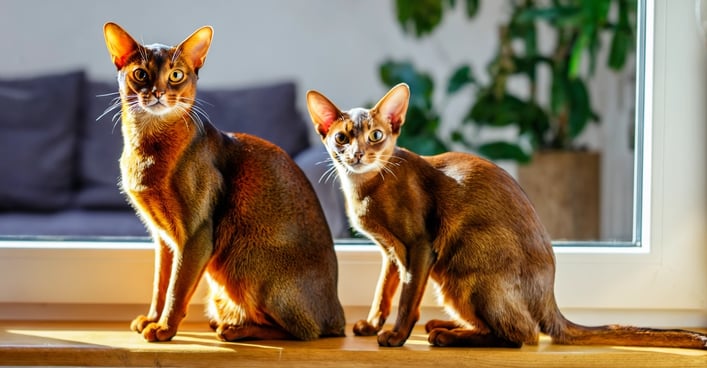
Abyssinian vs Oriental Shorthair: 2026 Breed Comparison Guide
Choosing between an Abyssinian and an Oriental Shorthair? Compare their energy, personality, care needs, and costs to find your perfect active feline companion.
Share this page
Abyssinian vs Oriental Shorthair: 2026 Breed Comparison Guide
Two of the most dynamic and intelligent cat breeds, the Abyssinian and Oriental Shorthair, offer distinctly different experiences for dedicated owners. While both are high-energy and demand engagement, their expressions of affection, independence, and appearance set them apart. This comprehensive guide provides the insights you need to make an informed decision for your lifestyle.
Origins and History
Abyssinian Origins
The Abyssinian is one of the oldest known cat breeds, shrouded in a degree of mystery. Despite its name suggesting Ethiopian (Abyssinian) roots, modern genetic research points to a likely origin in Southeast Asia or the coastal regions of the Indian Ocean.
Key Historical Points:
First officially exhibited at London's Crystal Palace in 1871.
Named after Abyssinia, the historical name for Ethiopia.
Possesses a natural "ticked" tabby coat, giving it a wild, cougar-like appearance.
Consistently ranks among the most popular pedigreed cat breeds globally.
Oriental Shorthair Origins
The Oriental Shorthair is a more modern creation, developed in mid-20th century England. Breeders aimed to create a cat with the elegant Siamese body type but in a vast array of colors and patterns not permitted in the traditional Siamese standard.
Tags
abyssinian catoriental shorthaircat breed comparisonactive cat breedsintelligent catscat care guide
Development Timeline:
1950s-1960s: Breeders crossed Siamese with domestic shorthairs, Russian Blues, and British Shorthairs.
1977: Granted championship status by the Cat Fanciers' Association (CFA).
Today: Recognized in over 300 color and pattern combinations, with a long-haired variant (Oriental Longhair) also established.
Physical Appearance Comparison
Size and Build
Feature
Abyssinian
Oriental Shorthair
Weight (Male)
8-12 lbs (3.6-5.4 kg)
Weight (Female)
6-9 lbs (2.7-4 kg)
6-8 lbs (2.7-3.6 kg)
Body Type
Lithe, muscular, and balanced
Long, svelte, tubular, and elegant
Bone Structure
Fine but surprisingly strong
Fine and delicate
Overall Impression
Athletic and agile
Gracefully refined and extreme
Coat Characteristics
Abyssinian Coat:
Texture: Soft, fine, and silky, lying close to the body.
Length: Short to medium.
Pattern: Exclusively ticked tabby (agouti). Each hair has alternating bands of color.
Common Colors: Ruddy (usual), sorrel (cinnamon), blue, and fawn.
Appearance: Creates a warm, glowing, and distinctly wild aesthetic.
Oriental Shorthair Coat:
Texture: Exceptionally fine, silky, and glossy.
Length: Very short.
Pattern: All patterns except colorpoint (reserved for Siamese). Includes solid, tabby, shaded, and smoke.
Color Variety: Over 300 recognized combinations, from ebony to lavender.
Appearance: Sleek, satin-like, and highlights the cat's elegant lines.
Head and Facial Features
Abyssinian:
Modified wedge-shaped head with a gentle contour.
Large, almond-shaped eyes in shades of gold, green, or hazel.
Large, alert ears, moderately pointed and wide-set.
Expression is alert, inquisitive, and intelligent.
Often sports a distinctive "M" marking on the forehead.
Oriental Shorthair:
Long, straight-sided wedge forming a perfect triangle from nose to ears.
Large, almond-shaped eyes, most commonly vivid green.
Strikingly large, pointed ears that continue the line of the wedge.
Long, straight nose profile.
Expression is exotic, intense, and inquisitive.
Personality and Temperament
Abyssinian Personality
Often described as the "clowns" or "acrobats" of the cat world, Abyssinians are:
Perpetually Energetic: They retain a kitten-like playfulness throughout their lives.
Inquisitive Explorers: They must investigate every nook, cabinet, and high shelf.
Affectionate on Their Terms: They form strong bonds but are typically not lap cats. They prefer to be near you, involved in your activities.
Highly Intelligent: They excel at puzzle toys and can learn tricks like fetching.
Social with Family: They enjoy being part of the household action but can be reserved with strangers.
Oriental Shorthair Personality
Oriental Shorthairs are the ultimate "Velcro" cats, known for:
Intense Devotion: They form exceptionally strong, almost dog-like attachments to their favorite people.
Extreme Vocalization: They are highly communicative with a wide range of meows, chirps, and opinions.
Sharp Intelligence: They are quick learners and can be easily trained to perform tricks or walk on a harness.
Demanding of Attention: They crave constant interaction and do not tolerate being ignored.
Playful and Mischievous: Their high energy is often channeled into interactive play and sometimes into clever mischief.
Temperament Comparison
Trait
Abyssinian
Oriental Shorthair
Energy Level
Very High
Very High
Affection Display
Moderate-High (Interactive)
Very High (Clingy/Devoted)
Independence
Moderate
Low
Vocalization
Low-Moderate (Chirps)
Very High (Conversational)
Playfulness
Very High
Very High
Tolerance for Solitude
Moderate (with enrichment)
Low
Grooming and Care Requirements
Grooming Needs
Both breeds are relatively low-maintenance due to their short coats.
Brushing: A weekly brushing with a fine-toothed comb or rubber grooming mitt is sufficient to remove loose hair and distribute skin oils.
Shedding: Both are minimal shedders.
Bathing: Rarely necessary unless the cat gets into something messy.
Nail Trimming: Should be done every 2-3 weeks.
Ear Cleaning: Check and clean gently monthly. Oriental Shorthairs may need slightly more attention due to their large ear surface area.
Monthly Time Investment
Task
Abyssinian
Oriental Shorthair
Weekly Brushing
10-15 minutes
10-15 minutes
Overall Maintenance
Very Easy
Very Easy
Estimated Monthly Total
~1 hour
~1 hour
Health and Lifespan
Abyssinian Health
Average Lifespan: 12-15 years
Common Health Considerations:
Pyruvate Kinase Deficiency (PKD): A genetic anemia (DNA test available).
Progressive Retinal Atrophy (PRA): Can lead to blindness (DNA test available).
Renal Amyloidosis: A serious kidney condition.
Patellar Luxation: Slipping kneecap.
Gingivitis/Tooth Resorption: Requiring good dental care.
Oriental Shorthair Health
Average Lifespan: 12-15 years
Common Health Considerations:
Progressive Retinal Atrophy (PRA): (DNA test available).
Liver Amyloidosis: Similar to the renal form in Abyssinians.
Dilated Cardiomyopathy: A heart condition (less common with modern breeding).
Strabismus (Crossed Eyes): A harmless cosmetic trait in some lines.
Dental Issues: Prone to gingivitis; regular dental care is important.
Healthcare Cost Estimate (Annual)
Expense
Abyssinian
Oriental Shorthair
Wellness Exam & Consult
$150 - $300
$150 - $300
Core Vaccinations
$80 - $150
$80 - $150
Recommended Genetic Screening
$150 - $250
$150 - $250
High-Quality Food (Monthly)
$35 - $60
$35 - $60
Pet Insurance (Monthly)
$30 - $50
$30 - $50
Annual Total (Approx.)
$770 - $1,450
$770 - $1,450
Cost of Ownership
Initial Purchase Costs
Source
Abyssinian
Oriental Shorthair
Pet Quality Kitten
$800 - $1,500
$600 - $1,200
Show/Breeding Quality
$1,500 - $2,500+
$1,200 - $2,000+
Adoption from Breed Rescue
$100 - $300
$100 - $300
Note: Always choose a reputable breeder who performs health screenings on their breeding stock.
Space: Requires ample room to run and, crucially, vertical space (cat trees, wall shelves).
Attention: Enjoys involvement but is not typically needy; suits moderately busy households.
Companionship: Often thrives with another active cat or pet as a playmate.
Activity Level: Best for active individuals or families who can provide interactive play.
Owner Experience: Better suited for owners familiar with active, intelligent cats.
The Ideal Home for an Oriental Shorthair
Space: Adaptable to apartments if sufficiently enriched, but mental stimulation is key.
Attention:Requires significant daily interaction. Not suited for people who are away often.
Companionship: Can suffer from separation anxiety; may need a companion if left alone.
Activity Level: Perfect for someone seeking a constant, interactive companion.
Owner Experience: Best for dedicated, patient cat lovers who appreciate (and can handle) a vocal shadow.
Exercise and Play Needs
Abyssinian Exercise
Daily Commitment: Minimum 30-45 minutes of active play.
Activity Style: Loves climbing, jumping, and acrobatic play. Puzzle feeders and treat-dispensing toys are excellent.
Key:Prevents boredom, which can lead to destructive behavior.
Oriental Shorthair Exercise
Daily Commitment: 30-45 minutes of interactive play. They want to play with you.
Activity Style: Enjoys fetch, feather wands, and learning tricks. Harness training for outdoor exploration is highly recommended.
Key: Provides the attention and mental connection they crave.
Pros and Cons Summary
Abyssinian
Pros:
✅ Breathtaking, wild ticked coat.
✅ Endlessly entertaining and playful.
✅ Highly intelligent and curious.
✅ Low-maintenance grooming.
✅ Social and bonded with family.
Cons:
❌ Extremely high energy demands.
❌ Can become mischievous or destructive if under-stimulated.
❌ Prone to certain genetic health conditions.
❌ Typically not a cuddly lap cat.
❌ Requires an experienced, engaged owner.
Oriental Shorthair
Pros:
✅ Stunning variety of colors and patterns.
✅ Unmatched devotion and loyalty.
✅ Highly trainable and intelligent.
✅ Very low grooming needs.
✅ Incredibly entertaining and communicative.
Cons:
❌ Can be overly demanding and vocal.
❌ Prone to separation anxiety; hates being alone.
❌ Requires near-constant attention and interaction.
❌ Not suitable for quiet or low-activity households.
❌ Best for very experienced cat owners.
Final Decision Guide
Choose an Abyssinian If...
You admire a "wild" look and athletic grace.
You want an active, involved pet that isn't overly clingy.
You can provide a cat-friendly environment with climbing opportunities.
You enjoy an intelligent, problem-solving companion.
You have a busy, but not absent, household.
Choose an Oriental Shorthair If...
You desire an extremely affectionate, "shadow" cat.
You are home often and can provide near-constant companionship.
You enjoy a vocal, conversational pet.
You want a unique, elegant appearance in virtually any color.
You are prepared for the demands of a highly social and needy feline.
Conclusion
The Abyssinian and Oriental Shorthair are both exceptional breeds for the right owner. They share high intelligence and energy but diverge fundamentally in their emotional needs. The Abyssinian offers the joy of a playful, independent explorer with a stunning natural coat. The Oriental Shorthair offers the depth of an intensely devoted, communicative, and elegant best friend.
Your choice ultimately hinges on your lifestyle and the type of bond you seek. Can you meet the Abyssinian's need for athletic stimulation and environmental enrichment? Or can you fulfill the Oriental Shorthair's profound need for your time, attention, and conversation? Answering these questions will lead you to your perfect, dynamic feline partner.
Last Updated: February 2026
choosing a cat
pedigreed cats
Cat's Doctor
Get AI-powered advice about your cat's health and care. Enter your cat's information and start a conversation with our veterinary assistant.
Get expert advice about cat care, behavior, nutrition, grooming, and training. Ask our AI cat care expert anything about your cat and receive professional guidance.