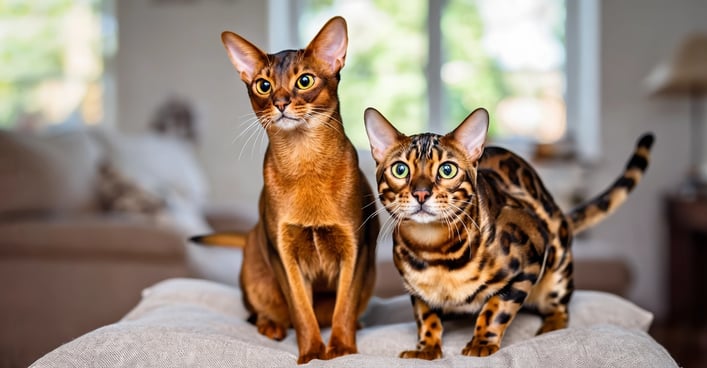
Abyssinian vs. Bengal Cat: Which Exotic Breed Is Right for You?
Abyssinian vs. Bengal: Discover which high-energy, exotic cat breed is the right fit for your home. Compare personality, care, and costs.
Share this page
Choosing between an Abyssinian vs. Bengal cat can be a difficult decision for any feline enthusiast. Both breeds captivate with their exotic, wild-inspired appearances and high intelligence. However, while they are strikingly beautiful and athletic, they possess distinct personalities, care demands, and ideal living environments. This comprehensive guide provides a detailed, side-by-side comparison to help you determine which of these extraordinary felines aligns best with your lifestyle.
Breed Histories
Abyssinian Origins
Ancient Mystique:
Alleged Origin: Ethiopia (formerly Abyssinia)
Likely Reality: Southeast Asia or the Indian Ocean coast
Formal Recognition: Late 19th century
Status: One of the oldest documented cat breeds
Historical Evidence:
Despite its name, genetic research points to Southeast Asian roots rather than direct Ethiopian ancestry. While ancient Egyptian art depicts similar-looking cats, this likely represents a naturally occurring type, not a direct lineage to the modern Abyssinian.
Development:
The breed as we know it was refined in Great Britain during the late 1800s, developed from cats imported by soldiers and traders. Its signature "ticked" coat was standardized in the early 20th century.
Bengal Origins
Choose an Abyssinian If...
✅ You want a highly active, "busy" cat with a slightly more independent streak.
✅ You are captivated by ancient breed history and elegant ticked coats.
✅ You can provide lots of vertical space and interactive play.
✅ You're an experienced cat owner ready for a clever, entertaining companion.
✅ You want high energy, but not necessarily the maximum intensity.
Choose a Bengal If...
✅ Your primary desire is a domestic cat with a truly wild appearance.
✅ You can dedicate significant time daily to interactive play and training.
✅ You are a highly experienced pet owner (cat or dog) seeking a "dog-like" cat.
✅ You are home often and can provide a rich, stimulating environment.
✅ You embrace vocal communication and intense, demanding affection.
Disclaimer: Individual cat personalities can vary within a breed. This guide provides general breed tendencies. Always meet the specific kitten or cat and consult with reputable breeders or rescue organizations. Both the Abyssinian and Bengal require a substantial, lifelong commitment and are not recommended for first-time cat owners.
Abyssinian vs. Bengal Cat: Which Exotic Breed Is Right for You? - Articles
Modern Hybrid Creation:
Origin: United States
Founder: Jean Mill in the 1960s–70s
Ancestry: Hybrid of the Asian leopard cat (Prionailurus bengalensis) and domestic cats
Status: A relatively modern, purpose-bred breed
Creation Story:
Breeder Jean Mill pioneered the Bengal to create a domestic cat with the stunning coat of a wild leopard. Early foundation cats (F1–F3 generations) retained strong wild traits. Today's pet Bengals are typically F4 or later, ensuring a domesticated temperament.
Controversy & Development:
Initial breeding faced challenges managing wild instincts. Through selective breeding, modern Bengals are fully domestic but inherit exceptional energy, intelligence, and a unique pelt-like coat.
Physical Characteristics Comparison: Size, Build, and Coats
Size and Build
Feature
Abyssinian
Bengal
Which is Larger?
Male Weight
8–12 lbs
10–15 lbs
Bengal
Female Weight
6–8 lbs
8–12 lbs
Bengal
Body Type
Lithe, graceful, athletic
Powerful, muscular, athletic
Bengal
Bone Structure
Fine to medium
Substantial and sturdy
Bengal
Length
Medium
Long-bodied
Bengal
Size Verdict: Bengals are notably larger and more muscular. Abyssinians are medium-sized, exhibiting a refined and elegant athleticism.
Coat Comparison
Feature
Abyssinian
Bengal
Pattern
Ticked (agouti)
Spotted or marbled
Length
Short
Short to medium
Texture
Soft, fine, silky
Dense, luxurious, pelt-like
Shedding
Minimal
Minimal
Grooming
Weekly brushing
Weekly brushing
Glitter
None
Common (gold/pearl dusting)
Coat Characteristics:
Abyssinian:
Each hair has multiple bands of color (ticking).
Creates a warm, radiant, shimmering effect without distinct body patterns.
Often described as having a "glowing" appearance.
Bengal:
Features high-contrast spots (often rosetted like a leopard) or swirling marble patterns.
Many coats have a unique "glitter" effect, causing the fur to sparkle in light.
Designed to mimic the appearance of a miniature wild cat.
Color Variations
Abyssinian Colors:
Ruddy: Warm reddish-brown (the original and most common)
Red: Rich cinnamon
Blue: Soft blue-gray with beige undertones
Fawn: Light cocoa with rose-beige undertones
Bengal Colors & Patterns:
Brown: Black or brown spots/marbling on a gold/orange background.
Snow: Variations include seal lynx, seal sepia, and seal mink points.
Silver: Black or gray spots/marbling on a silver-white background.
Blue: A rare and stunning slate blue/gray.
Charcoal/Melanistic: Darker, smoky background with black patterns.
Temperament & Personality Comparison
Abyssinian Personality
Core Traits:
Perpetually Active: Always on the move, investigating, and playing.
Inquisitive: Famed for getting into everything—cabinets, drawers, and shelves.
Highly Intelligent: Quick learners and adept problem-solvers.
Confidently Independent: Can entertain themselves but enjoy involvement.
Affectionate on Their Terms: Form strong bonds and follow owners, but are rarely lap cats.
Behavior Profile:
Thrive in high places; excellent climbers who appreciate cat trees and shelves.
Enjoy interactive games like fetch and can learn tricks.
Require constant mental stimulation to prevent boredom.
Social with their family but can be reserved with strangers.
Exceptionally Intelligent: Highly trainable; can learn complex behaviors.
Demanding: Require active engagement and can be vocal about their needs.
Adventurous & Bold: Fearless explorers with strong confidence.
Fascinated by Water: Uniquely love playing with, and sometimes in, water.
Behavior Profile:
Known for opening doors, faucets, and cabinets.
Excel at leash training and interactive play.
Can become destructive (scratching, vocalizing) if under-stimulated or bored.
Form deep, dog-like attachments to their favorite people.
Activity Level: Extremely High (10/10)
Temperament Comparison Table
Trait
Abyssinian
Bengal
More Pronounced In
Energy Level
Very High
Extremely High
Bengal
Intelligence
Very High
Exceptionally High
Tie (both are brilliant)
Independence
Higher
Lower (more demanding)
Abyssinian
Affection Style
Active companion
Intense, dog-like devotion
Bengal
Vocalization
Moderate
High (chirps, trills, meows)
Bengal
Water Interest
Typical (low)
High (often love it)
Bengal
Trainability
High
Very High
Bengal
Care & Lifestyle Requirements
Exercise & Enrichment Needs
Abyssinian Requirements:
Daily Interactive Play: 30–60 minutes minimum.
Vertical Space: Cat trees, wall shelves, and high perches are essential.
Mental Challenges: Puzzle feeders, rotating toys, and training sessions.
Supervision: Their curiosity requires a well-cat-proofed home.
Bengal Requirements:
Daily Interactive Play: 60+ minutes of vigorous activity.
Advanced Enrichment: Leash walking, agility courses, and clicker training.
Water Play: Provide safe opportunities (cat fountains, supervised bath play).
Constant Novelty: Boredom leads quickly to problematic behaviors.
Consequences of Insufficient Stimulation:
Issue
Abyssinian
Bengal
Destructive Behavior
Moderate risk
High risk (very common)
Depression/Anxiety
Possible
Likely
Excessive Vocalization
Possible
Very Likely
Weight Management
Needs monitoring
Usually stays lean due to activity
Grooming Needs
Both breeds are relatively low-maintenance:
Brushing: A weekly brushing with a soft slicker brush is sufficient for both.
Shedding: Both are minimal shedders.
Bathing: Rarely needed; Bengals may tolerate or enjoy it more.
Grooming Verdict: Both win for easy coat care.
Health Comparison
Common Abyssinian Health Concerns:
Progressive Retinal Atrophy (PRA): Can lead to blindness. Genetic testing is available.
Pyruvate Kinase Deficiency (PKD): A hereditary anemia. Reputable breeders test for this.
Renal Amyloidosis: A serious kidney disease.
Periodontal Disease: Requires good dental care routines.
Patellar Luxation: Slipping kneecap.
Common Bengal Health Concerns:
Hypertrophic Cardiomyopathy (HCM): A form of heart disease. Screening of breeding cats is crucial.
Progressive Retinal Atrophy (PRA): Similar to the Abyssinian form.
Patellar Luxation.
Anesthetic Sensitivity: Veterinarians should use specific protocols for Bengals.
Sensitive Stomachs: Prone to gastrointestinal issues; diet stability is key.
Health Summary:
Factor
Abyssinian
Bengal
Overall Robustness
Generally good
Generally good
Genetic Testing
Widely available
Widely available
Average Lifespan
13–16 years
12–16 years
Recommended Vet Care
Annual exams, breed-specific screening
Annual exams, including cardiac screening
Cost of Ownership (Estimated)
Initial Acquisition & Setup Costs
Expense
Abyssinian
Bengal
Purchase Price (Pet Quality)
$800–$2,000
$1,500–$3,500
Purchase Price (Show/Breeding)
$2,000–$4,000
$3,000–$6,000+
Initial Supplies (carrier, tree, etc.)
$300–$600
$300–$600
Initial Veterinary (vaccines, spay/neuter)
$200–$600
$200–$600
Estimated Initial Total
$1,300–$3,200
$2,000–$4,700
Annual Ongoing Costs
Expense
Abyssinian
Bengal
High-Quality Food
$400–$600
$500–$700
Litter
$150–$300
$150–$300
Routine Veterinary Care
$300–$600
$300–$600
Toys & Enrichment
$150–$300
$200–$400
Pet Insurance
$350–$600
$400–$700
Estimated Annual Total
$1,350–$2,400
$1,550–$2,700
Note: Bengal costs are typically higher due to initial purchase price, potential for higher insurance premiums, and greater enrichment needs.
Ideal Living Environment
The Perfect Home for an Abyssinian
Thrives With:
Active individuals or families who enjoy interactive play.
Homes with ample vertical space (catios, tall trees, shelves).
Experienced cat owners who understand feline intelligence.
Households with older, respectful children.
Other playful pets (they often enjoy feline companionship).
Struggles In:
Quiet, sedentary, or often-empty homes.
Small apartments without enrichment opportunities.
Homes with first-time cat owners (their energy can be overwhelming).
Households where a constant lap cat is desired.
The Perfect Home for a Bengal
Thrives With:
Extremely active, engaged owners who are home frequently.
Experienced cat or dog owners familiar with high-needs pets.
Families committed to leash training, tricks, and water play.
Homes that can be thoroughly cat-proofed and enriched.
Owners who appreciate and can manage vocal communication.
Struggles In:
Households with first-time pet owners.
Homes where owners work long hours away.
Quiet, calm environments—they create activity and noise.
Homes with many fragile decorations.
Pros and Cons Summary
Abyssinian Pros & Cons
Pros:
Breathtaking, elegant appearance with a warm glow.
Highly intelligent and trainable.
Independent yet socially interactive.
Low-maintenance grooming needs.
Generally healthy with a long lifespan.
Entertaining and engaging companion.
Cons:
High energy can be overwhelming.
Not a traditional cuddly lap cat.
Prone to boredom; requires constant stimulation.
Can be mischievous escape artists.
Specific genetic health risks require breeder diligence.
Bengal Pros & Cons
Pros:
Unmistakably exotic, wild-looking coat.
Extremely intelligent and highly trainable (like a dog).
Form intensely loyal, affectionate bonds.
Unique water-loving personality.
Minimal shedding and easy grooming.
Cons:
Extremely high maintenance for attention and activity.
Very vocal and demanding.
High risk of destructive behavior if bored.
One of the most expensive cat breeds.
Not suitable for novice owners or quiet homes.
Key Decision Factors at a Glance
Factor
Abyssinian
Bengal
Best For
Experienced owners wanting active elegance
Very experienced owners wanting exotic dynamism
Energy
Very High
Extremely High
Attention Needs
High
Very High & Demanding
Ideal Home
Active, enriched with vertical space
Very active, constantly enriched, possibly with outdoor access (leash/catio)
Budget
Moderate to High
High to Very High
Frequently Asked Questions
Q: Are Bengal cats considered wild or hybrid animals?A: Modern, properly bred Bengals sold as pets (typically F4+ generations) are 100% domestic cats. They are several generations removed from their wild ancestor, the Asian leopard cat. However, they retain a high degree of wild appearance and energy.
Q: Do Abyssinians really originate from Egypt or Ethiopia?A: While the name suggests Ethiopia and their likeness appears in Egyptian art, genetic studies indicate their foundation cats likely came from Southeast Asia or the Indian Ocean region. The breed was standardized in Great Britain.
Q: Can either breed live happily in an apartment?A: It is possible, but challenging. Both breeds need significant space to run and climb. A small apartment must be heavily enriched with cat trees, shelves, and daily rigorous play. Bengals, in particular, often struggle in confined spaces without dedicated outlets for their energy.
Q: Are Abyssinians or Bengals hypoallergenic?A: No cat breed is truly hypoallergenic. Both breeds shed minimally, which may reduce the spread of dander and help some allergy sufferers. However, they still produce the Fel d1 protein in their saliva, the primary allergen for most people.
Q: Can I leave either breed alone while I work a 9–5 job?A: Neither breed is well-suited to long daily solitude. They are social, intelligent, and prone to boredom and loneliness. If you work standard hours, strongly consider getting a pair (two Abyssinians, for example) or implementing pet sitters, interactive toys, or automated puzzle feeders.
Q: Which breed is better for families with young children?A: With proper supervision and by teaching children respect, both can be good family pets. Abyssinians are often a better match for families with older, calm children due to their active but slightly less demanding nature. Bengals play very rough and may unintentionally scratch small children; they are better with older kids who can engage in structured play.
Q: Is the required playtime exaggerated?A:No, it is not. For the health and happiness of these breeds—especially Bengals—the recommended daily interactive play is a critical necessity, not a suggestion. Failure to meet these needs is the leading cause of behavioral problems and owner surrender for both breeds.
Get expert advice about cat care, behavior, nutrition, grooming, and training. Ask our AI cat care expert anything about your cat and receive professional guidance.