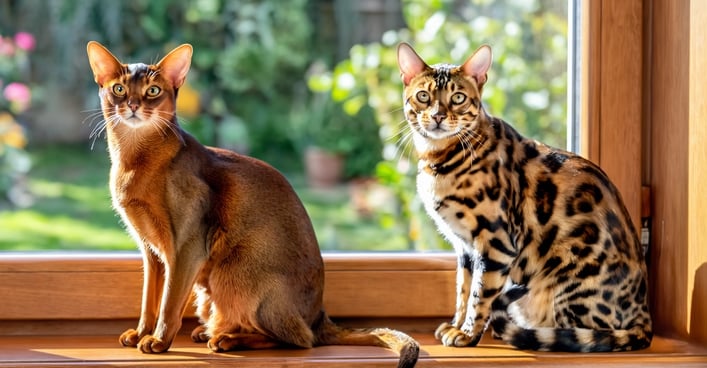
Abyssinian vs Bengal: The 2026 Breed Comparison Guide
Deciding between an Abyssinian and a Bengal? Our 2026 guide compares their wild looks, high-energy personalities, and care needs to help you choose the perfect feline companion.
Share this page
Abyssinian vs Bengal: The 2026 Breed Comparison Guide
The Abyssinian and Bengal are two of the most captivating and energetic cat breeds, celebrated for their wild-inspired aesthetics and dynamic personalities. Both are ideal for experienced owners seeking an interactive, intelligent companion. This comprehensive 2026 guide delves into their histories, temperaments, and care requirements to help you determine which breed aligns with your lifestyle.
Historical Origins
Abyssinian History
Ancient and Mysterious Lineage
The Abyssinian is one of the oldest known cat breeds, its origins wrapped in legend and intrigue.
Historical Timeline:
Ancient Egypt: Artifacts depict similar cats over 4,000 years ago.
1868: The first documented Abyssinian was brought from Ethiopia (Abyssinia) to England.
1871: Debuted at the Crystal Palace cat show in London.
1900s: Breeding programs expanded across Europe and America.
Modern Era: Maintains consistent global popularity.
Tags
abyssinian catbengal catcat breed comparisonactive cat breedsintelligent catscat care guide
Origin Theories:
Descendant of sacred Egyptian cats.
Developed in Southeast Asia (supported by genetic evidence).
Natural breed originating from Ethiopia.
Coastal Indian Ocean roots.
Genetic Insights:
Modern studies point to a Southeast Asian or coastal Indian Ocean origin, not Ethiopia, despite the breed's name.
Bengal History
A Modern Hybrid Creation
The Bengal is a deliberately engineered hybrid, developed by crossing domestic cats with the wild Asian Leopard Cat (Prionailurus bengalensis).
Development Timeline:
1963: Jean Mill pioneers the first documented cross.
1970s: Dr. Willard Centerwall breeds hybrids for leukemia research.
1980s: Jean Mill acquires these cats and refines the breed standard.
1983: The International Cat Association (TICA) accepts the Bengal.
1991: Achieves TICA championship status.
Modern Era: SBT (Stud Book Tradition) Bengals (F4+ generations) are considered fully domestic.
Breeding Purpose:
To create a domestic cat with the exotic, spotted appearance of a wild leopard, but with a predictable, companionable temperament.
Legal Note:
Early-generation hybrids (F1-F3) are heavily regulated or illegal in some regions. Only SBT Bengals are widely accepted as domestic pets.
Physical Characteristics
Size and Build
Feature
Abyssinian
Bengal
Weight (Females)
6-9 lbs (2.7-4 kg)
8-12 lbs (3.6-5.4 kg)
Weight (Males)
8-12 lbs (3.6-5.4 kg)
10-15 lbs (4.5-6.8 kg)
Body Type
Lithe, athletic, and graceful
Powerful, muscular, and substantial
Bone Structure
Fine to medium
Medium, solid
General Impression
Refined elegance
Athletic power
Both breeds are significantly more athletic than the average domestic cat.
Coat and Color
Abyssinian Coat:
Pattern: Ticked tabby (agouti). Each hair has alternating bands of color.
Texture: Short, fine, silky, and close-lying.
Colors: Ruddy (most common), sorrel, blue, fawn, and silver varieties.
Maintenance: Minimal shedding; weekly brushing is sufficient.
Bengal Coat:
Pattern: Spotted (rosettes) or marbled.
Texture: Short to medium, luxuriously soft, often with a unique "glitter" sheen.
Colors: Brown spotted/marbled, snow (lynx, mink, sepia), silver, charcoal, and rare blue.
Maintenance: Minimal shedding; weekly brushing. Many enjoy occasional baths.
Head and Facial Features
Abyssinian:
Head: Modified wedge with a slightly rounded contour.
Eyes: Almond-shaped, expressive; colors include gold, green, or hazel.
Ears: Large, pointed, and alert.
Expression: Alert, curious, and intelligent.
Bengal:
Head: Broad, modified wedge.
Eyes: Large, round to oval; gold, green, or blue (in snow variants).
Ears: Medium-sized with rounded tips.
Expression: Alert, wild, and intensely curious.
Temperament and Personality
Abyssinian Personality
Core Traits: Highly intelligent, extremely active, inquisitive, and people-oriented. They are "busy" cats who love to be involved in all household activities.
Behavioral Quirks:
Expert climbers who crave vertical space.
Often enjoy playing fetch.
Known to turn on faucets and open cabinets.
Form strong bonds with their family but are rarely lap cats.
Vocalization: Generally quiet, communicating with soft chirps and trills.
Bengal Personality
Core Traits: Exceptionally intelligent, confident, energetic, and playful throughout their lives. They are affectionate but demanding of attention and interaction.
Behavioral Quirks:
Famous for their love of water.
Excellent jumpers and climbers requiring ample vertical space.
Can learn to open doors and cabinets.
Often follow their owners from room to room.
Vocalization: Moderately vocal with a wide range of chirps, meows, and trills to communicate their needs.
Temperament Comparison
Trait
Abyssinian
Bengal
Activity Level
Very High
Extremely High
Affection Level
Moderate (follows, not cuddly)
Moderate (interactive, not cuddly)
Independence
Moderate
Low (demands engagement)
Intelligence
Very High
Very High
Vocalization
Low
Moderate to High
Child Friendly
Good with respectful children
Good with active, older children
Other Pet Friendly
Selective
Selective, can be dominant
Unique Trait
Quiet helper
Water enthusiast
Health and Lifespan
Abyssinian Health Profile
Common Concerns:
Progressive Retinal Atrophy (PRA): Genetic eye disorder. DNA testing is available.
Pyruvate Kinase Deficiency (PKDef): Genetic anemia. DNA testing is available.
Renal Amyloidosis: Kidney disease (less common in well-bred lines).
Hypertrophic Cardiomyopathy (HCM): A prevalent heart condition. Annual echocardiogram screening is strongly recommended.
Patellar Luxation: Kneecap dislocation.
Progressive Retinal Atrophy (PRA): DNA testing is available.
Pyruvate Kinase Deficiency (PKDef): DNA testing is available.
Average Lifespan: 12-16 years.
Health Comparison Summary
Both breeds are generally robust but have breed-specific genetic predispositions. Responsible breeders screen for these conditions. Annual vet check-ups and preventive care are crucial for both.
Grooming and Care
Both breeds are remarkably low-maintenance:
Brushing: Once a week to remove loose hair and distribute skin oils.
Other Needs: Regular nail trims, ear cleaning, and dental care.
Shedding: Minimal for both, making them a good choice for those concerned about fur.
Ideal Living Environment
Both breeds require:
An active, engaged household.
Plenty of vertical space (cat trees, shelves).
Interactive play sessions daily.
Mental stimulation via puzzle toys and training.
Secure outdoor access (like a "catio") is highly beneficial.
They are not suited for:
Sedentary owners or those away from home most of the day.
Small apartments without enrichment opportunities.
First-time cat owners unprepared for their high energy and intelligence (unless exceptionally committed).
Cost Comparison (2026 Estimates)
Initial Acquisition
Source
Abyssinian
Bengal
Pet Quality
$600 - $1,500
$1,200 - $3,000
Show Quality
$1,500 - $3,000
$3,000 - $6,000+
Rescue/Adoption
Rare, but check breed-specific rescues
Annual Ongoing Costs
Expense
Abyssinian
Bengal
High-Quality Food
$400 - $800
$500 - $1,000
Litter & Supplies
$250 - $400
$250 - $400
Routine Veterinary
$300 - $600
$400 - $700 (incl. HCM screening)
Insurance/Health Fund
$300 - $600
$400 - $700
Toys & Enrichment
$200 - $400
$250 - $500
Total Annual Estimate
$1,450 - $2,800
$1,800 - $3,300
Making Your Decision
Choose an Abyssinian If You Want:
A graceful, elegant cat with a ticked coat.
High intelligence coupled with a slightly more independent nature.
A very active but relatively quiet companion.
A cat that is busy and inquisitive but may give you occasional space.
Choose a Bengal If You Want:
The ultimate wild-looking, spotted or marbled coat.
An extremely interactive, dog-like cat that demands to be part of everything.
To be entertained by water play and incredible athletic feats.
A highly vocal and communicative feline partner.
Consider Another Breed If:
You desire a calm, low-energy, or lap cat.
You have limited time for daily interactive play and mental stimulation.
You are a first-time cat owner seeking a low-maintenance pet.
Final Verdict
Abyssinian: 4.6/5
An exceptional breed for active owners who appreciate refined beauty, sharp intelligence, and constant, graceful activity. They offer a slightly more manageable intensity than the Bengal.
Bengal: 4.5/5
A extraordinary cat for the right, highly committed owner. They deliver unmatched exotic beauty, interactive companionship, and energetic antics, but their demands for attention and stimulation are not for everyone.
Both breeds reward dedicated, experienced owners with a uniquely engaging and entertaining companionship. Your choice ultimately depends on whether you prefer the elegant, busy helper (Abyssinian) or the bold, wild-hearted entertainer (Bengal).
Last Updated: 2026 | Note: Both breeds are highly social and often thrive when adopted in pairs, especially if the household is away during the day.
exotic cat breeds
choosing a cat
Cat's Doctor
Get AI-powered advice about your cat's health and care. Enter your cat's information and start a conversation with our veterinary assistant.
Get expert advice about cat care, behavior, nutrition, grooming, and training. Ask our AI cat care expert anything about your cat and receive professional guidance.